10 minOctober 1, 2026

Our tools monitor millions of native, push, pop, and TikTok advertising campaigns.
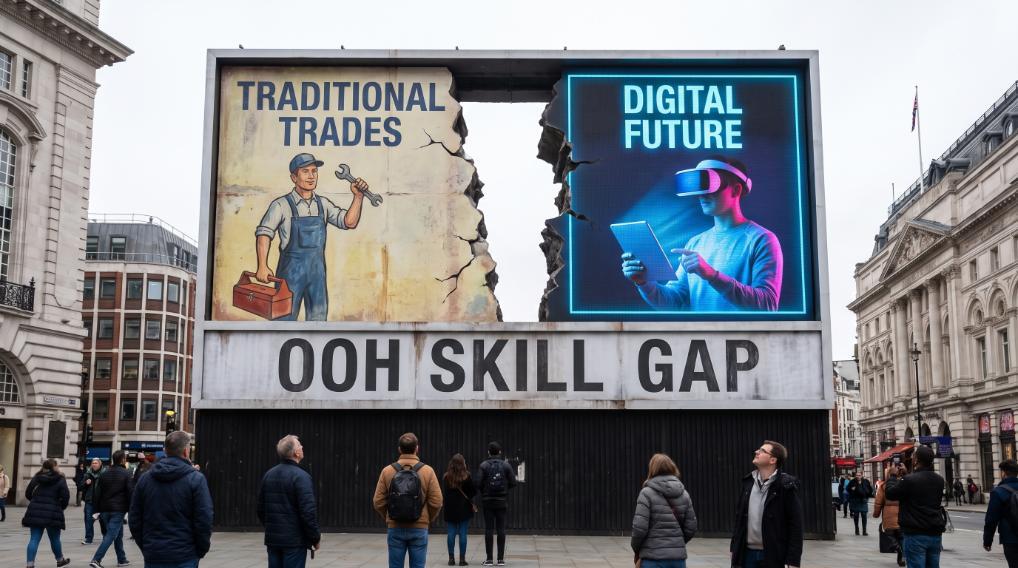
Get StartedScroll any recent OOH job board and a pattern jumps off the page. Listings for “Sales Manager – Outdoor Advertising,” “National Account Executive,” and “Local Media Sales Executive” all ask for some version of “experienced media or B2B sales pro” who can “build relationships” and “close deals” across a region, as the recurring classifieds in OOH Today’s employment listings make clear. The roles vary by market—Southern Illinois, New York, Miami, Dallas, Los Angeles, Denver—but the underlying requirement barely changes: prior sales experience, preferably in media, and a hunter’s mentality.
On paper, that sounds reasonable. Outdoor companies need people who can prospect, pitch, and bring in revenue. Yet that hiring picture is frozen in a pre‑AI, pre‑spy‑tool snapshot of the industry. It assumes that what differentiates a top OOH seller today is still charisma, hustle, and a thick Rolodex. In reality, the work of selling out‑of‑home has been quietly, but fundamentally, reshaped by data, automation, and surveillance‑grade targeting tools that didn’t exist when many veterans first learned the trade.
You can see the disconnect in how generic most OOH sales descriptions still are. In multiple consecutive classifieds, the same template recurs almost word‑for‑word: lead a sales team, grow revenue and market share, manage local and regional advertisers, and develop strategies to win new business, as one Southern Illinois “Sales Manager – Outdoor Advertising” role in OOH Today’s listings describes. There’s rarely a hint that these “strategies” now depend on understanding mobile location graphs, programmatic supply paths, or the privacy constraints around the device IDs that power modern OOH attribution.
In parallel, the broader advertising world is waking up to a different reality: it isn’t basic execution that’s scarce, it’s the ability to think strategically in an environment where machines handle more of the grunt work. A recent report from the World Federation of Advertisers and Mediasense, summarized by VideoWeek, found that as AI takes over repetitive tasks, “strategic judgement” has become the second most important capability for marketers—just behind AI fluency itself. Yet when companies were asked where their biggest talent gaps are, strategic thinking topped the list, selected by 72 percent of respondents.
That same report, as VideoWeek notes, highlighted that the most acute shortages all shared one trait: the ability to “turn complexity into decisions.” Data strategy, insight development, commercial trade‑offs—these are the capabilities that let someone look at a mess of signals and decide where to place a bet. In a spy‑tool OOH ecosystem—where vendors promise to track audiences via anonymized devices, quantify “impressions” down to a single board, and attribute store visits back to a roadside spectacular—that is exactly the differentiating skill set. Yet it is almost never named explicitly in OOH sales job specs.
Instead, owners and operators keep defaulting to a comforting label: “experienced OOH sales.” It suggests a safe pair of hands. But in a world where AI can auto‑populate a proposal and third‑party dashboards can spit out CPMs, pure selling experience is becoming table stakes. The invisible gap is everything that sits on top of those tools: interrogating the methodology behind an attribution study, challenging a suspiciously perfect footfall lift number, reconciling device‑level metrics with what a brand’s MMM or incrementality tests are showing, and then turning that into a simple, confident recommendation.
The irony is that the industry isn’t short on capable people. The WFA/Mediasense study cited by VideoWeek found nearly half of respondents rated overall marketing talent as strong or very strong. What’s missing isn’t effort or intelligence; it’s an explicit demand for strategic, data‑literate thinking in roles that have historically been defined as “just sales.” As long as OOH hiring managers cling to that illusion, they’ll keep recycling the same candidate profiles—and wondering why their teams struggle to sell sophisticated, surveillance‑enabled products with a playbook written for vinyl and gut feel.
Most independent OOH operators still picture their “buyer” as a harried local marketing manager or a regional brand lead with a desk phone and a calendar full of lunches. The reality on the other side of your sales deck looks very different. Today’s OOH buyers sit inside performance‑obsessed marketing teams that are already using AI copilots, multi‑touch attribution dashboards, and procurement “spy‑tools” that track every vendor email and pricing move. In many cases, your contact is more digitally sophisticated than the person trying to sell to them.
Marketers themselves will tell you this. In a recent WFA/Mediasense study covered by VideoWeek, brands ranked “strategic judgement” — setting direction, prioritising investments, making commercial trade‑offs — as the second most important future capability, right behind AI fluency. That pairing matters. The buyer across from your rep isn’t just “doing digital”; they are trained (or being trained) to translate complex data, budget pressure, and machine‑generated insight into specific decisions about which vendors get a line on the plan.
In that environment, generic “media sales experience” is table stakes at best and a liability at worst. A rep whose toolkit is limited to rapport, rate cards, and standard case studies is walking into a conversation where the buyer has already:
The buyer’s question is no longer “Do I like this rep?” but “Does this rep help me make a better decision than my tools and my inbox already allow?”
This is the gap most OOH hiring overlooks. Operators are still posting roles that sound like they were written in 2012, looking for “relationship builders” who can “hunt new business,” as you see repeatedly in the recurring classifieds on OOH Today’s employment listings. Meanwhile, the buyers they’re chasing are being measured on how well they use data, automation, and AI to wring more value out of every dollar. When 72 percent of marketers in that WFA/Mediasense study flagged “strategic thinking” as their biggest talent shortage, as VideoWeek’s analysis notes, they were effectively saying: “Help me turn complexity into decisions.” Very few OOH job specs, and even fewer sales interviews, are screening for that same muscle.
There’s another tell. When independent operators finally hire marketing support, it is almost always reactive. As Jonathan Graviss describes in his piece on why the first marketing hire is such a hard internal sell in independent OOH, the new marketer inherits a backlog of neglected tasks — the dated website, the dead social feed, the ugly proposals, the unstaffed events — but not a clear mandate to change how the commercial engine makes decisions. The role is defined as “activity,” not strategy, which means the sales team continues to operate with the same analogue instincts while buyers get more digital every quarter.
The result is a widening asymmetry. On one side, buyers armed with dashboards and AI are compressing the time between “awareness” and “shortlist” into a handful of clicks and internal messages. On the other, OOH sellers are still trying to “get a meeting” to walk through a 20‑slide deck. The invisible skill gap isn’t that your reps don’t know how to sell; it’s that they don’t know how to sell to someone who already has more information than they do.
Bridging that gap starts with acknowledging that your next great hire is not just a “closer.” It’s someone who can enter a digitally saturated buying process mid‑stream, interpret what the buyer’s tools are likely telling them, and then add something those tools can’t: context, nuance, and commercially literate recommendations. Until OOH hiring catches up to the reality that the average buyer is now more digital than the average seller, “sales experience” will keep looking impressive on paper and underperforming where it counts — inside the buyer’s tech‑enabled decision flow.
Strategy is scarce everywhere in advertising right now. That’s not a hunch; it’s quantified. In a global study of marketing talent, the WFA and Mediasense found that “strategic thinking” was both one of the most crucial future skills and the number‑one current shortage, cited by 72 percent of respondents as a gap in their teams’ capabilities, as VideoWeek reported. The same study put data strategy, execution, and insight development right alongside it—every one of them about turning complexity into decisions rather than just moving information around.
That shortage is not unique to OOH. But OOH is uniquely exposed if it ignores it.
Unlike digital‑only channels, OOH has a stubborn, physical cost structure. You have long leases, steel in the ground, vinyl and LEDs that can’t be “paused” with a click. When brand and agency teams are increasingly trained—and bonused—to optimise fluid budgets in real time, the partner who can’t match their level of strategic judgment quickly becomes the easiest line item to cut. If your team shows up with enthusiasm and inventory while your buyer shows up with models and measurement, you’re not just outgunned; you are misaligned.
This misalignment starts inside most independent OOH businesses. Owners often treat “strategy” as a luxury, something big holding companies can afford while local operators stay “close to the street” and “focus on relationships.” The same mindset shows up in how they make their first non‑sales hire. As Jonathan Graviss describes in his piece on why the first marketing hire is so fraught, many operators add a marketer to “relieve pressure” without a clear scope, baseline, or framework to judge success, which means the new role quickly devolves into a grab bag of tasks: updating the website, posting on social, polishing decks, coordinating events, and generally “making noise” without a defined commercial outcome, as he outlines in his analysis of marketing hires. That is not a marketing strategy. It’s a to‑do list.
The same pattern plays out with sales. Activity is rewarded because it is visible: calls logged, emails sent, proposals out. And yet, as Graviss notes in his breakdown of what separates truly great OOH salespeople from merely busy ones, the performance gap between two reps with the same inventory and comp plan rarely shows up on the calendar; it shows up “inside each interaction,” in the way one rep listens, interrogates the brief, and builds the kind of trust that survives underdelivery and competitor discounts, as he explains in his discussion of great versus busy reps. That is strategic behavior at the micro level—using each touchpoint to deepen understanding and shape the client’s thinking, not just tick off an activity metric.
Across the industry, however, the structures that would nurture that kind of strategic capability are either weak or actively counterproductive. In the WFA/Mediasense research, marketers argued that internal incentives often discourage them from sharpening strategic skills, rewarding short‑term delivery and task completion instead of long‑horizon judgment and cross‑channel trade‑offs, a pattern highlighted in VideoWeek’s coverage. Translate that to OOH and you get comp plans that celebrate the fastest path to a signed insertion order, not the slower, more demanding work of understanding how your panels fit into a client’s incrementality model, their retail footfall problem, or their CTV retargeting strategy.
The temptation inside OOH is to shrug and say, “Everyone’s struggling with strategy; we’ll be fine.” But that misses the asymmetry. If strategy is scarce, the few partners who can reliably connect OOH decisions to business outcomes will capture a disproportionate share of the budget. The rest will compete on price and personality in a market that is increasingly run by people and platforms that neither care about lunch nor believe in “awareness” unmoored from data.
That’s why OOH can’t afford to treat strategy as someone else’s problem or tomorrow’s investment. The industry doesn’t need every rep to become a brand theorist. It does need organisations that stop hiring purely for “experience” and “hustle” while leaving the real differentiator—strategic judgment in a spy‑tool era—as an accidental byproduct, instead of a core capability they deliberately build, measure, and reward.
Stop for a second and imagine your top rep’s first slide deck with a modern performance marketer. If the opening line is still “We’ve got amazing billboards in amazing locations,” you’ve already lost the room. In an era where buyers can compare every channel in a spreadsheet, “billboard inventory” is a commodity. Business outcomes are not.
That’s the pivot Brent Baer argues for when he asks what would happen if OOH “stopped selling billboards” and started selling what brands actually wake up worrying about: share growth, launches that don’t flop, and momentum against competitors, the real outcomes they’re buying in the first place, as he writes in OOH Today. In other words, the asset isn’t the product. The result is.
Once you accept that, your hiring criteria have to change. A rep who can “move units” of 14′ x 48′s but can’t translate a CMO’s OKRs into a measurable OOH plan is a liability. The invisible skill gap in most OOH sales teams isn’t hustle; it’s the ability to turn complexity into decisions. That’s the same strategic deficit brand-side marketers are complaining about, where “strategic thinking” tops the list of missing capabilities and is directly tied to things like prioritising investments and making commercial trade‑offs, according to the WFA/Mediasense study covered in.
Outcome‑selling in OOH means your frontline people need to be able to:
If that’s the job, then “five years of media sales experience” is a dangerously blunt filter. You should be screening for people who can do three things in an interview, without a net:
Getting there might mean changing who you hire and how you set them up. Independent operators already see what happens when they bolt on a function without defining the outcome. Jonathan Graviss describes how many first‑time marketing hires in OOH are made purely to “relieve pressure,” with no agreed baseline or framework for evaluating performance; the new person produces visible activity, but leadership can’t tie it to revenue and starts questioning the investment within months, as he explains in OOH Today. The same trap applies to sales. If you don’t define “we sell outcomes” in operational terms, you’ll keep hiring for volume and then be surprised when your team can’t win outcome‑based conversations.
So rewrite the sales role around outcomes. Build scorecards that reward share‑of‑wallet growth with strategic accounts, repeat multi‑market tests, and campaigns that renew because they moved a number the client already cared about. Then go find (or grow) people who can live in that world: commercially literate, strategically minded, comfortable with data, and confident saying, “I’m not here to sell you a billboard. I’m here to help you hit a number—and I’m prepared to show you how OOH will do it.”
If Section 4 was about changing the story you sell, this is about changing who’s capable of telling it.
Look at any typical OOH job listing and you’ll see the same DNA. The sales roles splashed across recent OOH classifieds are almost interchangeable: “build and maintain relationships,” “develop and execute sales strategies,” “close deals,” “grow revenue and market share.” It’s classic media sales—and there’s nothing wrong with that. But in a spy‑tool era where buyers walk into the room with dashboards, incrementality studies, and AI‑assisted budget models, that baseline is no longer sufficient.
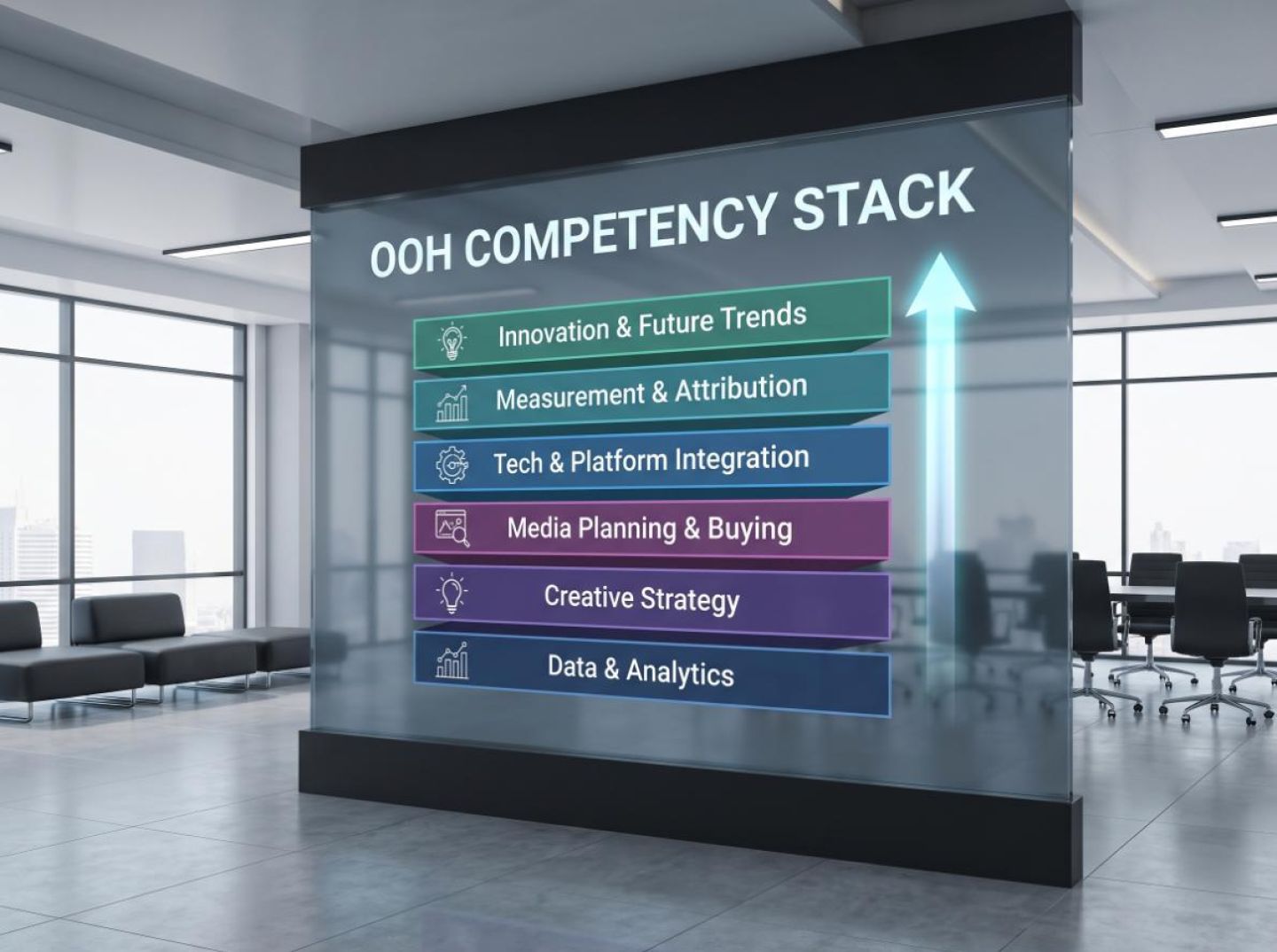
What OOH needs is a new competency stack: the traditional hunter instincts layered with what you might call “funnel intelligence.” Your best reps still need to prospect, negotiate, and manage complex relationships. They also need to understand how their panels and place‑based networks interact with a client’s full funnel—awareness, consideration, conversion, and retention—and then prove it in ways that hold up inside a performance marketer’s spreadsheet.
This is exactly where the broader marketing world is already moving. In a global study cited by VideoWeek, advertisers ranked “strategic judgement” and the ability to make commercial trade‑offs as top future capabilities, just behind AI fluency. The same report found that the biggest skill gaps today are strategic thinking, data strategy/execution, and insight development—the very abilities you need if you expect a rep to sit with a client’s media mix model, interpret lift studies, and recommend where OOH should play relative to paid social, search, and CTV.
Translate that into OOH reality and the competency stack starts to look very different from the boilerplate in most job ads:
Layer those on top of the classic skills—prospecting discipline, pipeline management, negotiating, territory planning—and you get a very different hiring profile from the one implied by most OOH sales postings, which still implicitly assume that relationship‑driven selling is the whole game. In reality, relationship capital is now table stakes; the edge comes from being able to plug OOH into the client’s data‑rich buying apparatus and still come out with budget.
This doesn’t mean abandoning the traditional sales toolkit. It means treating it as one layer in a stack. At the bottom: the timeless skills of media sales. In the middle: comfort with data, experimentation, and attribution. At the top: strategic judgement about where OOH moves the needle in a multi‑channel plan.
The organizations that rebuild their talent model around that full stack—through hiring, upskilling, or both—are the ones most likely to survive the next wave of AI‑driven buying. Because in a spy‑tool era, the rep who can only sell space is outmatched by the buyer’s software. The rep who can sell outcomes, grounded in funnel intelligence, is the one the software still can’t replace.
Receive top converting landing pages in your inbox every week from us.
Guide
Explore why traditional OOH sales experience is no longer enough as buyers become increasingly data-driven and equipped with AI, attribution, and competitive intelligence tools. This guide outlines the new OOH competency stack, from funnel intelligence and data literacy to outcome-based selling and strategic judgment.
David Kim
7 minOct 1, 2026
Quick Read
Discover how OOH professionals can transition into performance marketing by applying their existing strengths in audience targeting, site selection, creative strategy, negotiation, and media measurement. This guide shows how OOH talent can use ad spy tools and performance data to turn traditional media expertise into measurable digital growth.
Priya Kapoor
7 minSep 30, 2026
Most Read
Discover why competitive intelligence is becoming a critical function in modern OOH advertising teams. This guide explores how an Ad Intelligence Strategist can turn competitor monitoring into actionable insights for creative, targeting, pricing, sales enablement, and inventory strategy.
Samantha Reed
7 minSep 29, 2026