6 minSeptember 21, 2026

Our tools monitor millions of native, push, pop, and TikTok advertising campaigns.
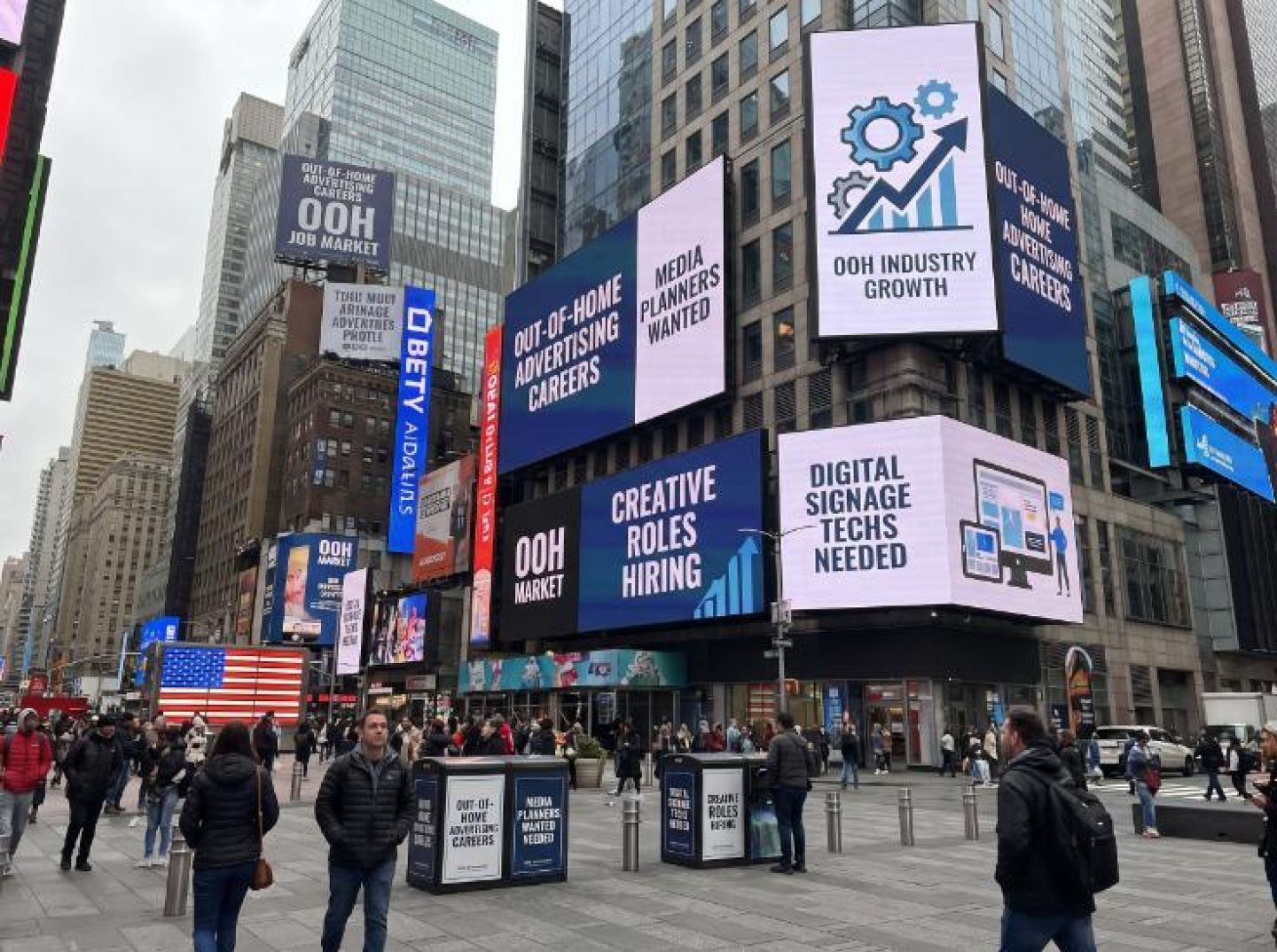
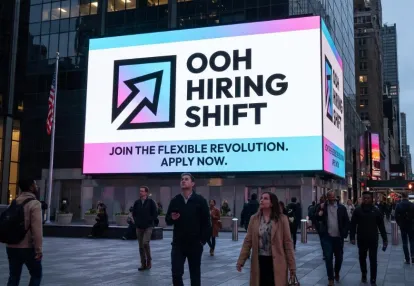
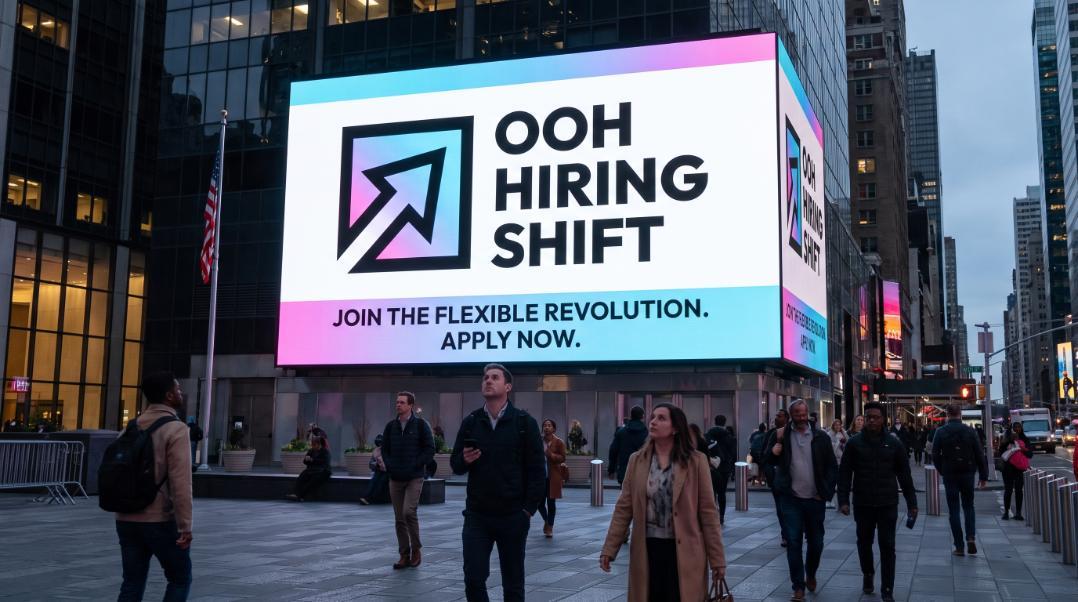
Get StartedScan any given week of OOH industry job boards and you’ll see the same story, told in slightly different typefaces. The classifieds on sites like OOH Today reliably spotlight sales reps, account executives, sign installers, LED techs, real estate scouts, and printing-related roles. One June roundup touts “11 OOH Employment Opportunities” ranging from a Business Development Representative at Liquid Outdoor Media in New York to an Ad Sales Account Executive in Miami, a Sales Representative in Dallas, and a Local Media Sales Executive in Denver. Another issue promotes careers spanning “printing, mobile billboards, photos, truck sides, and experiential,” alongside operations and installation work that keeps the physical inventory live in-market.
What’s missing from these lists is as telling as what’s included. The roles that dominated the analog era—printing, posting, maintaining structures, selling spots—are still the protagonists of the OOH hiring narrative. When the same classifieds invite advertisers to email in order to “place a classified ad,” they are reinforcing a worldview where the center of gravity is the billboard as physical object, not the campaign as data-rich, digitally orchestrated experience. Even organizations that proudly describe themselves as “leading outdoor advertising compan[ies] with a national portfolio of digital and static out-of-home media assets,” as Liquid Outdoor Media does in its Business Development Representative listing, still frame the job almost entirely as traditional media sales and relationship management.
Meanwhile, on the demand side, the conversation has moved on. In the AI era, where agents increasingly mediate every digital impression, OOH’s most powerful differentiator is that it reaches people directly, without algorithmic filtration. As one AdQuick case study puts it, unmediated physical attention has become more valuable precisely because everything else is filtered. Marketers no longer need convincing that OOH “works”; they cite its low CPMs, strong memory impact, and action-driving creative performance as table stakes. In fact, recent research summarized in AdQuick’s analysis of OOH as a trust medium shows that 98% of marketers already consider OOH a core or supporting part of connected commerce strategies, and 86% plan to increase spend.
The gap isn’t demand—it’s distribution and operational friction. The same AdQuick piece notes that if, when a marketer configures a cross-channel buy, “the out-of-home button is not even on your screen,” OOH effectively doesn’t exist in that plan. That is not a value problem; it is a workflow and infrastructure problem. OOH still gets treated as a specialty, manual buy: phone calls, PDFs, emails, and scattered spreadsheets instead of real-time inventory, standardized measurement, and instant optimization. The Cannes Lions “Infrastructure for Culture” campaign was designed explicitly to show where this is heading: a system where planning, buying, and measuring OOH is as seamless as any digital channel, turning OOH from a craft project into core media infrastructure, as the Cannes case study argues.
Yet if you look back at the job listings, you’d never know this transition was underway. The roles are overwhelmingly framed around selling boards, managing territory, installing hardware, and servicing LED screens. They are crucial, but they describe an industry frozen in a pre-digital self-image. There is almost no explicit demand for people who can reduce that operational friction: no landing-page optimizers, no conversion modelers, no attribution analysts, no marketing engineers tasked with making OOH “show up as a button” inside the tools where modern media gets bought.
In other words, the OOH job market is still hiring for a world where the printing press is the hero, even as the actual growth story is shifting toward the people who can plug OOH into digital buying infrastructure and prove performance beyond impressions. Until hiring narratives catch up to that reality, OOH will keep underselling its own potential—not because the medium can’t compete, but because the talent mix is still calibrated for an era when steel, vinyl, and ink were the only metrics that mattered.
If you strip away the acronyms and the nostalgia, most OOH hiring is still organized around one blunt objective: “sell more billboards.” Sales reps sell location, ops teams install and service structures, printing and production keep the vinyl moving. It’s all geared to moving space, not shipping outcomes.
What’s missing is the one metric every other modern channel has already reorganized around: the ability to repeatedly ship creative concepts that are proven to work somewhere else, with minimal friction.
In digital, nobody gets hired because they “sold a lot of impressions.” They get hired because they can point to a portfolio of landing pages, funnels, and experiments that systematically turned strangers into customers. You’re not judged on how many ad units you pushed; you’re judged on how many campaigns you shipped that cleared a performance bar.
OOH, perversely, still celebrates the inverse. The job boards spotlight people who can open doors and close space—“Business Development Representative (Media Sales),” “Ad Sales Account Executive,” “Local Media Sales Executive”—plus the operational muscle to hang and maintain those buys. That weekly parade of roles in places like OOH Today’s classifieds is a roll call of inventory-centric thinking. The heroes of that narrative are the ones who can get more faces lit, more boards built, more signs installed.
But that’s not how the channel is actually starting to create value for serious marketers.
Advertisers are no longer asking, “Can you sell me boards in Miami?” They’re asking, “Can you deploy a concept that’s already proven to move the needle in channels my CFO understands, and make it just as easy to buy, measure, and optimize as everything else on my plan?” As one AdQuick case study put it, the opportunity in OOH is no longer proving the medium works—that’s settled—it’s removing the operational friction that keeps it from being used more often.
That friction isn’t just workflow and APIs. It’s talent.
Most OOH roles are still scoped as if the hardest problem is convincing someone to buy a static board. Meanwhile, the real bottleneck is getting more OOH concepts shipped that behave like high-performing landing pages: fast to launch, testable, and grounded in a clear, measurable objective that marketers can see in their dashboards alongside CTV and retail media. When OOH is “not even on your screen” in the planning tools, it effectively doesn’t exist as a choice, as one analysis of OOH’s trust advantage in the AI era argues.
The missing metric, then, is not gross square footage sold, or even GRPs delivered. It’s something closer to “shipping rate of proven concepts”:
Right now, almost no OOH job description is written to optimize for those outcomes. The classifieds ask for “motivated self-starters” to “develop new business” for digital spectaculars and lifestyle-center media, as seen in Liquid Outdoor’s sales listings, but they rarely ask whether that person has ever taken a high-ROI creative from paid social, rebuilt it for a street-level digital screen, and designed a test to prove it actually drove incremental search or store visits.
In other words, the industry is hiring for inventory velocity when it should be hiring for concept velocity.
“Landing-page rippers”—the people who can look at a working funnel, extract the core proposition, rebuild it for a physical canvas, and ship it with a test plan—are now more strategically valuable than someone who merely knows how to sell a 14×48. They are the ones who convert OOH from a specialty order into the “infrastructure” of a modern plan, the way that Cannes effort used OOH to insert itself into the broader festival conversation by design, not by chance.
Until the dominant hiring metric shifts from “who can sell more boards?” to “who consistently ships proven concepts into the real world, with data to show for it?”, OOH will keep behaving like a pre-digital medium in a post-digital market. The work will stay powerful, but its distribution will lag. And in an era where marketers already believe the channel works and are poised to increase investment, that misalignment isn’t just an HR quirk—it’s a growth cap.
Top affiliates don’t start with a billboard. They start with a landing page that is already printing money.
In the performance world, the creative hierarchy runs in one direction: TikTok hooks, YouTube pre‑rolls, native widgets, email subject lines, SMS blasts, and landing pages battle it out in real time. Cost per click, cost per lead, and ROAS turn every piece of copy into a line item. Over a few brutal days, hundreds of variations get tested. Ninety‑five percent die. The survivors are not theories; they’re mathematically proven offers.
That is the raw material top affiliates bring into OOH.
They’ll take a landing page that’s been stress‑tested across millions of impressions and reverse‑engineer the narrative into a three‑second outdoor story: headline, promise, proof, payoff. The irony is that this “winner sourcing” is precisely what most traditional OOH orgs never see when they’re hiring. Job ads on sites like OOH Today obsess over territories, inventory types, and install skills, while the single most predictive asset of OOH performance in 2026 is whether the underlying concept has already survived a digital Thunderdome.
Once a winner exists, the playbook shifts to channel‑fit engineering, not “big idea” guessing.
Affiliates will:
They’ve already watched these ingredients compound in digital. They know, for example, that a certain testimonial or visual sequence increases downstream purchase intent. So when OOH gets layered into a broader plan, they’re not hoping that “awareness” eventually does something; they’re weaponizing a story they’ve already seen cut through the kind of cognitive noise that AdQuick’s Cannes case study describes on the Croisette.
Critically, they also understand something OOH veterans still underestimate: outdoor is now one of the few unmediated attention streams left. As AI agents increasingly filter email, feeds, and search, the physical world becomes a trust surface, not just a reach vehicle. In their analysis of OOH as a “trust medium,” the team at AdQuick points to the channel’s uniquely low CPMs and outsized impact on memory and action; digital‑first affiliates read that as: if a concept can win in hyper‑competitive auctions, putting it into an unfiltered medium is a force multiplier.
So they instrument it like a performance channel.
Instead of “run boards, wait for brand lift,” top affiliates wire OOH into the same feedback loops they use for Facebook, search, and native:
This is where their hiring lens diverges most sharply from the roles filling up OOH classifieds. They’re not looking for people who can “sell billboards in Miami” or “manage digital spectaculars in Los Angeles.” They’re hunting for landing‑page rippers and funnel architects who can:
To a legacy operator, that looks almost invisible. There’s no new steel going into the ground, no heroic rush to get vinyl printed by Friday. But from the affiliate’s perspective, the printing press is just a commodity execution layer. The scarce skill—the one that quietly governs who wins the next decade of OOH—is the ability to turn a digital proof of concept into an outdoor weapon, then prove it in the same language CFOs already trust.
Traditional OOH organizations were never designed to prove anything beyond “the boards are up and the invoices went out.” That’s not a knock on operators; it’s the operating system they inherited.
Look at how most OOH job descriptions are written. The classifieds pages are a roll call of roles that exist to move physical inventory: Business Development Representative, Ad Sales Account Executive, Local Media Sales Executive, Sign Installer, LED Video Screen Service Tech, Printing Services. Every one of those functions is measured by space sold, structures installed, contracts renewed, or vinyl delivered on time. Not a single listing promises “we will know, with confidence, how many customers this ad drove and what each one cost.”
So when you drop a traditional OOH marketer into a performance conversation, they are structurally handicapped. As Jonathan Graviss points out in his piece on how to measure what marketing is actually doing, most operators default to activity metrics because that’s what they can see: impressions, social followers, website sessions, “awareness.” Those numbers might be real indicators of effort, but to a sales‑first leadership team they do not connect cleanly to pipeline, proposals, or revenue. The marketer walks into a quarterly review with charts; the CEO walks in with a forecast. They are speaking different languages.
The same pattern repeats at the campaign level. OOH has quietly become one of the most efficient and trustworthy media channels in the mix; programmatic DOOH is projected to hit $1.35 billion in spend with some of the lowest CPMs of any medium. Neuroscience studies show digital out‑of‑home driving 3.2x more neurological response than static, and roughly 80% of consumers say they’re likely to take action after seeing a strong OOH creative. But those are industry‑wide statistics. They live in case studies and trade decks. They rarely get stitched into a specific client’s P&L in a way that lets an operator say: “For this advertiser, this route, this creative, here’s how many incremental customers we drove and what each one was worth.”
Affiliates, by contrast, are hired to live or die by that level of specificity. Their resumes don’t brag about how many “award‑winning campaigns” they touched; they brag about how many funnels they scaled from $500/day to $50,000/day while holding cost per acquisition below target. Their work is natively link‑based: every headline, every hook, every pre‑sell page is attached to a tracking link, and every tracking link rolls up to a landing page whose job is painfully simple—turn traffic into money.
Because the entire affiliate stack is already wired to revenue, “show your work” is trivial. Screenshots of dashboards, side‑by‑side cohort charts, before/after LTV curves—this is the default language of affiliate performance. When they walk into a room, they aren’t defending activity; they’re presenting unit economics. And when they bring that muscle into OOH, everything changes. The board itself becomes just another traffic source in a spreadsheet, right next to TikTok, native, or email. You can see whether the “I‑95 Northbound, exit 12” placement is beating or lagging a TikTok ad set on cost per lead. You can kill the loser and scale the winner. For the first time, a physical board is being judged by the same metric that governs the landing page it points to.
This is why “landing‑page rippers” now quietly outrank printing presses as OOH hires. It’s not that operators suddenly stopped needing installers or production managers; it’s that those functions can’t close the measurement gap Graviss describes, where activity numbers fail to earn trust with a revenue‑obsessed leadership team. Affiliates can, because they arrive with an expectation that every dollar of spend must be traceable to a dollar of outcome—even when the click starts in the real world, on a piece of metal 40 feet in the air.
The next generation of OOH strategist is not the person who knows every landlord in a three‑state radius. It’s the person who can look at a live funnel dashboard, see where attention is leaking, and use out‑of‑home as the offline lever that tightens the whole system.
This profile looks almost upside‑down compared to the résumés scrolling past in the current employment listings. Instead of optimizing for who can shepherd a print file to a vinyl plant, you’re optimizing for who can shepherd a click all the way to revenue.
Funnel‑fluent means they can start from the P&L, not the poster. They understand cost per acquisition and payback windows. They know how cold traffic from TikTok behaves differently than branded search, and they can read a cohort chart without asking analytics to “pull a quick report.” In performance‑native orgs, this is just called “being a marketer.” In OOH, it’s still treated like a niche skill.
The Cannes campaign AdQuick ran to bring its “infrastructure for culture” message to the festival is a preview of this mentality. The team didn’t treat out‑of‑home as a prestige backdrop; they used it as an on‑ramp into a broader conversion system, producing immediate inbound demand and new‑business conversations because the placements were wired into a larger narrative and measurement stack, not because the boards were particularly shiny, as their case study makes clear. A funnel‑fluent OOH strategist thinks like that by default: what’s the story, what is the action, where does this traffic land, and how do we prove it?
Asset‑light is the second shift. Read through the current classifieds for OOH roles and you’ll still see printing, sign installation, and LED service techs sitting alongside account executives as if they are all part of the same strategic stack. They’re not. Owning physical production capacity is no longer a strategic advantage; it’s gravity. The more your strategy is tangled up in trucks, printers, and service routes, the harder it is to respond when a client’s CAC spikes or a new offer starts to outperform.
The modern OOH strategist treats physical inventory like cloud computing: rented as needed, API‑connected, and spun up or down based on performance. Instead of solving for “How do I keep my presses busy?”, they solve for “How do I make it as easy to deploy and optimize OOH as it is to ship a new Facebook ad set?” That’s what campaigns like Cannes demonstrated: when planning, buying, and measurement are handled through software, OOH shifts from a specialty project to part of the core marketing infrastructure, as the AdQuick team explicitly framed in their summary and takeaways.
Channel‑agnostic is the final, uncomfortable requirement. If your “OOH strategist” cannot make a case for when not to use OOH, you don’t have a strategist; you have a quota carrier with a map. The buyers you’re trying to win are already operating in a world where programmatic DOOH is a line item on the same screen as CTV and retail media, and OOH only exists for them if it is as easy to toggle on and off as those other channels. As one recent analysis of OOH’s role in connected commerce noted, marketers overwhelmingly see OOH as a core or supporting component of their plans and intend to increase spend, but the real bottleneck is operational friction and discoverability, not belief in the medium’s effectiveness, according to AdQuick’s examination of OOH as a trust medium in the AI era.
A channel‑agnostic strategist understands this landscape. They’ve managed or at least sat inside growth loops where Meta, Google, email, SMS, CTV, and affiliates are all competing for incremental budget. They know how to argue for OOH in that room not with nostalgia, but with math: unmatched CPMs, multi‑touch lift, and downstream behaviors like branded search and direct traffic. And they’re willing to concede when the numbers say the next dollar should go somewhere else.
Put simply: the new OOH strategist profile is closer to a DTC growth lead or top‑tier affiliate than a territory rep. They can rip a landing page, write a headline, instrument a test, and read the results. They are comfortable renting assets instead of owning them. And they see billboards, kiosks, and street‑level media as one more set of levers inside a larger performance engine, not as sacred real estate that must be defended at all costs.
If you buy the premise of this article so far, you don’t “fix” your landing‑page problem by firing your press operator. You fix it by hiring one or two people whose entire job is to make every impression your plant produces easier to buy, easier to track, and easier to justify at the next board meeting.
That means designing roles around outcomes, not activities. Jonathan Graviss has already made the case that measurement frameworks need to start from sales outcomes, not marketing activity. The same logic applies to hiring. You don’t need “a marketing person.” You need someone whose work can be seen clearly in pipeline, proposals, and retained advertisers.
A practical way to do this is to define a “Funnel Strategist” or “Performance Marketing Lead” with three explicit responsibilities:
2. Translate OOH into the client’s dashboard.
The friction holding OOH back is rarely that clients doubt it works; it’s that planning and buying are still more manual than other channels, which keeps OOH out of fast‑moving plans, as the Cannes Lions case study pointed out. Your landing‑page hire should know how to show up inside the client’s existing measurement stack: UTM structures that mirror their naming conventions, post‑view windows that match their internal reports, and regular recaps that connect OOH touches to site behavior, lead quality, and assisted revenue.
3. Build repeatable measurement frameworks.
Instead of reporting vague “web traffic” from a campaign, this person sets up before‑and‑after benchmarks that leadership already believes in: inbound briefs generated, sales meetings booked, proposals sent, renewals closed. Graviss’s argument that visibility metrics invite skepticism rather than trust becomes your hiring brief: if a candidate cannot explain how they would tie an OOH campaign to those operator‑friendly metrics, they are not your operator‑friendly marketer.
You can hire this talent without blowing up your existing structure if you are intentional about what you stop hiring for.
Look back at your last five non‑plant job descriptions. How many lines are dedicated to canvassing landlords, cold‑calling agencies, managing installations, or “supporting sales with materials”? How many mention split‑testing landing pages, building multi‑step signup flows, or integrating OOH with marketing automation? The employment ads that dominate the trade press are overwhelmingly built around surface‑area expansion, not depth of conversion.
Changing that balance does not require net‑new headcount. It requires swapping one “generalist marketer/sales assistant” hire for a specialist who can:
This is also how you protect, not threaten, your presses.
When OOH is easier to buy and easier to prove, it moves from specialty line item to “infrastructure” in omnichannel plans, the same shift that made the Cannes work a proof of where OOH is heading in AdQuick’s view. That infrastructure demand does not reduce the need for inventory; it expands it. Panels that can be tied cleanly to brand‑safe, high‑trust, high‑action outcomes in an era of algorithmic noise, as the trust‑medium research emphasizes, are panels that stay lit.
Hiring a landing‑page ripper is not a digital indulgence. It is a capacity investment that lets every sheet your presses run participate in the metrics conversation your clients already have. The operators who make that hire first will be the ones whose plants are the busiest five years from now.
Receive top converting landing pages in your inbox every week from us.
In-Depth
OOH hiring is still heavily focused on traditional sales, printing, and operations while modern advertisers increasingly demand measurable, digitally integrated campaigns. This guide explores how funnel-fluent marketers, landing-page optimization, competitive intelligence, and performance measurement can help OOH operators connect physical media to measurable business outcomes.
Priya Kapoor
7 minSep 21, 2026
Most Read
The post-cookie world is pushing OOH beyond traditional awareness media and toward measurable digital funnels. This guide explores new OOH-first roles that connect physical placements to digital actions, experiential data, attribution, and real-time demand signals.
Rachel Thompson
7 minSep 20, 2026
Must Read
Celebrity campaigns can create massive short-term demand, but affiliates need to know when and where that attention can be captured without simply cannibalizing brand traffic. This guide explains how to use ad spy data, search signals, creative angles, and disciplined bidding to turn celebrity-driven buzz into measurable affiliate opportunities.
Liam O’Connor
7 minSep 19, 2026