7 minSeptember 19, 2026

Our tools monitor millions of native, push, pop, and TikTok advertising campaigns.
Get StartedScan a few OOH job listings and you’ll see the same pattern on repeat: title inflation, carved‑up territories, years of experience, and the ever-present requirement for a “strong book of business.” What you almost never see is the one question that now decides who actually wins campaigns: Can this person systematically decode what competitors are doing across every channel and turn that into action?
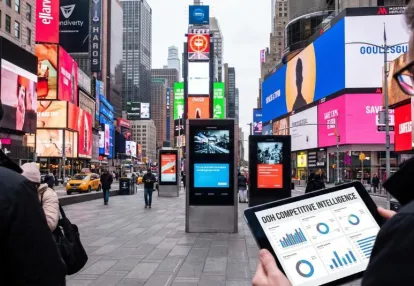
That omission made sense when out‑of‑home was sold like real estate and measured like a rough guess. It doesn’t make sense anymore. Today, OOH sits inside an ecosystem where AI, programmatic DOOH, and omnichannel attribution are table stakes. Platforms like AdQuick are already treating OOH as a fully integrated performance channel, using machine learning to analyze trillions of placement combinations and surfacing real-time data about audience, behavior, and the “halo effect” on adjacent digital campaigns. If your buyers are planning and optimizing in that world, but your people are still selling like it’s 2013, you’re not just behind — you’re invisible.
At the same time, the intelligence gap is getting wider. Competitive insight used to mean “we heard they booked a programmatic test with Brand X” or “their boards are full this quarter.” Now, as one MarTech playbook on AI-powered competitive intelligence explains, the real shift is from rearview-mirror reporting to forward-looking interpretation: tracking how messaging evolves, which categories are heating up, where rivals are quietly pulling back, and what those moves signal about budgets and strategy. The teams that win aren’t the ones collecting the most screenshots; they’re the ones running the fastest intelligence loops and acting before everyone else has even written the recap.
OOH is no exception. When an operator like Trillboards invests in a demand engine such as hellOOH, they’re not buying “better reports.” They’re tapping into a verified campaign graph, a mapped universe of agencies and decision‑makers, and a predictive layer that flags who is likely to spend, where, and in which formats next. As one analysis in OOH Today puts it, the next era of OOH will not be won by the companies with the most inventory, but by those with the fastest intelligence loops. That is competitive intelligence in practice — not a dashboard, but a learning system.
Yet look back at those job listings. How many ask if a GM can design those loops? How many ask if an AE knows how to reverse‑engineer a rival’s media mix from creative in the wild, or interrogate an RFP to see which DSP, attribution partner, and audience segments are already baked in? How many probe whether an operator understands how AI‑driven search and answer engines surface vendors, and what it would take to appear when buyers ask where to spend next quarter’s test budget? As one piece on the “next frontier” for OOH operators argued, the companies that build their presence around the questions buyers are actually asking become the default answers when humans — and AI systems — go looking for solutions, which is exactly how authority compounds quietly.
This is why “ad spying” can’t be dismissed as a sketchy affiliate hack anymore. In a world where an AI can monitor pricing pages, product releases, and message shifts across dozens of competitors every day, as tools highlighted in MarTech’s competitive stack now do, the real competitive advantage is the human (or team) that knows how to aim that visibility at the OOH market — decoding who is scaling spend, which narratives are winning with which audiences, and how to reposition your inventory, packaging, and story before the RFP even hits your inbox.
Every GM, seller, and operator who wants to stay visible and funded in this environment needs the same missing skill: the discipline to treat competitive intelligence as a core operating system, not an occasional slide in a quarterly review. Until that shows up in how we hire, train, and evaluate OOH talent, the gap between the companies with data and the companies with real advantage will keep getting wider.
Scroll through OOH job listings and you can almost fill in the template from memory.
Roles are defined by turf (“Southeast Regional AE”), tenure (“5–7 years in OOH or related media”), and Rolodex (“must bring a strong book of business”). The competencies are familiar too: relationship management, proposal building, pipeline hygiene, comfort with CRM, ability to “tell the OOH story.” On the surface, it all sounds reasonable.
But read those same descriptions through the lens of how OOH is actually bought, measured, and optimized today, and a gap appears you can’t unsee: there is almost no explicit requirement that the hire know how to decode the market.
The industry keeps hiring as if the job is to work a fixed territory. The reality is that the job is increasingly to understand, in near real time, who is spending, where, through whom, on what formats, and why—and then to turn that into smarter outreach, packaging, and pricing.
In digital, this shift already happened. Senior content and performance roles now call out competitive research, workflow automation, and market analytics as core competencies. In one large study of content SEO roles, for example, a significant share of senior listings explicitly required workflow automation skills and treated competitive intelligence as part of a broader performance toolkit, alongside SEO, conversion optimization, and AI-driven analysis, as Semrush’s research documents. Those teams no longer see “keeping tabs on competitors” as a side project; it’s a defined responsibility.
Paid media has made the same turn. Practitioners are taught to build formal “competitor intelligence frameworks” that specify what to monitor, how often, and how findings translate into action. A modern Google Ads playbook doesn’t stop at a one-off spy on rival keywords. It pushes marketers to monitor competitor bids, ad creative, landing pages, and budget patterns on a repeatable cadence so insights continuously feed campaign decisions, as outlined in Semrush’s guide to Google Ads competitor analysis. The assumption is clear: if you’re running spend in that channel, you are running structured competitive intelligence.
OOH job descriptions, by contrast, still read like we’re in an era where the only variables that matter are inventory, relationships, and hustle. They nod to “market awareness” or “industry knowledge,” but almost never define those phrases as the ability to systematically interrogate data about who’s buying which formats, via which agencies, across which markets, and how that behavior is changing.
That blind spot is especially stark given how quickly out-of-home itself has been pulled into the same performance and intelligence paradigm as digital. Platforms like AdQuick have already turned OOH into a measurable, data-rich performance channel, using machine learning to evaluate trillions of media combinations and exposing real-time signals about audience, behavior, and campaign impact. When OOH buying is being optimized with that level of precision, an AE or sales leader who can’t interpret competitive patterns is operating with one eye closed.
On the operator side, the bar is rising even faster. New intelligence platforms are actively building “living models” of demand that track verified campaign activity over time, map decision-makers and agencies, and forecast likely spend and category shifts before they show up in the trade press. One such system continuously ingests OOH signals to answer not just “What happened?” but “What is happening, why, and what’s likely to happen next?”, creating a multi-layered view of campaign behavior and decision-maker networks, as described in OOH Today’s coverage of Trillboards’ hellOOH. The competitive field is no longer defined by who knows “everyone” in town; it’s defined by who can act fastest on this kind of structured intelligence.
When job descriptions ignore that reality, two things happen:
The missing skill in those job listings isn’t another flavor of “relationship building.” It’s the ability to run a continuous, structured competitive intelligence loop for OOH—across buyers, formats, markets, and adjacent channels—and to convert what that loop reveals into concrete moves on pricing, packaging, and positioning. Until roles are defined around that capability, operators will keep hiring for yesterday’s version of the job while competing in tomorrow’s version of the market.
In the rest of marketing, teams are quietly rewiring themselves around “intelligence loops” — systems that continuously observe the market, interpret what’s changing, and feed those learnings straight back into execution. OOH talks about “staying on top of the competition,” but most org charts and job descriptions still assume a world of static territories and quarterly recaps, not live feedback loops.
Look at how digital channels are evolving. Search and performance marketers are being told explicitly to build a competitor intelligence framework: define what to monitor, how often to check it, and exactly how findings change bids, budgets, and creative. As one Google Ads competitor analysis guide puts it, the teams that consistently outperform don’t treat competitive reviews as a one‑off project; they treat them as a repeating system that turns “inputs” (keywords, ad copy, landing pages, new entrants) into “outputs” (new tactics, revised targeting, fresh creative). That is an intelligence loop.
Strategic marketing is making the same shift. Instead of passively watching dashboards, leading teams are using AI to track competitor messaging, positioning shifts, and content bets at scale, then asking, every single time, “What does this mean for us?” According to an AI‑powered playbook for competitive intelligence, most organizations are stuck in the rearview mirror—collecting “what happened last week” — while the real advantage comes from tools and workflows that highlight where competitors are moving, where they’re pulling back, and where the gaps are that you can own going forward, all in near real time, as described in this.
OOH, meanwhile, is being dragged into the same future whether it’s staffed for it or not. The emergence of market‑intelligence platforms that continuously ingest verified campaign data, map decision‑makers, and model demand patterns has made that clear. One launch article described the next era of OOH bluntly: it “will not be won by the companies with the most inventory. It will be won by the companies with the fastest intelligence loops,” highlighting an approach that replaces backward‑looking “what happened?” reporting with “what is happening, why, and what is likely to happen next?” built from live campaign graphs, agency hierarchies, and predictive demand signals, as outlined in this.
Notice the pattern across these worlds:
Now compare that to the average OOH sales job. It still assumes a world where the valuable skills are territory knowledge, persistence, and relationships. Intelligence is implied (“stay informed on the market”) but never operationalized. There is no expectation that an AE can look at a competitor’s multi‑channel plan, decode the strategy behind it, and translate that into a counter‑move within days.
Yet that is exactly how marketers are being hired elsewhere. In content and SEO, for example, employers now list competitive analysis, workflow automation, and AI fluency as core requirements, not nice‑to‑haves. A recent study of the “Content SEO Manager” role found that practical AI experience and the ability to connect insights to measurable growth outcomes are increasingly table stakes, with AI cited in 43% of senior postings, reflecting a world where continuous intelligence is baked into the job description itself, as shown in this.
OOH is not exempt from that pressure. Brand‑side CMOs are leaning on AI advisors and evidence‑driven planning. As one industry commentary framed it, the future will not be won by the medium with the loudest pitch, but by the medium with the strongest proof that it drives business outcomes, urging OOH companies to stop assuming their value is self‑evident and start feeding AI‑driven decision systems with hard, comparative evidence of impact, as argued in this.
That puts OOH operators and sales leaders at a crossroads. The rest of marketing is staffing for people who can live inside intelligence loops — who treat competitor monitoring, signal interpretation, and rapid response as a daily craft. OOH job listings, by contrast, are still hiring like those loops don’t exist. The gap is no longer theoretical; it’s structural. And it’s the gap that will separate the companies that merely sell space from the ones that consistently win the smartest campaigns.
Ask most OOH sellers what they know about “what’s on the boards” in their market, and you’ll hear some version of: “I drive the route every Monday and keep an eye on who’s up.” That’s not competitive intelligence. That’s a windshield survey.
“Ad spying” sounds tactical and a little dirty, but in a modern OOH context it’s simply market research done at the level of reality your buyers now expect. When digital teams talk about monitoring competitor search ads or landing pages, they’re not gossiping — they’re running a continuous research program that feeds strategy, creative, and bidding decisions. Guides to Google Ads competitor analysis describe a repeatable system: define what to monitor, check it on a consistent cadence, and wire insights directly back into campaigns. That is exactly the missing loop in most OOH organizations.
The first mental shift is this: you’re not “spying on ads,” you’re observing market behavior.
Every campaign that goes up in your city is a live data point about:
Digital marketers already treat their competitors’ activity as a structured dataset. Competitive tools watch rivals’ keywords, copy, and landing pages, then feed findings into optimization workflows so teams can spot missed intent, copy winning angles, or sidestep costly bidding wars, as outlined in Semrush’s framework for ongoing Google Ads intelligence. OOH can operate the same way — but only if you stop treating other people’s billboards as “background” and start treating them as research objects.
Once you do, “ad spying” turns into a disciplined practice with three jobs:
This is where OOH’s data evolution matters. Platforms that unify inventory, performance data, and analytics have already shifted the channel from intuition to intelligence. By treating OOH as a measurable, performance-driven medium — with real-time delivery that brings it “into parity with modern performance channels,” as the AdQuick team describes its platform — you’re not just guessing where competitors might be investing. You can actually quantify how aggressively they’re leaning into certain corridors, DMAs, or audience cohorts.
That matters because buyers are no longer satisfied with “we think your competitors are up around town.” They’re trained by search and social to ask sharper questions:
In digital, those questions get answered by the same kind of ongoing frameworks Semrush recommends: cadence-based monitoring, focused inputs, and explicit links from insight to action. In OOH, you answer them by turning passive observation into active intelligence: logging every major campaign in your market, tagging each with category and strategy, and then comparing that live map with your own inventory and your client’s objectives.
AI is starting to close the gap between channels. Just as marketing teams now use AI to track message shifts, product positioning changes, and category “white space” at a scale that would overwhelm a manual analyst, as described in MarTech’s overview of AI-first competitive stacks, OOH teams can lean on machine learning to analyze trillions of potential unit combinations and audience patterns. When those optimization engines are paired with structured, on-the-street competitive inputs, “who’s on that board” stops being trivia and becomes a strategic variable you can plan and optimize against.
Put bluntly: in a world where OOH has been “moved from a world of intuition to a future defined by precision and performance,” as the AdQuick write-up on intelligence-driven OOH notes, refusing to look closely at everyone else’s campaigns isn’t politeness. It’s neglecting a core research function. Ad spying is just market research with your eyes open — and in modern OOH, it’s the baseline, not the bonus.
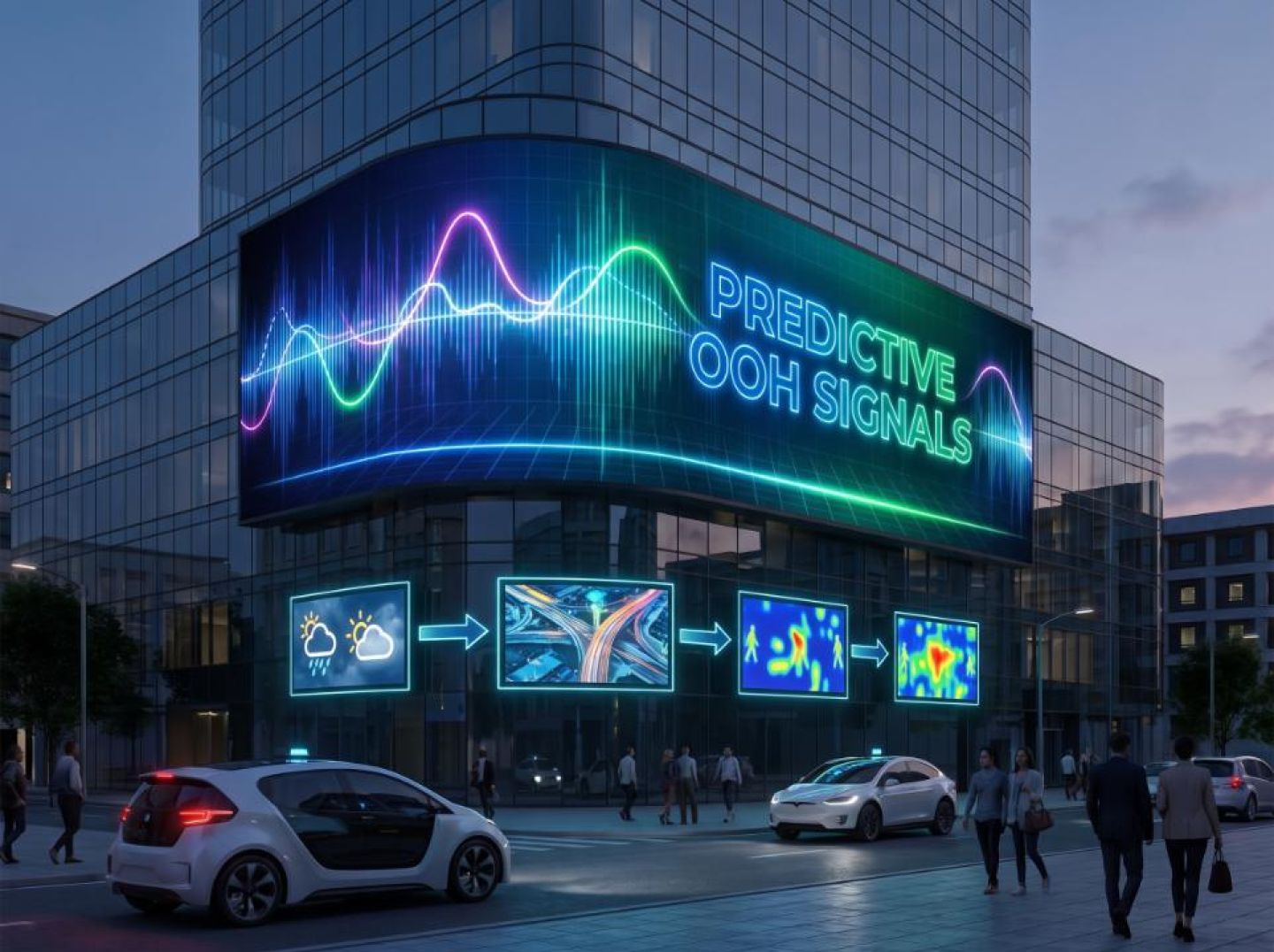
In most OOH orgs, “competitive reporting” still means a monthly deck: who spent, roughly where, maybe a few photos pulled from someone’s iPhone. It’s a backward-looking audit, not a forward-looking system. But once you treat competitive activity as a live data stream instead of a quarterly recap, those same signals become the raw material for prediction.
Other parts of marketing have already made this leap. As one guide to AI-powered competitive intelligence put it, the real shift is from “rearview mirror” dashboards to models that ask, “What is happening, why, and what is likely to happen next?” and then use AI to watch for subtle shifts in messaging, strategy, and behavior at a scale humans alone can’t match (MarTech). OOH is just beginning to apply that logic to what’s running on the boards.
The key is to move from snapshots to signals. A snapshot is “Brand X is up on three bulletins this month.” A signal is “Brand X has increased OOH spend by 40% quarter-over-quarter, shifted from static to digital units along commuter corridors, and synchronized creative with a retail promotion.” When you track those signals over time and across markets, you stop asking, “What did they buy?” and start asking, “What does this pattern tell us about demand, and how fast is it moving?”
That’s why platforms designed around real-time OOH data, like the systems powering Trillboards’ move into a continuously updated demand graph, focus on building living models rather than static databases. By mapping verified OOH campaigns over time and tying them to the agencies and decision-makers behind the spend, they create a longitudinal picture of how categories expand, how brands test markets, and which formats tend to precede bigger rollouts, turning competitive “ad spying” into a forecastable demand curve rather than a photo gallery of other people’s boards (OOH Today).
Prediction starts when you connect three layers of competitive signal:
Feed enough of this into an intelligence system and patterns emerge. You can identify the categories that tend to repeat buys every quarter, the brands that move from urban cores to suburban arteries when they hit a certain growth stage, and the agencies that consistently test one operator’s inventory before shifting volume across a whole DMA. Those aren’t curiosities—they’re early warning systems for tomorrow’s RFPs.
This is exactly how performance marketers already think. In digital, AI-driven planning engines evaluate trillions of inventory combinations and optimize toward the best outcomes, collapsing the distance between observation and action. OOH is heading the same direction as platforms like AdQuick use machine learning to turn what used to be guesses about “good boards” into precision placement based on demographic, behavioral, and performance data (AdQuick). Competitive signals are simply another high-value input: if the model can see where your competitors are over- or under-weighted, it can recommend smarter counter-moves instead of generic coverage.
There’s another reason this predictive layer matters: the next “buyer” you have to convince may be a model, not a person. As one analysis of AI’s impact on media planning argued, the media that wins budget will be the one that can most clearly prove its value to an AI advisor sitting next to tomorrow’s CMO (OOH Today). If you can show not just that your boards were filled, but that your sales team consistently anticipated demand, intercepted competitors’ expansion, and captured share because you acted on real competitive intelligence, you’re no longer just selling space—you’re selling a predictive capability.
This is the real payoff of treating “what’s on the boards” as intelligence instead of trivia. Competitive signals stop being a lagging indicator of who beat you to a contract last month, and become a leading indicator of where your next deal, your next format bet, and your next market entry should be. OOH gets smarter not by adding more charts to the recap, but by teaching every team—from sales to operations to revenue leadership—to think in terms of “what this means next” instead of “what this meant then.”
Competitive-intelligence fluency in OOH isn’t a mysterious “analyst brain.” It’s a practical way of working that shows up in how someone plans, sells, and reports — day in, day out.
You can hear it in how they talk. A rep with CI fluency doesn’t say, “I drive the route and keep an eye on who’s up.” They say things like:
That shift — from observations to pattern language — is the core tell. They’re not just seeing ads; they’re seeing systems and timing.
In practical terms, CI fluency in an OOH role looks like five specific behaviors.
1. They run on a framework, not vibes.
Windshield surveys are vibes. A fluent operator works from a simple competitive framework: what they monitor, how often they check it, and how it feeds decisions. That’s the same discipline high-performing search and media teams use when they build a recurring competitor intelligence framework for Google Ads: clear inputs, a set cadence, and an explicit path from findings to campaign changes.
In OOH, that might look like:
When a rep can describe that system without reaching for a manager, you’re looking at CI fluency.
2. They can turn raw sightings into positioning insight.
A CI-fluent seller doesn’t just log, “New CBD brand on the bypass.” They ask the same kinds of questions AI-powered CI teams now ask about competitors’ messaging and positioning gaps: What’s the promise? What audience are they clearly chasing? What channels are they ignoring?
On the OOH side, that translates to:
The fluency isn’t in the tool; it’s in the habit of asking, “What does this move say about their strategy — and what does it open up for my customer?”
3. They treat AI and automation as normal parts of the job.
In digital marketing, senior roles now assume familiarity with workflow automation and AI — nearly a third of senior content roles explicitly list automation, and AI shows up in 43% of senior listings as a required skill. Competitive OOH will follow the same path.
CI-fluent OOH pros:
They’re not waiting for their company to “roll out AI.” They’re already using it to shrink the time between signal and story.
4. They link competitive moves to measurable outcomes.
Modern marketers are hired to show how their work moves KPIs, not just to “do marketing,” and competitive skills are valued because they connect directly to performance. As one study of content SEO roles put it, senior hires are expected to show how their decisions drive specific growth metrics, from organic traffic to conversion performance tracking.
CI-fluent OOH teams behave the same way. They can say:
In other words, they don’t just know who’s spending. They can demonstrate how reacting (or not reacting) to that spend affects the client’s real-world results.
5. They sell as if they’re the market’s best source of truth.
Operators who build content around buyer questions — not just inventory promotion — are already learning that this is how you become “the answer” in an AI-first world. As one OOH-focused marketing firm explained, consistently publishing clear, question-structured content positions an operator as the market’s most useful source and earns visibility when buyers turn to AI assistants for help choosing vendors (“the answer in your market”).
Competitive-intelligence fluency shows up here, too. A rep who understands the field can:
That combination — a defined system, pattern recognition, AI-enabled speed, performance linkage, and a point of view on the market — is what separates “I drive the route” from true competitive intelligence inside an OOH role.
Receive top converting landing pages in your inbox every week from us.
Must Read
Celebrity campaigns can create massive short-term demand, but affiliates need to know when and where that attention can be captured without simply cannibalizing brand traffic. This guide explains how to use ad spy data, search signals, creative angles, and disciplined bidding to turn celebrity-driven buzz into measurable affiliate opportunities.
Liam O’Connor
7 minSep 19, 2026
In-Depth
OOH is becoming a data-driven, performance-focused channel, but many job descriptions still overlook competitive intelligence as a core skill. This guide explains how OOH teams can build intelligence loops, use ad spying as market research, and turn competitive signals into smarter sales, planning, and positioning decisions.
Liam O’Connor
7 minSep 19, 2026
Editor’s Pick
More MarTech does not always mean better performance. This guide explains why ad intelligence can give performance marketers faster, more actionable competitive signals while reducing the complexity, data fragmentation, and operational friction of bloated marketing stacks.
Samantha Reed
7 minSep 18, 2026