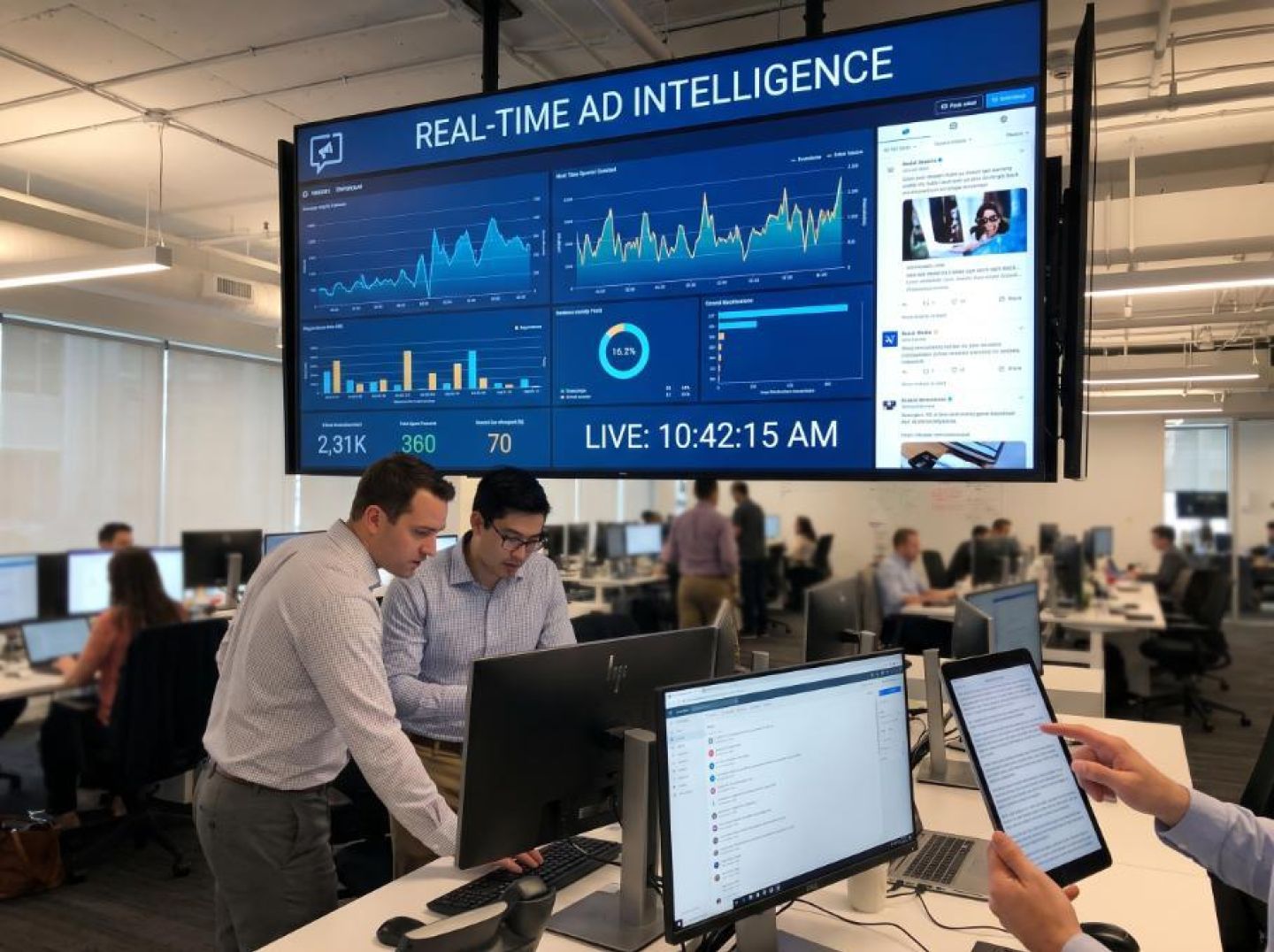

Our tools monitor millions of native, push, pop, and TikTok advertising campaigns.
Get StartedFor all the talk of disruption, most of today’s “AI-powered” competitive intelligence stack is built around a surprisingly comfortable agreement about what matters and how it should be measured. That quiet alignment is what creates the illusion that nothing is really contested.
On the surface, the tools look very different: monitoring platforms, gap analyses, AI copilots, model-specific visibility dashboards. But if you zoom out, they tend to agree on the same three premises:
You can see this consensus clearly in how ad and search intelligence is being reframed. In adtech, the shift toward conversational interfaces promises a “faster route from question to answer,” where a marketer asks who ramped up CTV spend in Germany and gets a neatly packaged response within seconds, not days, as described in an analysis of AI-first ad intelligence workflows. In search and PPC, similar logic powers the recommendation to dump your own and competitors’ campaigns into an LLM, ask which paid keywords you’re missing, and get back a prioritized shortlist that condenses a half-day task into an hour, as outlined.
In both cases, AI’s job is framed as compression: from raw data to structured answers, from sprawling exports to an actionable gap list. The work is to get to “what we already know we should be looking at” more efficiently.
That’s where the silent consensus becomes dangerous. Because if the underlying frame is wrong or incomplete, AI just helps you be wrong faster.
Consider how strongly current advice centers on coverage gaps: missing topics, missing keywords, missing channels. A modern content gap analysis now incorporates qualitative signals—sales calls, support tickets, community threads—to catch unspoken questions and intents, not just what shows up in keyword tools, as one detailed guide to audience-led gap analysis argues. This is progress, but it still assumes the most important thing is what your audience is already trying (or failing) to articulate.
What it does not question is the premise that your job is to “close the gap” to some emergent consensus view of the category: the queries users raise, the patterns competitors establish, the surfaces where models tend to answer. There is very little appetite to ask whether certain gaps are strategically healthy—places where you should not follow, or where you might want to remain deliberately absent.
Even the more sophisticated AI-augmented CI stacks are built around detection and synthesis, not disagreement. Monitoring tools scan for changes in pricing pages, product messaging, and sales conversations at scale, surfacing the shifts your team might miss, while sales-oriented platforms push real-time competitive context into reps’ workflows, as described in a survey of CI platforms and their AI features. But the implied end-state is still alignment: see what everyone else is doing, and then adjust.
Where we do see cracks in the consensus, they’re treated as anomalies to be fixed, not signals that the frame itself is unstable. When large language models produce wildly different “recall” patterns—Notion mentioned 17 times more often in one model than another, or legacy insurers effectively replaced by their digital-native rivals in AI outputs, as a recent AI visibility index found—the recommendation is to measure each model separately and patch gaps by model, prompt, and source. The assumption is that brands deserve consistent “visibility” across models, and any divergence is a problem to be solved.
What’s missing is a real contest over which visibility actually matters. If Gemini consistently under-cites your brand, is that a visibility crisis, or evidence that its training mix doesn’t include the niche experts you actually care about? If AI-based recall replaces incumbent insurers with digital upstarts, is that a ranking error, or a forecast?
The current ecosystem largely dodges these questions by flattening everything into gaps and coverage. AI systems are lauded when they “move from reporting what happened to informing what should happen next,” as one vision of next-generation ad intelligence puts it—yet the “should” is still anchored in the same unchallenged KPIs, the same authority signals, the same idea that convergence on a shared map of the market is inherently good.
That is the real silent consensus: that better competitive intelligence means seeing what everyone else sees, only earlier and more clearly. What remains deeply under-explored is the opposite instinct—using AI not to erase disagreement and divergence, but to surface and protect it.
Most of what we call “competitive intelligence” today is really competitive reporting. The modern CI stack is optimized to answer a very specific set of questions, in very specific channels, with very familiar units: keywords, creatives, spend, impression share, ROAS. It’s powerful within that box—and almost nonexistent outside it.
Look at how mature the search and display side of the stack has become. A typical workflow for Google Ads “competitor analysis” revolves around tools like Auction Insights, the Transparency Center, and third‑party suites such as Semrush’s Advertising Toolkit. The questions this stack is built to answer are tight and tactical:
Guides to “gap analysis” in paid search bake this in: you export competitor paid keywords and ad copy, export your own account, then have an LLM reconcile the lists to reveal “missing” queries and prioritize them by CPC and “competitor signal strength,” as one Semrush walkthrough explains. It’s efficient. It’s repeatable. But it’s also narrowly scoped to what’s visible in a single auction format and what can be summarized into a spreadsheet.
The same pattern shows up in content intelligence. A modern content gap analysis looks for topics competitors rank for that you do not, then extends that view with qualitative inputs like sales calls and support tickets. As a recent Semrush guide puts it, the goal is to surface where your content is “absent, thin, outdated, unclear, or misaligned.” Again, the unit of analysis is pre‑defined: URLs, keywords, topics, intents. You’re still competing in a neatly bounded arena—search results and AI answer boxes—where coverage can be tallied and compared.
On the media side, the stack has evolved from channel‑specific tools toward more unified cross‑media dashboards. With the right setup, marketers can now track competitor spend and creatives across social, CTV, linear TV, online video and display, often in near‑real time, as one AdExchanger analysis notes. But even here, the outputs are still overwhelmingly descriptive: spend curves, share‑of‑voice estimates, bursts of activity by format or market. The same piece points out that dashboards were supposed to solve the fragmentation problem and are now “beginning to show their limits” precisely because they remain a step removed from the decisions they’re meant to inform.
AI, in its current embedded form, largely reinforces this narrowness rather than breaking it. Some platforms now promise a faster “route from question to answer,” where a marketer can ask which competitors ramped CTV in Germany last quarter and see the supporting creatives within seconds, as described in that same AdExchanger piece. Conversational layers and copilots sit on top of existing telemetry and schemas; they compress analysis time without really expanding what gets analyzed. The question set is still: who spent what, where, and with which assets?
You can see the boundaries most clearly at the edges of new channels. Six months into ChatGPT Ads, advertisers are still flying blind on anything beyond their own campaign outcomes. There’s no equivalent of Auction Insights, no impression share, no competitive reporting, and no benchmarks by industry or campaign type, as Search Engine Journal observes. The only numbers most teams see are CPC, cost per attributed sale, ROAS—without any view into the competitive pressure or relevance dynamics behind those prices. In other words, the CI stack effectively stops at the point where the platform no longer exposes familiar levers and leaderboards.
Taken together, these patterns show how narrow today’s “AI‑powered CI” really is. It covers:
What it largely does not cover are the contested, ambiguous parts of competition: why a rival changed strategy, which internal bets they’re making, how new interfaces like conversational agents are quietly rewriting the funnel, or what “good” even looks like in categories where the metrics aren’t standardized. The current stack is excellent at illuminating the parts of the landscape that vendors and platforms already instrument. It remains strikingly narrow—and mostly silent—everywhere else.
For all the dashboards, exports and “market maps” we surround ourselves with, one core dimension of competitive reality is still largely invisible: what rivals are doing in real time, at the level of actual campaigns and auction decisions.
Most ad intelligence today is either rearview-mirror or zoomed so far out that it blurs into abstractions: share of voice, total spend, category trends. Useful, but not the thing performance teams actually argue about at 9:30 a.m. on a Monday. They want to know: Who just turned on that new CTV flight in Germany? Did their push coincide with our CPC spike in branded search? Are we losing mid-funnel intent to new AI-native inventory like ChatGPT Ads while our competitors quietly figure it out?
The stack is not built to answer those questions.
Even in channels we consider “mature,” competitive visibility stops short of live, campaign-level intelligence. In search, Auction Insights helps, but it’s still a coarse view of overlap and impression share, not a narrative of who changed bids, budgets, or match coverage and when. Tools like Optmyzr’s MCP illustrate how much work it still takes just to assemble a complete picture of one account’s own auction environment: unifying fragmented change history, consolidating negatives across four different levels, and stitching in Auction Insights and vertical benchmarks so that questions like “who moved our ROAS in March?” actually have a factual answer, instead of a Slack thread full of guesses, as the Optmyzr team explained in a recent piece on making AI safer inside live ad accounts.
Now imagine having that level of grounded clarity not only for your account, but across your competitive set, and not weekly or monthly, but as the campaign decisions land. That is the missing dimension.
The gap is even more glaring in new, AI-driven environments. Six months into ChatGPT Ads, early adopters still lack basic competitive context: there is no Auction Insights equivalent, no impression share, no cross-advertiser benchmarks by vertical or campaign type. As a result, even a simple metric like CPC is hard to interpret because advertisers can’t see whether a price shift was driven by changes in competition, relevance scoring, inventory mix, or the kinds of conversations their ads were matched to, as Search Engine Journal’s reporting on ChatGPT Ads has pointed out. The underlying auction is a relevance-weighted second-price system, but the competitive pressure shaping that second price is effectively opaque.
What’s missing is not more static “coverage” of channels, but a unified, cross-media substrate that can be interrogated in real time at the level where decisions are actually made: campaigns, flights, creatives, audiences, auctions. As one ad intelligence provider argued in a reflection on why most tools still feel “pre‑AI,” the real bottleneck isn’t access to data; it’s the inability to turn fragmented, cross-channel signals into fast, comparable, action-ready answers about who’s investing where, with what creative, and how that behavior is shifting week to week across markets like CTV, social, and AI-native surfaces such as ChatGPT Ads, a point underscored in their analysis of how dashboards are failing modern decision-making.
AI agents and copilots on top of narrow, channel-specific feeds don’t solve this; they accelerate the wrong thing. They move you faster from question to partial answer, leaving the blind spots intact. A planner can now ask, “Which competitors increased CTV investment in Germany?” and get a prettier chart, but not necessarily see the search and AI-assistant budgets that quietly shrank to fund that shift, or the creative sequencing that linked an upper-funnel CTV concept to mid-funnel search and conversational ads.
The missing dimension, then, is not just “more data,” but live, campaign-level ad intelligence that is:
Until that foundation exists, competitive intelligence will continue to chronicle what happened last quarter while the real competitive battles are decided, in real time, inside auctions and campaigns no one can properly see.
In AI-first ad environments like ChatGPT, Gemini, Perplexity, and AI-overview search, the assumptions baked into traditional competitive intelligence simply stop working.
Start with the most basic expectation: that you can tell whether you’re doing “well” relative to others. In the first six months of ChatGPT Ads, advertisers have seen only a thin slice of performance data—CPC, cost per attributed sale, ROAS—without the contextual guardrails they’re used to in search or social. There is no Auction Insights, no share-of-voice lens, no cross‑advertiser benchmarks by vertical or campaign type, as Search Engine Journal’s reporting on early ChatGPT Ads adopters makes clear. That missing layer makes even simple numbers like CPC almost uninterpretable: if price goes up, you can’t tell whether you’re facing more competition, falling relevance, a shift in inventory, or simply different kinds of conversations being matched.
The problem isn’t just the lack of dashboards; it’s that the underlying mechanics are different. ChatGPT’s relevance‑weighted, second‑price auction leans heavily on the live conversational context, landing page signals, and loosely defined “context hints” rather than keywords or hard audience definitions. As Search Engine Journal notes in its breakdown of the format, those hints explicitly do not guarantee delivery against specific queries or users. That upends the logic of keyword‑ and audience‑based CI. You can no longer reverse‑engineer a rival’s strategy from the phrases they bid on, because there are no exposed phrases. You can’t estimate their intent coverage by watching impression share, because there is no impression share.
AI search creates a second, equally destabilizing blind spot: brand presence is now mediated by models whose internal rankings do not resemble Google’s. When MarTech analyzed an “AI visibility index” across major LLMs, they found that even “consensus” brands were anything but consistent: productivity tool Notion was referenced seventeen times more often by Claude than Gemini, while insurance brands like State Farm were heavily over‑represented in some models and nearly invisible in others. If your CI stack is optimized around SERP share or display SOV, it may tell you you’re dominant—while one or more models have quietly de‑ranked you in their default recommendations.
That fragmentation is exactly where most current CI workflows break. Dashboards that roll everything into one blended “AI visibility” or “brand presence” score can hide the real issue. As the MarTech analysis of sector‑level disruption shows, some categories (like travel) still map roughly to legacy authority signals, while others (like insurance and education) have been re‑sorted around digital natives and content engines. If you don’t measure each model, prompt category, and source set separately, you can’t tell whether you have a broad AI problem—or, more likely, a Gemini problem, a ChatGPT problem, or a “we never publish the kind of content these systems like to cite” problem.
Meanwhile, inside the major ad and marketing platforms, AI automation is quietly removing the very levers CI was built to analyze. Audience selection, bid strategy, and creative allocation are increasingly decided by opaque optimization layers rather than explicit marketer choices. As MarTech’s coverage of the “AI performance shake‑up” puts it, platforms “take the driver’s seat,” deciding who sees what and when, while legacy metrics like clicks or opens become weaker proxies for real impact. When your campaign spikes or suddenly drops, you often can’t tell whether it was your creative, a seed audience tweak—or a model update you’ll never see documented.
This is where even AI‑augmented CI tools risk accelerating the wrong conclusions. Without broad, comparable, cross‑media data, conversational layers simply help you ask better questions of incomplete inputs. As one AdExchanger analysis of next‑gen ad intelligence argues, AI on top of fragmentary or inconsistent coverage just “accelerates incomplete analysis.” You get faster answers that are still structurally wrong because they’re grounded in pre‑AI assumptions: that channels are stable, that auctions expose meaningful competitive signals, that authority in Google equals authority everywhere.
The net result is a growing gap between where performance is actually being decided—inside AI‑mediated conversations and black‑box optimization loops—and what your CI stack is capable of observing. Until competitive intelligence is rebuilt around real‑time, model‑specific, campaign‑level signals, teams will keep steering by instruments that no longer match the sky they’re flying through.
Competitive intelligence fails not because teams lack dashboards, but because there’s a widening gap between the questions marketers need answered and what their tools can actually say in time to matter.
On paper, we’ve never had more visibility. Modern platforms can map spend, placements, and creatives across TV, social, display, and CTV, often in near-real time, as AdExchanger noted when it described today’s ad landscape as “rich in data.” Yet most of that visibility is backwards-looking and channel-siloed. It tells you what happened, not what to do next, and certainly not how to adapt as AI-driven auctions shift under your feet.
You can see this clearly in AI-first environments. Six months into ChatGPT Ads, advertisers still don’t have a shared sense of what “good” performance looks like; they’re staring at CPC and ROAS in isolation, with no Auction Insights‑style view of who else showed up, who won, or why. When CPC climbs, a dashboard can show you the number, but it can’t answer the questions you actually care about: Did a new rival just enter this space? Did OpenAI’s relevance model start preferring different intents? Are we being priced out of certain conversational contexts?
The same pattern plays out in mature platforms, just with better tooling. In Google Ads, a marketer can pull Keyword Gap reports, Auction Insights, and creative archives in a few clicks. Guides on Google Ads competitor analysis walk through how to identify missing keywords, pull competitor copy, and benchmark impression share using tools like Semrush’s Advertising Toolkit. But the real work doesn’t stop at “we’re missing these 120 paid terms” or “Competitor B’s impression share jumped 20 points.” The pressing questions are: Which of these gaps are strategically important? What should we cut to fund them? How fast do we need to react before the auction dynamics harden?
Dashboards rarely help you cross that bridge from descriptive to prescriptive. They fragment answers across tabs, channels, and time periods, forcing teams into manual synthesis—exporting CSVs, stitching tables, and arguing over which metric “really” matters. As one AdExchanger analysis pointed out, the limiting factor is no longer data access but the speed and quality of interpretation: how quickly can a marketer move from “something changed” to “here’s what we’ll do about it”?
AI is supposed to collapse that gap, but simply sprinkling machine learning on top of old reporting patterns doesn’t change the underlying workflow. If the output is just more charts, you’ve added complexity, not clarity. Where AI does start to close the question–answer gap is in two specific shifts.
First, interaction changes. Instead of drilling down through nested reports, a media lead should be able to ask, in plain language, “Which competitors increased CTV spend in Germany last quarter, how does that compare to the UK, and what creatives supported the shift?” and get a structured answer within seconds. This is precisely the kind of conversational querying that newer ad intelligence products and AI research workflows are beginning to support: pulling cross-market, cross-channel patterns into a single, synthesized response rather than leaving humans to assemble the puzzle.
Second, cadence changes. In a world where AI search results and agentic assistants are rewriting discovery flows weekly, a quarterly “competitive deep dive” is already stale. Analysts on the Semrush side argue that the power of AI-assisted competitive research lies less in any single analysis and more in making it fast enough to repeat frequently, turning what used to be half-day investigations into hour-long reviews that can run on a regular rhythm. When an AI layer continuously surfaces shifts—new domains gaining AI search visibility, a rival suddenly dominating comparison queries, a fresh cluster of use cases emerging in ChatGPT conversations—you’re no longer reacting to a static dashboard; you’re responding to a living stream of competitive hypotheses.
The end state is not a prettier report. It’s a workflow where the path from “What’s happening?” to “What should we do?” is radically compressed. Competitive intelligence stops at the dashboard; competitive advantage starts when you can interrogate that data like a collaborator, get a pointed, cross-channel answer, and immediately translate it into budget moves, creative tests, and bidding changes—before your rivals’ dashboards have even refreshed.
If traditional CI was built for a world of static websites and quarterly media plans, a digital‑native playbook has to start from a colder premise: the spies are blind, the signals are noisy and the battlefield is an AI system you don’t control.
Nowhere is that clearer than in ChatGPT Ads. Six months in, advertisers can see basic performance metrics like CPC, cost per attributed sale and ROAS, but almost nothing about how those numbers came to be. There is no equivalent of Google’s Auction Insights, no impression share, no visibility into who else showed alongside you, and no published performance benchmarks by industry or campaign type, as Search Engine Journal reported. You’re trying to run “competitive” analysis in a channel that withholds the very notion of a competitor.
That forces a different model of spying.
First, spying becomes inference, not observation. OpenAI’s relevance‑weighted second‑price auction means that changes in CPC can be driven by competition, by conversational context, by your landing page, or by the opaque “context hints” you pass into the system—and the platform gives you almost no tools to disentangle those factors, as Search Engine Journal’s coverage makes clear. A digital‑native CI playbook has to reconstruct the invisible auction by watching downstream effects across many accounts, campaigns and markets, not by staring at one advertiser’s dashboard.
Second, spying has to be continuous and broad, not episodic and narrow. When your competitor tweaks pricing, rewrites a value prop, or quietly launches a new positioning in their docs, the signal won’t show up as a neat “share of voice” chart; it will surface as a pattern of small, fast changes scattered across the web. That’s the gap dedicated monitoring platforms like Crayon and Klue were built to fill, crawling pricing pages, changelogs and sales collateral for subtle shifts that an analyst would miss, as MarTech’s playbook on AI‑powered CI describes. In AI‑mediated channels, those micro‑changes can instantly alter how often your ads are deemed “most relevant” and even which conversations you’re invited into at all.
But spying is only the first leg of the playbook. The hard part is synthesis.
In a pre‑AI world, CI teams manually stitched together scattered signals—what competitors say on LinkedIn, what they buy on CTV, what they hide in their release notes—and then handed over slide decks weeks later. That timeline is now untenable. Competitive signals appear simultaneously across social, linear TV, CTV, online video, display and AI‑driven environments like ChatGPT Ads, and budgets move fluidly in response, as AdExchanger has argued. If your synthesis loop still runs on quarterly memos, you’re playing a turn‑based game in a real‑time arena.
A digital‑native CI system has to collapse that loop. It needs a unified, cross‑media data foundation so that when a competitor shifts CTV spend in Germany, you can immediately see how their search, social and conversational presence moved with it. Then it needs AI that works as a reasoning layer, not a reporting gimmick: agents that can answer, “Who entered our space in the last 60 days, where did they over‑index, and which of our segments now see them more often than us?” in seconds, not days. When platforms like Optmyzr’s MCP ground their agents in full change history, auction data, and vertical benchmarks across multiple ad platforms, they illustrate how AI can compress the path from signal to diagnosis inside a live account, as MarTech’s coverage of safer AI in ad accounts highlights. CI has to demand that same level of grounding and cross‑boundary visibility.
Finally, strategy has to be built on absences as much as on presence. In AI‑mediated channels, what your competitors choose not to compete for can be as revealing as the bids they place. The most interesting questions in the new playbook are often negative ones: Which intents does no one seem willing to pay for? Which audience segments are underserved in certain contexts? Where are competitors pulling back their narrative in thought leadership while pushing harder in performance media? As MarTech’s guidance on positioning gaps points out, those empty spaces are often where your openings live.
Put bluntly, “doing CI” in a world of ChatGPT Ads and cross‑channel AI auctions is not about getting a better dashboard screenshot of your rivals. It is about building a system that can spy by inference, synthesize across opaque and fast‑moving signals, and surface strategic moves—new battles to enter, old ones to abandon—faster than your competitors can even articulate the questions.
Receive top converting landing pages in your inbox every week from us.
Guide
Explore what today’s AI-powered competitive intelligence still misses, from real-time campaign visibility to opaque AI-first ad platforms. This guide outlines a digital-native CI playbook for turning fragmented signals into faster, more strategic decisions.
Marcus Chen
7 minOct 5, 2026
Guide
Discover how data-first strategists are reshaping the modern creative agency and redefining the Managing Director’s role around performance, media intelligence, and real-time decision-making. This guide explores the new MD toolstack, competitive intelligence, funnel diagnostics, and the feedback loop connecting creative intelligence with media execution.
Elena Morales
7 minSep 30, 2026
In-Depth
Most brands tracking AI search visibility are making the same mistake: they're auditing themselves while ignoring the far richer source of intelligence—their competitors. Every AI-generated answer reveals a map of who owns buyer intent, which content structures AI systems trust, and where visibility gaps remain unclaimed. By combining competitor AI footprint analysis with paid media intelligence and organic search data, marketers can uncover profitable opportunities faster than traditional SEO or AEO approaches alone.
Rachel Thompson
7 minJul 3, 2026