6 minAugust 3, 2026

Our spy tools monitor millions of native ads from over 60+ countries and thousands of publishers.
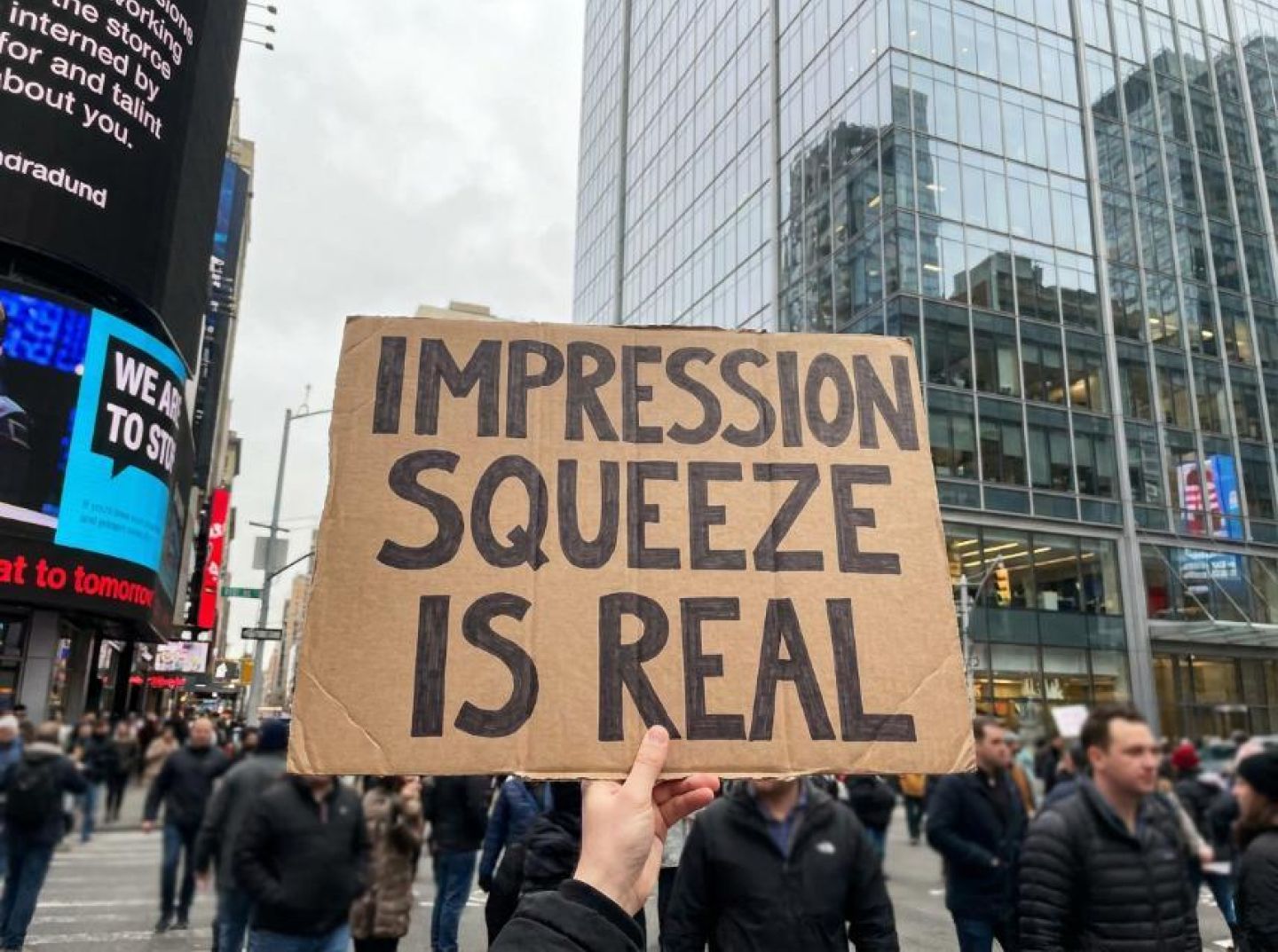
Get StartedThe alarm bells ringing across digital advertising right now are real. As Search Engine Journal documented in a detailed analysis of the changing Google Ads landscape, AI Mode and AI Overviews have eaten into the space where ads used to live, producing an 11% year-over-year decline in impressions. The ad canvas is shrinking. Agents don't scroll. And the emerging "shortlist economy" — where AI assistants return three to five options and that's the entire consideration set — means that if you aren't surfaced by the algorithm, you never get to make your pitch. These are legitimate, data-backed concerns that any marketer should take seriously.
But there's a blind spot in virtually all of this analysis, and it's hiding in plain sight: the entire conversation assumes that "digital advertising" and "search advertising" are the same thing.
Read the coverage closely. The impression squeeze is framed as a crisis of fewer ad slots inside Google's evolving search experience. The shortlist economy is a threat because it replaces ten blue links — the terrain where search advertisers have built their empires — with a curated handful of AI-endorsed recommendations. The existential dread is palpable, but it's existential only if your entire acquisition model depends on intercepting search intent at the moment someone types a query into Google.
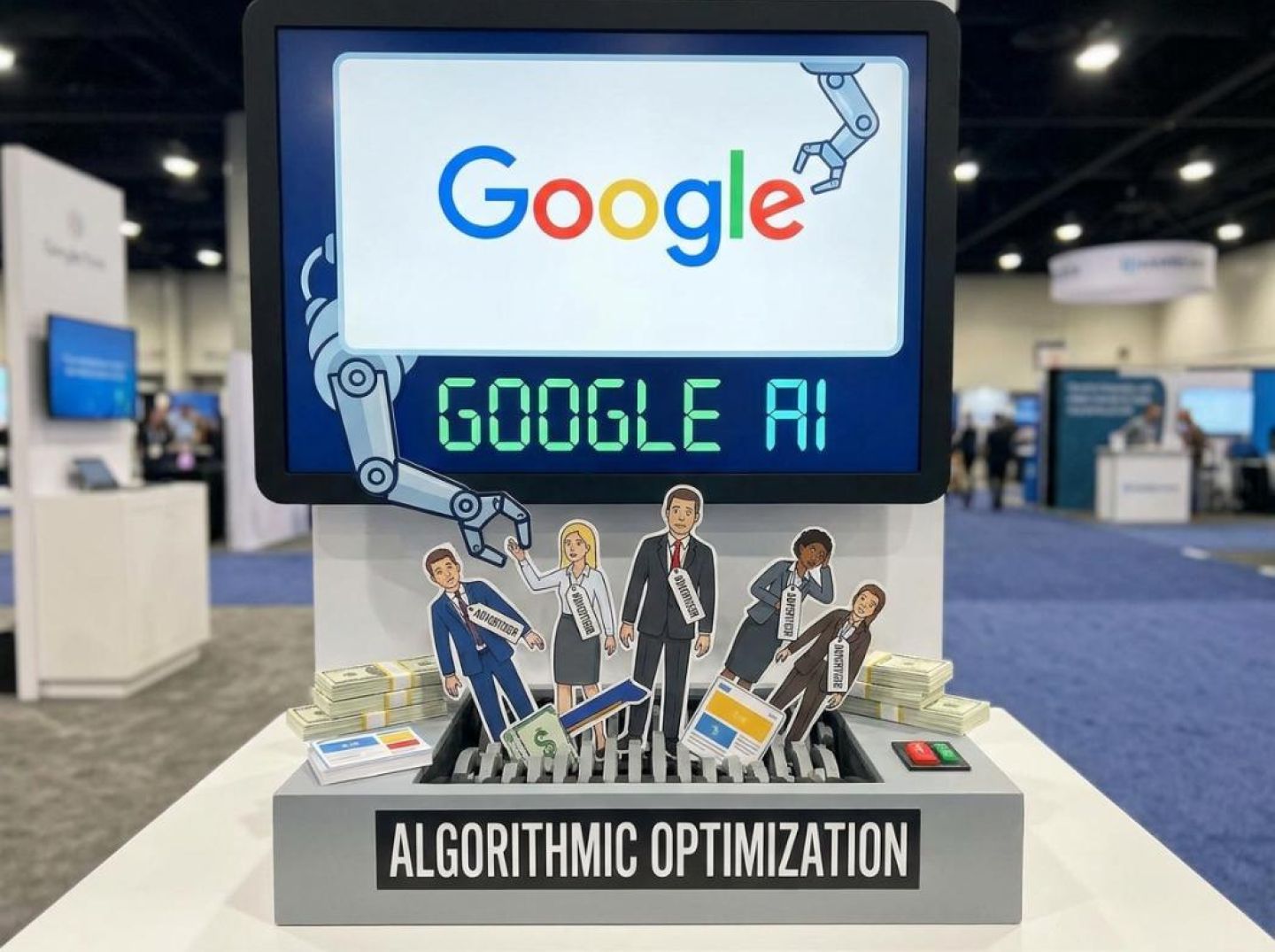
Meanwhile, the problems run even deeper than shrinking real estate. As AdExchanger revealed in its examination of what it calls "the cult of performance," Google's own AI products are actively cannibalizing its advertisers from the inside. The platform's AI-powered campaigns — AI Max for Search and Performance Max — will, left unchecked, dramatically increase bids on a brand's own name and related terms, effectively charging advertisers to capture traffic they would have earned organically. Worse, the biggest buyers of garbage made-for-advertising inventory are these same AI-powered platform ad products, which chase cheap, often discreditable placements around the web to generate attributable clicks and impressions. The system isn't just offering fewer impressions; it's degrading the quality of the impressions that remain and then claiming credit for conversions it didn't actually drive.
This is the part nobody wants to say out loud: the impression squeeze is a squeeze on one channel posing as a squeeze on all channels. Google search advertising has become so synonymous with performance marketing that an entire industry has trouble imagining what demand generation looks like outside of it. When analysts warn that automated traffic is growing roughly eight times faster than human traffic, the implicit assumption is that this spells doom — because the only playbook most teams have is bidding on keywords and hoping the right person clicks.
But performance marketing is not a single channel. It never was. The impression squeeze is devastating if you've staked everything on a shrinking canvas controlled by a platform with clear incentives to extract more revenue from fewer opportunities. It's far less threatening — and in some cases, it's an outright advantage — if you've been building acquisition pipelines in formats and ecosystems that these AI disruptions haven't touched. Native advertising and push notification channels operate on entirely different infrastructure, with entirely different economics. They don't depend on query intent. They don't compete for three slots on an AI-generated shortlist. And they aren't subject to the platform self-dealing that makes Google's own ad products increasingly adversarial to the advertisers funding them.
The diagnosis is right. The prescription is too narrow. And the advertisers who recognized this early are already capitalizing on it.
The impression squeeze narrative has a blind spot the size of the entire interrupt-based advertising ecosystem. When analysts describe the shrinking ad canvas — fewer impressions inside search results, AI agents that evaluate rather than browse — they are describing a crisis specific to one family of ad formats: those that depend on a user typing a query and scanning a results page. Native display, push notifications, and pop/popunder ads were never on that page to begin with, which means they were never in the blast radius.
To understand why, it helps to revisit the framework that Search Engine Journal laid out when describing Microsoft's three eras of the web. The first era — "help me find it" — is the classic search paradigm, ten blue links and a prayer. The second — "help me choose" — is the comparison-shopping, review-reading phase that AI Overviews now compress into a single summary. The third — "do it for me" — is the agentic layer, where automated traffic is growing roughly eight times faster than human traffic. All three eras describe the progressive collapse of intent-initiated discovery. The user starts with a question, and the platform answers it with decreasing need for clicks, scrolls, or ad exposures along the way.
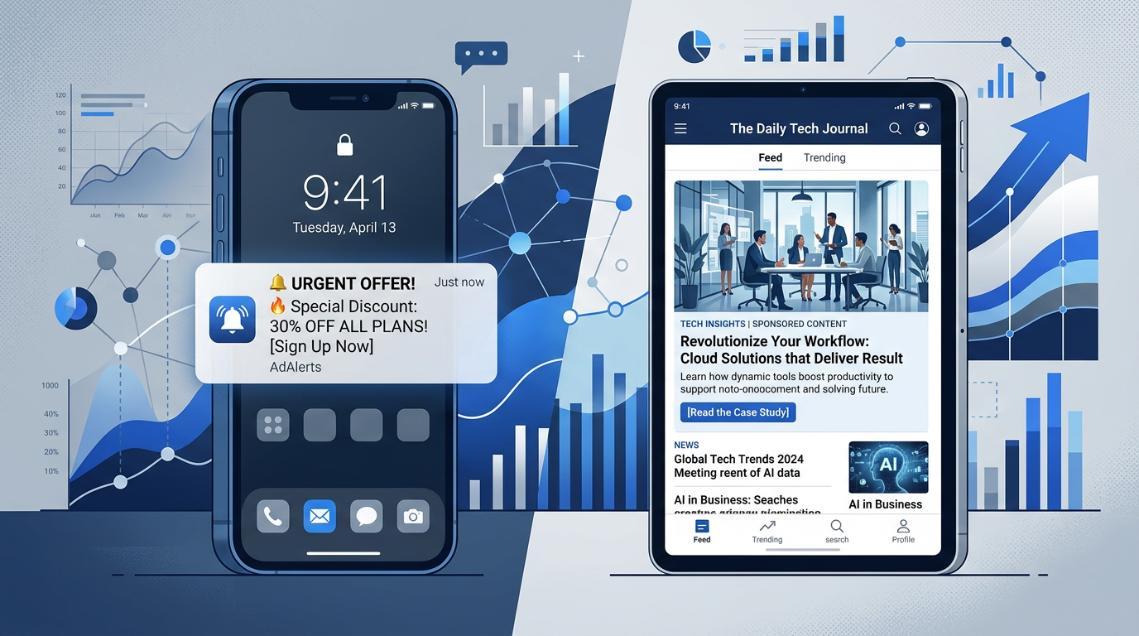
Native and push advertising operate in a fundamentally different moment. They do not harvest existing demand; they create it. A native ad unit appears while someone is reading an article about meal prep or scrolling a tech-news site — there was no query, no keyword match, no results page competing for real estate with an AI Overview. A push notification arrives on a phone's lock screen independent of any search session entirely. A popunder loads beneath the active browser window on a download page. None of these formats require the user to ask for anything first, which means none of them lose inventory when an AI agent answers a question before the user ever sees an ad slot.
This distinction matters even more when you consider what is happening on the publisher side of the equation. As Neil Patel documented, smaller publishers have experienced a 60 percent decline in search referral traffic, and the recommended survival playbook now centers on owned channels, direct audience relationships, and diversified distribution. Publishers who still attract readers do so through loyal audiences, newsletters, social sharing, and content that AI systems want to cite — not through Google's organic click stream. Native ads are literally the monetization layer of that surviving publisher ecosystem. When a publisher shifts from search-dependent traffic to a direct, brand-loyal audience, the native inventory on those pages doesn't vanish; it persists, and in many cases it becomes more valuable because the audience is more engaged.
Push notification inventory follows the same logic. A subscriber list is an owned asset. It does not shrink when Google rearranges its results page or when an AI agent completes a purchase without ever opening a browser. The impression exists the moment the notification is delivered, regardless of what is happening inside any search engine.
The structural takeaway is simple but powerful: the impression squeeze is a contraction of query-triggered ad surfaces. Channels that were never triggered by a query — native display woven into editorial content, push notifications delivered to opted-in devices, pops served on file-hosting and utility pages — sit outside that contraction entirely. Their supply curve is governed by publisher audiences and device subscriptions, not by how much space Google allocates between an AI Overview and the first organic link. As search impressions compress, these interrupt-based channels don't just survive; they become a larger share of the total available ad canvas by default.
The concept of the "shortlist economy" has become one of the most anxiety-inducing ideas in digital marketing this year, and understandably so. When retail media strategist Roger Dunn coined the term to describe how AI assistants compress the entire consideration set into three to five options, he gave a name to something brand marketers had been sensing for months: the funnel is getting narrower at the very top, and if you're not on the AI's list, you're invisible. The Semrush survey data reinforcing that narrative — 43% of U.S. shoppers discovering new brands through AI, 47% noticing AI-mentioned brands with regularity — reads like a mandate. Get on the shortlist or die.
But here's what the panic obscures: the shortlist economy is only an existential threat to brands whose entire customer acquisition model begins with someone else's query. If your go-to-market strategy depends on a consumer asking ChatGPT "what's the best running shoe for flat feet" and hoping your brand appears in the response, then yes, you are now competing for one of five slots on a list you cannot directly control, optimized by an algorithm whose ranking criteria remain largely opaque. That is a genuinely precarious position.
Native and push advertisers operate in a fundamentally different universe. They don't wait for a query. They don't hope an AI agent surfaces their offer. They place a creative — a headline, an image, a landing page — in front of a segmented audience and let the performance data decide what survives. The consideration set isn't curated by a large language model; it's constructed by the advertiser through creative rotation, bid optimization, and audience targeting. In this model, you are the shortlist. You decide which offers compete for attention, you control the sequencing, and you measure the outcome directly against cost-per-acquisition targets rather than against some murky "share of voice on AI surfaces."
The distinction becomes even sharper when you consider where the free visibility window is heading. The organic AI citation that brands are scrambling to earn today won't stay free forever. As platforms monetize their AI surfaces — Google is already running ads inside AI Mode and testing formats like Direct Offers — the brands that invested heavily in shortlist positioning will find themselves paying for that placement, just as they learned to pay for search ads a generation ago. The difference is that the new canvas is smaller, the control is weaker, and the creative real estate is dictated by a conversational interface rather than a customizable ad unit.
Meanwhile, the performance marketing model that powers native and push has always operated on a pay-to-play basis, but with a critical advantage: the advertiser retains full creative and targeting control. When AdExchanger documented how Google's AI ad products aggressively steer keyword decisions — even bidding up a brand's own name to cannibalize organic results — it illustrated the fundamental tension in platform-dependent advertising. The platform's optimization goals and the advertiser's goals are not always aligned. In native and push environments, there is no intermediary AI deciding whether your brand deserves to appear. You buy the placement, you test the creative, you scale what works, and you kill what doesn't. The feedback loop is yours.
This is why the shortlist economy, for all its genuine implications for search-dependent brands, is a problem that belongs to a different industry. Performance advertisers who build their funnels through interrupt-based creative testing were never waiting for permission to appear. They already controlled the list — because they built it themselves.
Google's AI ad products aren't just optimizing for your goals anymore — they're optimizing for Google's. And the evidence is piling up fast enough that pretending otherwise has become a strategic liability.
As AdExchanger laid out in a scathing analysis, the word "steer" is appearing more and more in Google communiques as AI Max for Search and PMax take increasingly direct control over keyword targeting. The mechanism is elegant in its self-interest: if an advertiser hands Google's AI the keys, the first thing it does is dramatically increase bids on the brand's own name and closely related terms — even if that brand already occupies the top organic result. You are, in effect, paying to cannibalize your own free traffic. Google's AI doesn't care that the click would have happened anyway. It cares that the click is attributable, because attributable clicks justify more spend, which justifies more AI control, which generates more attributable clicks. The flywheel spins, and the advertiser's budget drains into a loop that enriches the platform without generating incremental demand.
The rot extends beyond brand bidding. The same AdExchanger piece identifies the biggest buyers of garbage MFA inventory as AI-powered platform ad products, which chase cheap, often discreditable placements across the open web to manufacture attributable impressions. Meta, meanwhile, has been shrinking its ad "safe zones" so that more scrolls and taps accidentally open ads — then retroactively crediting those interactions through a new "engage-through attribution" framework. The platforms are engineering both the accident and the measurement system that calls the accident a conversion.
This is the structural risk that search advertisers are now forced to manage: the platform they depend on is simultaneously their distribution channel, their competitor for organic traffic, and the referee that decides whether its own tactics count as performance. No amount of manual auditing fully neutralizes that misalignment. You can set negative keyword lists, restrict placements, and cap bids, but you're playing defense inside a system whose incentives run opposite to yours.
In the native and push ecosystem, that adversarial dynamic simply doesn't exist. You buy traffic from a network at a known CPM or CPC. You own the landing page. You measure post-click actions — leads, sales, app installs — with your own tracking stack or a third-party attribution tool. The network has zero incentive to cannibalize your organic presence because you never had organic presence on its platform to begin with. There is no "organic listing" on a push notification network that the same network's AI could bid against on your behalf.
The bifurcation Forbes Chief Innovation Officer Nina Gould described — that publishers are now selling visibility within the AI knowledge ecosystem, not just impressions — actually underscores the advantage. Search-adjacent inventory is being reshaped by AI agents, AI Overviews, and platform steering in ways that make its true value increasingly opaque. Direct publisher inventory, the kind native ads occupy, remains a straightforward impression sale on a page a real human is actually reading. The transaction is legible. The value exchange is honest. And as impression counts decline eleven percent year-over-year inside search, that honest inventory becomes not just preferable but competitively essential.
The advertisers who recognize this aren't abandoning search — they're rebalancing toward channels where the platform isn't also the predator.
So the case for diversifying into native and push is compelling — but compelling doesn't eliminate risk. The question every paid search advertiser asks before moving budget is the same one: How do I avoid burning through test spend learning what already works in a channel I've never run?
The answer is competitive intelligence, and it's more accessible in native and push than most search advertisers realize.
Unlike Google's increasingly opaque auction — where Performance Max and AI Max obscure which keywords, placements, and creative variations are actually driving results — native and push advertising ecosystems are remarkably transparent if you know where to look. Spy tools like Anstrex, AdPlexity, and SpyPush let you see exactly which creatives competitors are running, which landing pages they're sending traffic to, which ad networks they're buying on, and in many cases how long a particular campaign has been live. Longevity is the key signal: if a creative has been running for sixty days or more, it's almost certainly profitable, because no media buyer sustains spend on a loser that long.
This kind of visibility effectively collapses the learning curve. Instead of entering native with twenty untested angles and hoping three survive, you can study which hooks, images, and page structures are already converting in your vertical and build your first round of tests around proven patterns. You're not copying — you're pattern-matching, the same way a smart search advertiser would study auction insights and competitor ad copy before launching a new campaign.
The intelligence layer matters even more given what's happening in search. As AdExchanger detailed, Google's AI ad products are increasingly steering advertisers toward decisions that serve Google's margin rather than the advertiser's ROI — bidding up branded terms you'd rank for organically, pushing spend into made-for-advertising inventory to generate attributable-but-worthless clicks. In that environment, the ability to see what's actually working before you spend is not a luxury. It's the minimum viable due diligence that Google no longer lets you perform inside its own ecosystem.
The competitive intelligence playbook for native and push follows a straightforward sequence. First, filter by your vertical and geo to see which offers and angles dominate. Second, sort by run time to separate tests from proven winners. Third, study the landing pages — not just the headlines, but the structure: are top performers using long-form advertorials, listicles, quiz funnels, or direct response pages? Fourth, note which networks the winning campaigns run on, because network selection in native and push affects traffic quality as dramatically as keyword match type does in search.
Neil Patel's team has emphasized that the brands navigating algorithmic volatility best are those keeping humans in the loop — reviewing signals, making judgment calls, and recalibrating strategy based on real-time data rather than handing decisions to automated systems. The same principle applies here. Competitive intelligence tools give you the raw signal, but interpreting which patterns translate to your offer, your audience, and your margin still requires a human strategist who understands the difference between a tactic that works generically and one that fits your brand.
The net effect is that the traditional argument against channel diversification — "we don't know what works there yet" — no longer holds. In native and push, you can study what works before you spend a dollar. In search, you increasingly can't see what's working even after you've spent thousands. The information asymmetry has flipped, and the advertisers who recognize that are already reallocating.
Receive top converting landing pages in your inbox every week from us.
In-Depth
Discover how city-level ad intelligence can help marketers build campaigns that feel local while scaling globally. Learn how to use Anstrex to uncover geographic, language, creative, and funnel patterns across Native, TikTok, Push, and Pops, then turn those insights into repeatable localized campaigns.
Elena Morales
7 minSep 16, 2026
Most Read
Demand generation is shifting from marketing automation alone toward real-time market intelligence and proven creative signals. This guide shows how to use native, push, pop, and TikTok ad intelligence to uncover winning hooks, turn them into demand gen IP, and connect those insights across ads, email, landing pages, and the full customer journey.
Elena Morales
7 minSep 13, 2026
Most Read
Discover how to connect ad spy data with on-site behavior, CRM insights, and revenue outcomes to uncover the real drivers of ROI. Learn how to turn Anstrex from a creative swipe tool into a closed-loop system for testing winning ad angles, funnels, and customer journeys.
Dan Smith
7 minSep 9, 2026