12 minAugust 10, 2026

Our spy tools monitor millions of push notification ads from over 90+ countries and thousands of publishers.
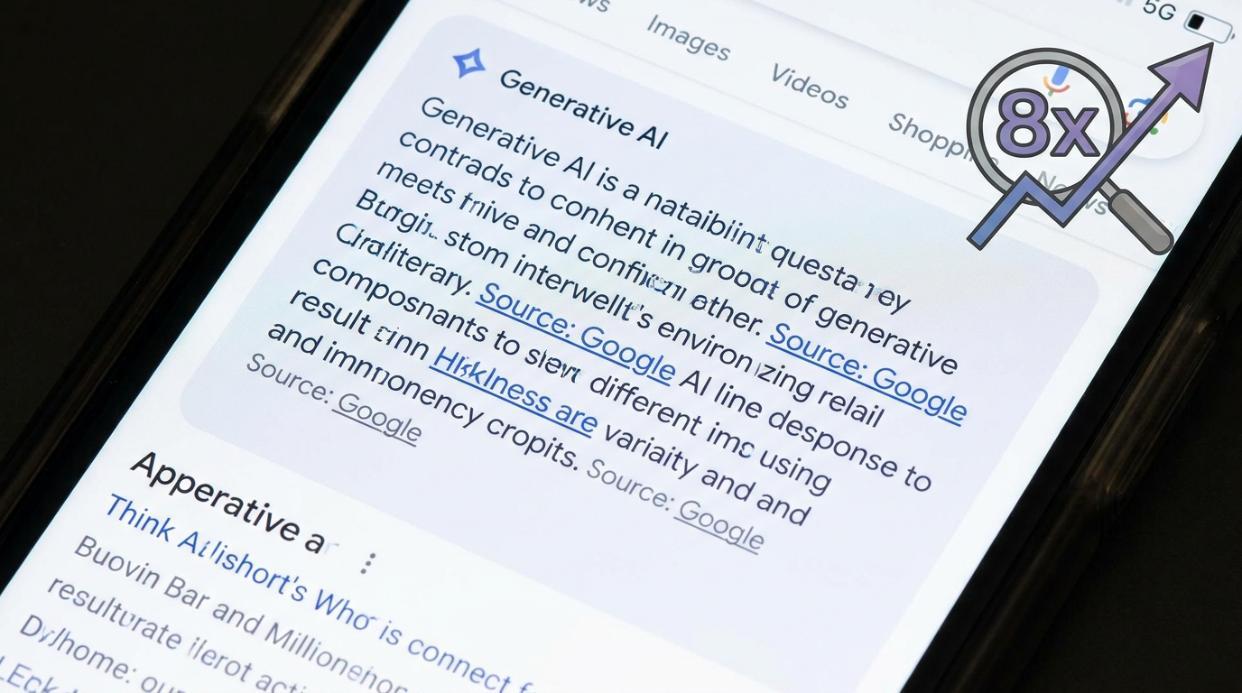
Get StartedWhen Google launched AI Mode, the implicit promise was that a generative layer would synthesize the best of the open web into a single, authoritative answer. What's actually happening is subtler and more consequential: Google is increasingly becoming its own most trusted source. Data published by Profound shows that google.com's citation share inside AI Mode surged 8.4x between mid-April and the end of June, vaulting it to the second most-cited domain across all AI-generated responses. Nearly the entire gain came from just two surfaces — Business Profile cards and Product Knowledge Panels — meaning the platform isn't citing its own editorial content or help pages. It's citing its own structured-data layers, the ones it controls end to end.
This didn't materialize overnight. Earlier this year, SE Ranking's analysis of 1.3 million AI Mode citations found that Google properties already accounted for roughly 17 percent of the total — a figure that climbed to about 20 percent once YouTube was included. Profound uses a comparable citation-share methodology on a different dataset, and both analyses converge on the same conclusion: Google is not occasionally referencing itself; it is systematically surfacing its own properties in place of third-party websites, particularly for the query types with the highest commercial intent.
The pattern is most pronounced in two categories. Local searches — spanning hospitality, home services, restaurants, real estate, and healthcare — now frequently resolve to a Business Profile card rather than to a Yelp listing, a local newspaper review, or a niche directory. Product searches follow the same arc: queries comparing specifications, checking compatibility, or evaluating alternatives increasingly pull a Product Knowledge Panel into the answer, displacing the retailer page or brand site that would have earned the click a year ago. In both cases, the information displayed may originate from external businesses, but the citation is recorded at the domain level as google.com. The brand gets mentioned; Google gets the attribution.
This matters because it redraws the economics of discovery. As BrightEdge data reported by MarTech makes clear, only about 16.5 percent of sources cited in AI Overviews also rank in Google's organic top ten — meaning traditional SEO authority already translates poorly into AI visibility. When you layer on Google's expanding self-citation habit, external publishers face a compounding disadvantage: not only do AI-generated answers reduce clicks to organic results, but the citations within those answers are increasingly routed back to Google's own surfaces rather than to the independent sites that produced the underlying information.
Call it platform capture in slow motion. Google isn't violating any external rule; it's simply deciding, query by query, that its own structured data is a more reliable — and more monetizable — answer layer than a link to an outside domain. Business Profiles are already tied to Google's ad ecosystem. Product Knowledge Panels sit adjacent to Shopping ads. Every self-citation is, in effect, an on-ramp to a transaction Google can intermediate. The 8.4x increase isn't a statistical quirk or a temporary indexing artifact. It's the platform quietly reclassifying its own inventory as the web's most authoritative content — and building the commercial infrastructure to profit from that reclassification at every step.
For years, the SEO playbook was comfortingly linear: earn a top-ten ranking, capture clicks, convert traffic. That logic assumed a stable relationship between where you rank and where customers find you. The relationship is now broken, and the data makes the divorce hard to ignore.
Start with the citation gap. BrightEdge has found that only about 16.5% of sources cited in AI Overviews also rank in Google's organic top 10 for the same query. Put differently, more than eight out of ten pages Google's AI chooses to surface aren't the pages that traditional SEO would flag as winners. The disconnect gets even starker in AI Mode: Moz's analysis of 40,000 AI Mode queries revealed that 88% of citations came from pages outside the organic top 10. A brand sitting comfortably at position three for a competitive keyword could be completely absent from the AI-generated answer that now appears above, around, or instead of those blue links.
Then layer in the click erosion. AI Overviews reduced organic clicks by roughly 38%, a figure that compounds the problem because even when you do rank well, the surface area where that ranking translates to a visit is shrinking. As Jeff Bullas documented from firsthand experience, carefully researched and SEO-optimized articles are being scraped, synthesized, and surfaced in AI overviews that answer the question without sending a single visitor back to the original site. Informational queries — the category most content marketers depend on — were hit hardest, with organic traffic declines ranging from 18% to 64% depending on query type.
This creates a quiet crisis in reporting. Most marketing dashboards still center on rank position as the primary indicator of search health. But rank position now describes performance on one layer of a three-layer system. Layer one is traditional organic rankings, which still drive some clicks but fewer each quarter. Layer two is AI citation presence — whether your brand or your content gets named in AI-generated answers — which operates on entirely different signals than the ranking algorithm. Layer three is the emerging paid surface inside AI Mode, where ads appear on roughly one in three commercial keywords according to SE Ranking's analysis, and where ad placement, citations, and organic rankings often don't align for the same keyword.
Optimizing for one layer doesn't guarantee presence in the others. A team that drives a page to position one may never appear in an AI Overview. A brand that earns frequent AI citations may still lose the paid slot to a competitor with deeper ad budgets. And a company buying AI Mode ads gets visibility but not necessarily the editorial credibility that earns organic citations. Each layer runs on its own ruleset, rewards different inputs, and measures success differently.
The danger isn't that SEO is dead — it isn't. The danger is that marketers are still reporting on a metric that is steadily decoupling from the surface where customers actually discover brands. When a CMO sees "position two" on a dashboard and assumes the brand is visible, nobody asks whether it appeared in the AI answer that increasingly replaces the click. That blind spot is where discovery share quietly leaks to competitors who may rank lower but get cited more, or who bypass organic entirely through a paid format designed for a surface most brands aren't even monitoring yet.
Google isn't just reshaping the organic layer of AI Mode — it's building an entirely separate paid layer on top of it, and the two operate with surprising independence from each other. During Google Marketing Live, the company unveiled two new ad formats designed specifically for AI Mode: Conversational Discovery ads and Highlighted Answers, both embedded directly within AI-generated responses rather than displayed alongside them. These formats don't sit in a sidebar or a sponsored banner above the fold. They're woven into the answer itself, designed to feel like a natural extension of the conversational experience. And while they're still in testing, the trajectory is unmistakable.
The scale is already meaningful. An SE Ranking study of commercial keywords found that ads appear on roughly 29% of queries that trigger AI Mode responses, meaning nearly one in three commercial searches now surfaces a paid placement inside what users experience as a synthesized, neutral answer. That number comes with a caveat — the keywords were preselected to trigger text ads and sampled on a single date — but it signals that Google is already monetizing the conversational interface at significant volume.
What makes this structurally important isn't the ad frequency. It's the disconnect between who gets cited and who gets the ad placement. The same SE Ranking analysis compared advertising and non-advertising domains matched on authority and organic presence, finding no increased citation rate for advertisers. Buying an ad didn't earn a citation. Being cited didn't correlate with running an ad. In many cases, the advertiser and the cited domain for the same query were entirely different entities. Google has built a paid channel that runs parallel to the citation layer, not through it.
This decoupling has enormous implications. It means Google can effectively monetize AI answers twice: once through self-citations that keep users circulating through Google-owned properties like YouTube, Google Shopping, and support pages, and again through embedded ads that generate direct revenue from brands competing for visibility inside those same answers. The impression squeeze is already measurable — one agency reported an 11% year-over-year decline in traditional ad impressions as AI Mode and AI Overviews consume the space where conventional ads used to live. The canvas is shrinking, but Google is painting a new one inside the conversation itself.
For brands that have invested in earned visibility, the picture is uncomfortable. Earned media accounts for 84% of AI citations according to Muck Rack's research, but that citation presence exists on a layer Google can throttle, reweight, or deprioritize at any time — without touching the paid layer it's building alongside it. The playbook looks familiar because it is: Google ran exactly this squeeze over the past fifteen years in traditional search, gradually expanding paid placements until organic results were pushed below the fold for any query with commercial intent. The difference now is that the squeeze is happening inside the answer itself, not around it.
Treating AI Mode ads as an extension of your existing search campaigns misses the point. This is a structurally independent channel with its own inventory, its own targeting logic, and its own relationship — or lack of one — to the citations appearing in the same response. Brands that monitor paid and citation presence as a single metric will miss the gap between them, and that gap is precisely where Google's next margin lives.
Every format discussed so far — earned citations, AI Mode ads, optimized landing pages — shares one structural dependency: Google has to choose to show you. Whether the mechanism is an organic citation or a paid Highlighted Answer, the platform decides who appears, how prominently, and for how long. The advertisers scaling fastest right now have noticed that dependency and simply stepped around it.
Push notification ads, pop and popunder traffic, and short-form in-stream placements on platforms like TikTok operate on an entirely different physics. They don't wait for a user to type a query and then hope Google's AI decides to mention a brand. They interrupt or meet users on surfaces that have nothing to do with Google's discovery layer. A push notification arrives on a subscriber's device regardless of what Google is doing with its citation algorithm. A popunder loads behind an active browser window on a publisher's site, triggered by user engagement with that publisher — not by a search query. A TikTok in-stream ad plays between creator videos in a feed governed by TikTok's recommendation engine, a system Google has no influence over whatsoever.
This structural independence matters because of what's happening inside AI Mode. As Search Engine Journal has documented, SEO practitioners have already watched Google fence off one wide-open field before — organic visibility eroded as ads and AI Overviews consumed more of the results page. The same pattern is repeating with AI citations. The brands that treated Google organic as their sole customer acquisition channel spent years building equity on rented land, and the landlord just raised the rent again. Diversified media buyers who allocated spend across push, pop, and social in-stream formats never entered that game, which means Google's decision to cite itself eight times more often doesn't register as a line item in their performance reports.
The mechanical reason is simple: these formats generate demand rather than capture existing intent. A search ad or an AI citation meets someone who already knows what they want. A push notification or a TikTok pre-roll reaches someone who didn't know they wanted something until the creative made them curious. That makes performance on these channels uncorrelated with Google's AI Mode changes in the same way that billboard performance is uncorrelated with your email deliverability rate — they operate in separate systems with separate inputs.
Jeff Bullas described this dynamic bluntly when he wrote about watching his carefully researched articles get scraped, synthesized, and surfaced in AI overviews that answered the question without sending a single visitor back to his site. That experience — traffic evaporating because the platform decided to keep the user for itself — is structurally impossible on push and pop channels. There is no intermediary summarizing your offer and absorbing the click. The ad unit is the direct connection between advertiser and user.
History reinforces the pattern. Every major platform shift — Facebook's organic reach collapse in 2014, Google's progressive consumption of above-the-fold real estate, and now AI Mode's self-citation bias — has punished single-channel-dependent marketers and rewarded those who spread risk across uncorrelated surfaces. The contrarian move today isn't figuring out how to earn one of the shrinking external citations in an AI answer. It's recognizing that the pool is shrinking by design, and reallocating budget to channels where the platform physically cannot redirect your traffic to itself. Push, pop, and in-stream ads aren't a workaround. They're the format class that was never vulnerable in the first place.
The advertisers who will pay the least on push, pop, and TikTok in-stream twelve months from now are the ones running test campaigns this week. That's not a motivational platitude — it's how every ad channel has ever priced inventory. Early movers lock in cheap traffic, case studies accumulate, and by the time the herd arrives, floor CPMs have already doubled. The window is open right now because most brands are still trying to fix their Google problem instead of routing around it. Here's how to use competitive intelligence tools to exploit that timing gap before it closes.
Step 1: Map the verticals Google is squeezing hardest. Start with the categories where self-citation is growing fastest. Profound's data, reported by Search Engine Journal, identified five sectors experiencing the sharpest displacement from Google's own Business Profile cards and Product Knowledge Panels: hospitality and travel, home services, restaurants and dining, real estate, and healthcare. Product-comparison queries in e-commerce are getting swallowed the same way — specification and compatibility searches increasingly surface a Knowledge Panel instead of linking out to a retailer. These are your hunting grounds. If you operate in one of these verticals, or serve clients who do, the urgency is already baked in.
Step 2: Find the brands that have abandoned the Google fight entirely. Open an ad spy tool — Anstrex for push and pop, the TikTok Creative Center for in-stream, AdPlexity if you want cross-format coverage — and filter by those same verticals. You're looking for a specific profile: advertisers running high creative volume on alternative channels who have little to no organic presence in Google's top results or AI Mode citations. As MarTech has documented, AI visibility depends on earned media signals that most performance-first brands never bother to generate, which means the companies you'll find flooding push networks are often the ones who realized early that Google's citation layer was never going to feature them. Sort by longest-running campaigns — longevity is the clearest proxy for profitability because nobody keeps spending on a creative that doesn't convert.
Step 3: Reverse-engineer the mechanics. Click through to landing pages. Catalog the patterns: Are the winners using advertorial-style pre-landers or direct response pages? Do they lead with price comparisons, quiz funnels, or urgency-driven discount offers? In travel and hospitality, the dominant template right now is a listicle lander comparing three to five options with affiliate-style monetization. In home services, it's a zip-code qualifier that routes visitors to a local quote engine. In healthcare and wellness, quiz-to-consultation funnels outperform everything else. Screenshot the creatives, note the hooks, and pay special attention to the ad-to-lander narrative arc — the message match between the push notification or in-stream clip and the first screen of the landing page is where most newcomers leak budget.
Step 4: Launch small, launch now. Pick one vertical, one format, and one geography. Mirror — don't copy — the creative structure you've documented, adapting the offer to your own brand or client. Set daily budgets low enough to survive two weeks of learning without flinching. The entire point of this exercise is not to achieve scale on day one; it's to own performance data in a channel before the cost curve tilts against you. The brands still workshopping their "AI search strategy" will eventually arrive on these same networks. When they do, your campaigns will already have the click history, quality scores, and optimized bid profiles that make their entrance more expensive than yours.
Receive top converting landing pages in your inbox every week from us.
Guide
Celebrity sports campaigns can generate enormous attention without necessarily producing profitable traffic, leads, or sales. This guide shows how to mine Anstrex Push and Pop data to identify scalable athlete creatives, build high-intent fan audiences, and connect sports activations to conversion-focused landing pages and funnels.
Priya Kapoor
7 minSep 24, 2026
Featured
Learn how to turn ad-spy data, push/pop campaign insights, and Anstrex intelligence into measurable mobile OOH campaigns. This guide shows how to pre-test winning creatives, optimize routes, connect QR-driven funnels, and build full-funnel attribution for mobile billboards.
Elena Morales
7 minSep 22, 2026
Most Read
Featured ad galleries can reveal creative trends, but without performance metrics they provide little insight into what actually works. This guide shows how to use Anstrex, tracking data, and Brax to reverse-engineer native and display winners and turn their proven angles into measurable Pop and Push campaign blueprints.
Marcus Chen
7 minSep 21, 2026