11 minAugust 16, 2026

Our tools monitor millions of native, push, pop, and TikTok advertising campaigns.
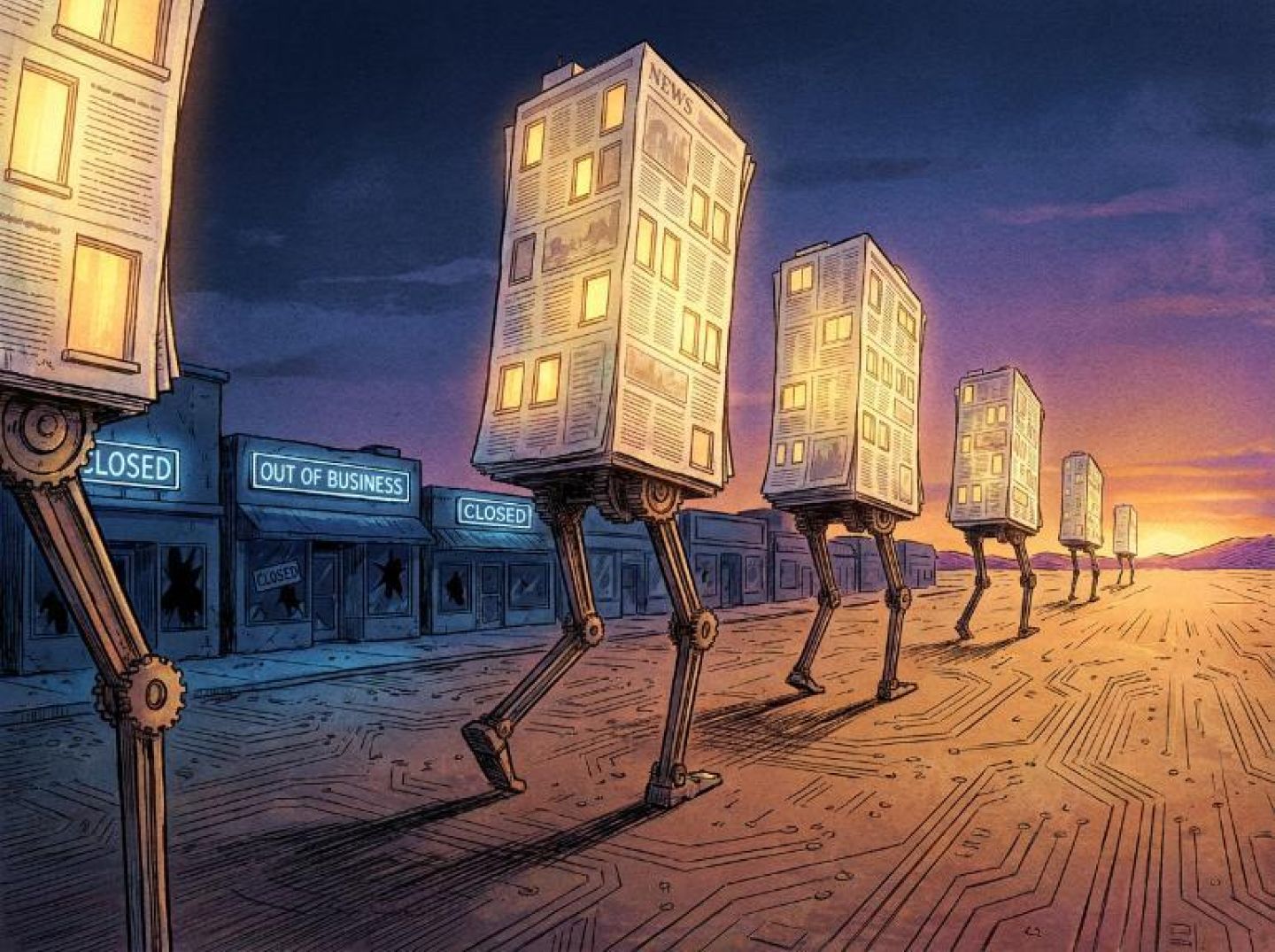
Get StartedThe number landed quietly in late July, but it should have set off alarms in every media-buying team on both sides of the Atlantic. Ozone's Q2 data revealed that publisher ad supply across the UK and US fell by 40 percent year over year — not a seasonal dip, not a measurement quirk, but a structural collapse in the volume of impressions available on the open web. For an industry that has spent the better part of a decade building programmatic strategies around abundant, cheap publisher inventory, that single data point represents a tectonic shift in the ground beneath their feet.
The mechanics behind the decline are brutally straightforward. Google's AI Overviews and the rise of conversational chatbots are intercepting search queries before users ever reach a publisher's page. The click that once carried a reader from a search result to an article — generating a page view, loading an ad call, producing a billable impression — increasingly never happens. The answer appears at the top of Google itself, and the user moves on. Advertisers running campaigns across the open web reported an 11 percent decline in impressions year over year, a figure that understates the damage for publishers who depend heavily on search referral traffic.
No company illustrates the pain more clearly than Reach, the UK media group behind the Mirror, the Express, and dozens of regional titles. In its half-year earnings update, Reach reported that overall revenues declined by nine percent year over year in the first half of 2026, with digital revenues — the growth engine the company had spent years cultivating — down by 11 percent. Platform page views, the core metric underpinning its display advertising business, cratered by 40 percent. CEO Piers North did not sugarcoat the outlook, telling investors the company is now working on the assumption that Google traffic is "unlikely to recover" and that Reach is moving "further away from a reliance on referral traffic." When the chief executive of one of a country's largest digital publishers describes search traffic as a permanently depleted resource, that is not a warning — it is a post-mortem.
What makes this moment particularly dangerous for media buyers is that the contraction is happening on both sides of the marketplace simultaneously. On the demand side, Google's AI features are absorbing the clicks that once fed publisher traffic. On the supply side, publishers are responding rationally: delisting from exchanges, shifting to paid subscriptions, licensing content directly to AI platforms, and pouring resources into off-platform channels like YouTube and social video. As Forbes Chief Innovation Officer Nina Gould put it, "Publishers aren't just selling impressions anymore — they're selling visibility within the AI knowledge ecosystem." The open-web ad marketplace is being squeezed from both ends, and the inventory pool that programmatic buyers treat as a given is evaporating in real time.
Yet walk into most agency planning meetings today and you will find media plans built on 2023 assumptions: plentiful reach across premium publisher sites, predictable CPMs, and a long tail of inventory to mop up performance goals. Those plans are already outdated. The 40 percent supply drop is not a trend line that will self-correct once Google tweaks an algorithm. It is the new structural reality of the open web — and the buyers who fail to recognize it are allocating budget into a market that is shrinking faster than their spreadsheets can update.
The chain reaction is mechanically elegant and brutally simple. When a user asks Google a question and receives a fully synthesized answer inside an AI Overview or AI Mode, the incentive to click through to the source website evaporates. Fewer clicks mean fewer publisher page views. Fewer page views mean fewer available ad impressions across the Google Display Network and the broader programmatic ecosystem. And fewer impressions mean the entire supply chain that funds independent journalism, niche expertise, and long-tail content production is being quietly starved of oxygen — by the very company that built it.
The data confirms what many media buyers have sensed anecdotally. Advertisers tracked an 11% year-over-year decline in impressions across Google's ad surfaces in 2026, a contraction driven directly by AI products consuming the real estate where ads used to live. But the raw impression count only tells part of the story. The deeper structural shift is what retail media strategist Roger Dunn calls the "shortlist economy" — the phenomenon where AI assistants surface three to five recommendations and compress the entire consideration set into a handful of options. If a brand, publisher, or product doesn't make that algorithmically curated shortlist, it functionally ceases to exist. The long tail of discovery that once made search advertising so powerful for niche players and mid-market brands is being amputated.
This creates a paradox that should keep Google's leadership awake at night. AI Overviews and AI Mode are the company's flagship growth engine, the products Sundar Pichai spotlights in every earnings call. But they systematically destroy the third-party publisher ecosystem that generates the Network ad inventory Google also sells. The company is cannibalizing its own advertising supply chain — consuming the content that publishers create, delivering it directly to users without a click, and then wondering why those same publishers have fewer page views to monetize.
The problem extends beyond traffic. Google's own infrastructure economics are accelerating the squeeze. As Search Engine Journal has explained, Google uses resource allocation models to determine how aggressively it crawls and indexes any given site. When AI-generated answers satisfy user demand directly, the perceived demand for the underlying source pages drops. Google's systems respond by throttling crawl budgets, meaning even sites that produce high-quality content at scale find their pages indexed more slowly or not at all. The justification is coldly rational: why would Google spend precious data center resources crawling and rendering pages that its own AI has already rendered unnecessary?
Google's response so far has been to offer transparency rather than remedy. In June, the company introduced its first generative AI performance reports inside Search Console, allowing publishers to see how often their sites appear in AI Mode and AI Overview results, broken out by impressions, pages, countries, devices, and dates. The reports are technically useful — they give publishers a clearer picture of their visibility on AI surfaces. But visibility without clicks is a hollow metric when your business model depends on monetizing the traffic that follows. The new analytics dashboard doesn't solve the fundamental problem; it simply offers publishers a more detailed view of their own decline. It is less a lifeline than a confirmation that the old model — publish, rank, earn traffic, sell ads — is over, and Google itself has ended it.
For the first time in the history of digital advertising, opting out of Google Search is no longer commercial suicide — it's a rational business decision. And some of the largest publishers in the English-speaking world are doing the math and reaching exactly that conclusion.
The most striking case study is USA Today Inc. The company, which operates not just its flagship title but a sprawling nationwide network of local news sites, is prepared to delist from Google entirely. CEO Mike Reed has been public about the economic calculus: the company has already struck licensing agreements with Meta, Microsoft, and Amazon, monetizing its content through direct deals rather than depending on the increasingly unreliable drip of search referral traffic. The network has hit its target of one billion pageviews every month for three consecutive years — not because of Google, but in spite of it, by building audiences through newsletters, social media, and events. The licensing revenue model offers something search traffic never could: predictable income with contractual protections.
What makes Google's position uniquely precarious is a self-inflicted wound. As Adweek reported, Google — unlike every other hyperscaler or pure-play AI company — has refused to strike licensing deals with publishers. Microsoft pays. Meta pays. Amazon pays. OpenAI and Anthropic pay. Google, the company whose AI Overviews depend most heavily on publisher content, offers nothing. That asymmetry has transformed what was once a hypothetical negotiating posture into an active exodus strategy. Publishers who might have tolerated diminished search traffic in exchange for remaining discoverable are now staring at a platform that simultaneously cannibalizes their content and refuses to compensate them for it.
Across the Atlantic, the UK's Reach — owner of the Mirror, Express, and dozens of regional titles — is executing a version of the same playbook at speed. CEO Piers North told investors the company is operating on the assumption that Google traffic is "unlikely to recover" and has restructured the business accordingly. The pivot encompasses original content, paid subscriptions, quality video, social engagement, off-platform distribution on YouTube and Facebook, and emerging AI licensing deals. The results are already visible in the numbers: off-platform revenues grew over 90 percent even as platform page views cratered by 40 percent year over year. Reach is not mourning the loss of Google traffic — it is actively building a business model designed to survive without it.
This is the shift that should alarm every media buyer still running programmatic campaigns against open-web display inventory as though nothing has changed. Publishers are not simply losing traffic to AI Overviews and waiting for it to come back. They are relocating their content, their audiences, and their monetization strategies behind walls that programmatic buyers cannot easily reach — walled-garden platforms, direct licensing agreements, newsletter ecosystems, and subscription gates. Every publisher that follows USA Today Inc. and Reach down this path removes another slice of the addressable inventory pool that display and programmatic buyers have relied on for two decades.
The implications compound quickly. As premium publishers withdraw their best content from the open web, the inventory that remains skews toward lower-quality, made-for-advertising sites — precisely the kind of supply that brand-safety tools flag and sophisticated buyers avoid. Media buyers who continue bidding on open-web display without accounting for this structural contraction are not just overpaying for diminishing supply. They are bidding on a resource that is actively disappearing underneath them.
The paradox at the heart of AI search isn't adoption — it's belief. A Botify/Ipsos study surfaced a striking disconnect: only 28 percent of Americans say they trust AI-generated search results, and a near-majority — 49 percent — say nothing would change their mind. That's not skepticism waiting to be overcome with better citations or more polished summaries. That's a structural trust deficit baked into how nearly half the population relates to the technology reshaping their information environment.
And yet, the same population is using it. A December 2025 Semrush survey found that 43 percent of shoppers have discovered a new brand through AI, and 47 percent say they notice AI-mentioned brands often or very often. Meanwhile, on the infrastructure side, Microsoft's data shows automated traffic growing roughly eight times faster than human traffic, as agentic systems — the "do it for me" layer — increasingly handle queries that used to generate human clicks. The machines trust AI search just fine. The humans, not so much.
This mismatch produces a bifurcated discovery market. AI surfaces are dominating the top of the funnel: they generate shortlists, surface brands, and shape consideration sets before users ever reach a traditional results page. But because trust is low, users don't stop there. They bounce. They seek verification — on publisher sites, in forums, through social feeds, from newsletters. The AI answer becomes a hypothesis; the verification source becomes the conviction point.
Here's where the economics turn cruel. The very publishers that serve as verification destinations are the ones losing traffic, revenue, and ad inventory to the AI layer that creates the need for verification in the first place. As Reach CEO Piers North told investors, his company is now operating on the assumption that Google traffic is "unlikely to recover," with platform page views down 40 percent year over year. The publisher is pivoting to off-platform distribution, video, and licensing deals — strategies that keep the editorial lights on but steadily reduce the display ad inventory that media buyers once relied upon. When the Ozone alliance reported a 40 percent year-over-year decline in ad supply across UK and US publishers in Q2, it confirmed what the trust data already implied: the verification layer is hollowing out even as user demand for it persists.
This fragmentation is precisely what makes alternative ad channels — native placements, push notifications, pop inventory — more than niche fallbacks. They become structurally necessary. In these environments, intent is expressed through action: a click, a subscription opt-in, a deliberate engagement with content. There is no AI intermediary deciding whether a page view happens. There is no shortlist algorithm compressing an entire category into five options before the user even sees an ad. The signal is first-party and behavioral, not inferred by a model that half the population doesn't trust anyway.
For media buyers, the trust gap reframes the strategic question. It's no longer simply about where impressions are cheapest or most plentiful. It's about where user conviction actually forms — and whether ad infrastructure still exists in that environment to capture it. Increasingly, the answer points away from the AI-intermediated search layer and toward the fragmented but action-rich channels where human skepticism, paradoxically, makes every verified click more valuable.
The irony of Google's AI boom is that it's making the "unsexy" ad channels — native, push, pop, direct-to-publisher buys — strategically essential. These formats don't depend on Google's crawl budget, aren't subject to AI Overview cannibalization, and aren't losing inventory because a publisher decided to delist from search. They operate entirely outside the AI-disrupted search-to-publisher pipeline that has dominated digital advertising for two decades. And as that pipeline contracts, the budget has to go somewhere.
The pressure is coming from both ends simultaneously. On the supply side, the open web is losing ad inventory at an alarming rate — Reach, one of the UK's largest publishers, reported that platform page views declined by 40 percent year over year even as it pivoted toward off-platform distribution and licensing deals. When a publisher of that scale loses nearly half its traditional page views, it's not just a traffic story — it's millions of programmatic ad impressions evaporating from the open auction. Multiply that across every publisher absorbing similar declines, and the math for display-heavy media buyers gets brutal fast: less inventory, higher CPMs, worse placements, all for audiences that are increasingly fragmented across AI interfaces the buyer can't control.
On the demand side, the emerging AI-native ad surfaces aren't offering the transparency that performance marketers require. As Ben Kahan, head of programmatic at Brainlabs, described it when discussing his agency's ChatGPT ad buys through Criteo, the spend still feels like "putting money into a black box" — and as AdExchanger reported, he lacks control over volume or saturation until a campaign ends. Google's own AI Mode surfaces are similarly opaque; Performance Max campaigns now feed ads into AI Mode automatically, and as Search Engine Journal has documented, it was already the most opaque campaign type Google offers. The result is a strange new reality where the world's largest ad platforms are asking for more budget while offering less visibility into what that budget actually buys.
This is precisely why native ads, push notifications, and pop traffic are absorbing an outsized share of redirected spend. These channels have structural advantages in the current environment: they reach users directly, bypassing search entirely; they aren't vulnerable to AI intermediation; and their inventory isn't shrinking because a publisher pulled out of Google's index. But they carry their own challenge — opacity of a different kind. There's no centralized auction dashboard showing what every competitor is bidding. There's no equivalent of Google's Auction Insights report. The creative, the landing page, the offer, the angle — all of it lives in a less transparent ecosystem where information asymmetry is the default.
That asymmetry is exactly what makes competitive intelligence the new structural moat. When everyone is bidding in a transparent Google auction, intelligence is useful but not decisive; the auction itself reveals pricing signals in real time. In native and push, the buyers who know what creatives competitors are running, which landing pages are converting, and which offers are gaining traction hold a disproportionate advantage over those flying blind. The less transparent the channel, the more valuable the intelligence — and as budgets migrate toward these formats at scale, the gap between informed buyers and uninformed ones will widen into something that looks less like an edge and more like a wall. The media buyers who build that intelligence infrastructure now, while the migration is still early, are the ones who will own the economics of these channels before their competitors even arrive.
Receive top converting landing pages in your inbox every week from us.
Quick Read
Discover how OOH professionals can transition into performance marketing by applying their existing strengths in audience targeting, site selection, creative strategy, negotiation, and media measurement. This guide shows how OOH talent can use ad spy tools and performance data to turn traditional media expertise into measurable digital growth.
Priya Kapoor
7 minSep 30, 2026
Most Read
Discover why competitive intelligence is becoming a critical function in modern OOH advertising teams. This guide explores how an Ad Intelligence Strategist can turn competitor monitoring into actionable insights for creative, targeting, pricing, sales enablement, and inventory strategy.
Samantha Reed
7 minSep 29, 2026
Recently Updated
Explore what OOH hiring trends reveal about the gap between traditional billboard operations and the industry’s performance-marketing ambitions. This guide examines job boards, missing data roles, and the growing need for competitive intelligence and performance-focused tools in out-of-home advertising.
David Kim
7 minSep 28, 2026