7 minAugust 11, 2026

Our spy tools monitor millions of native ads from over 60+ countries and thousands of publishers.
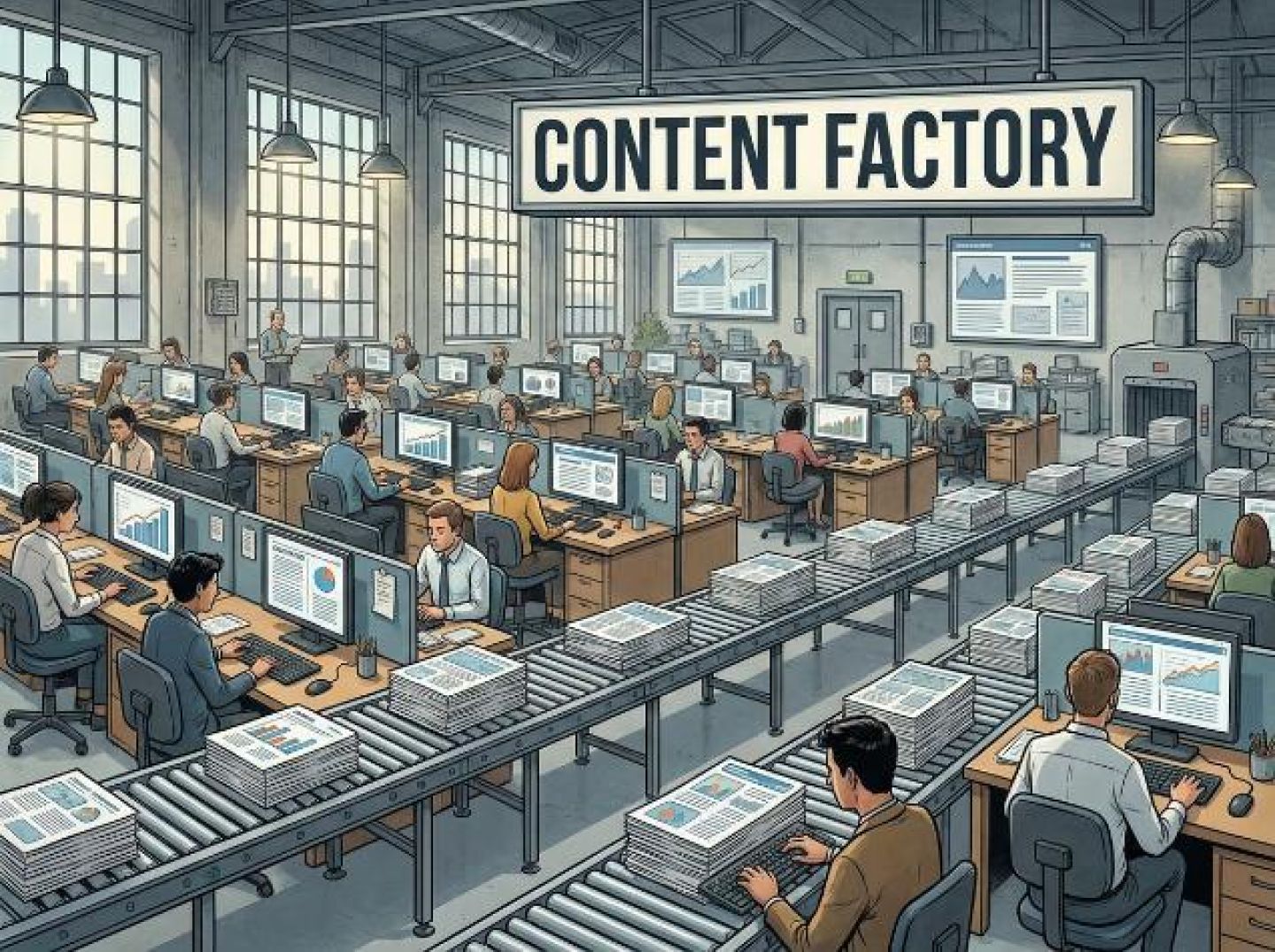
Get StartedFor years, the advertising industry's biggest bottleneck was production. Great creative ideas died on the vine because brands couldn't afford the studio time, the freelancers, or the weeks of iteration needed to turn a concept into a campaign. AI obliterated that bottleneck almost overnight. Product images that once cost thousands of dollars can now be generated for pennies. Video scripts, copy variations, platform-specific resizes — all of it can be produced at a speed and scale that would have been unthinkable three years ago. The industry is celebrating, and understandably so. But it's ignoring a second-order consequence that's already reshaping the competitive landscape: when every brand in your vertical has the same superpower, that superpower stops being super.
The numbers tell the story. U.S. businesses are expected to pour $57 billion into AI-powered advertising this year alone, roughly 12% of total ad spend. That investment is fueling what MarTech describes as continuous creative optimization loops, where AI evaluates engagement signals and automatically evolves messaging to improve performance — hundreds of variations tested and refined in days rather than quarters. The result is an arms race of volume. Every DTC brand, every mid-market SaaS company, every local service provider now has access to the same generative engines, the same template libraries, the same rapid-fire testing infrastructure. The production advantage that early adopters enjoyed has already collapsed into table stakes.
What's flooding into the ecosystem isn't just more creative — it's more similar creative. When everyone feeds the same trending hooks, the same competitor screenshots, and the same product specs into the same handful of models, the outputs converge. Feeds become a hall of mirrors. And the platforms have noticed. Meta's Andromeda update is perhaps the clearest signal that the pipes are already clogged: as Social Media Examiner reported, the update ended the once-common practice of running hundreds of slight variations of the same ad, because the platform now treats near-duplicate creatives as a single creative. In other words, the very strategy that many advertisers adopted to game algorithmic distribution — flood the zone with minor tweaks and let the machine find a winner — has been neutralized by the machine itself.
This is the creative surplus problem. Not a shortage of ads, but a glut of indistinguishable ones. The traditional logic was simple: more creative means more chances to win the auction, more surface area for the algorithm to optimize against. But when differentiation collapses, more volume just means more noise. Platforms penalize it. Audiences scroll past it. Performance flattens.
The industry's instinct is to respond with even faster production cycles, even more variations, even tighter optimization loops. But as MarTech itself argues, when execution is automated, differentiation comes from stronger inputs — clearer positioning, sharper messaging frameworks, and more distinctive brand narratives. The bottleneck hasn't disappeared; it's migrated. It moved upstream, from the production floor to the strategic layer where someone has to answer a much harder question than "can we make more ads?" The question now is: do you know which kind of ad to make in the first place? And more importantly, do you know what's actually working — not for you, but for the competitors who seem to have figured it out?
That shift — from production advantage to intelligence advantage — is where the real competitive edge lives now. And it explains why the most sophisticated advertisers have quietly stopped obsessing over their own creative output and started obsessing over everyone else's.
The data tells a story that should make every marketing leader uncomfortable. A Digiday survey of more than 100 marketers found that two-thirds use AI for data analysis and 57% for content creation — but only 32% trust it to actually buy ad placements. That's not a rounding error. It's a philosophical line in the sand: marketers have collectively decided that AI is good enough to make things but not to decide things. And that contradiction is quietly bleeding budgets dry.
Think about what this means in practice. Brands are using AI to generate product images, churn out copy variations, and resize assets for every conceivable platform. The production pipeline has never moved faster. But the strategic layer sitting above all that output — the decisions about what to produce, who to target, and where to place it — is still governed by the same mix of human intuition, historical precedent, and outright guesswork that existed before generative AI entered the picture. The result is a dangerous middle ground where speed amplifies the consequences of every bad strategic call. When you can produce a hundred ad variations in an afternoon, running in the wrong direction gets expensive fast.
This isn't just a theory. As AdExchanger reported, marketers draw a clear distinction between assistive AI and autonomous decision-making, delegating "grunt work, such as stock-style creative generation or data analysis, so long as they're subject to human approval." Without human oversight, brands worry AI could make poor media-buying decisions that hurt performance — or go entirely off the rails, leaving marketers on the hook. That fear isn't irrational, but it's producing a lopsided adoption pattern that optimizes the cheapest part of the workflow while leaving the most expensive part untouched.
Fraser Cottrell, CEO of direct-to-consumer ad creative agency Fraggell, offers a framework that directly addresses this gap. In a three-step system he outlined for Social Media Examiner, the very first step isn't generating creative at all — it's building a brand knowledge base through deep research. Before any image gets rendered or any headline gets tested, you train generative AI on who your customers are, what your brand stands for, and what a great ad actually looks like. The premise is straightforward: AI without context produces slop. AI with deeply informed context produces creative that has a strategic reason to exist.
Most advertisers skip that foundational step entirely. They jump straight to generation because generation is the part that feels productive. Spinning up fifty variations of a product shot delivers an immediate dopamine hit of output. But output without strategic grounding is just organized waste. You're filling Meta's algorithm with volume that lacks intent, and no amount of speed compensates for creative that doesn't know why it exists.
The real gap in AI adoption isn't between companies that use AI and those that don't. Nearly everyone is using it now — four in ten advertisers are testing AI creative this year, and over a third are exploring AI-driven workflows, according to an iSpot report. The gap is between those who use AI to execute faster and those who use it to think better. The first group has a content machine. The second group has a competitive advantage. And right now, the first group vastly outnumbers the second.
Consider Unilever's announcement that it would work with 300,000 creators, 71% of whom are using AI tools to generate content distributed across dozens of platforms in hundreds of markets simultaneously. That number isn't just a production story — it's an intelligence crisis. As Search Engine Journal's analysis of the model put it bluntly, at that scale "the evaluation infrastructure that used to separate good creative decisions from bad ones stops working." Human review panels can't keep pace. A/B testing individual assets across a network that large is logistically impossible. Traditional brand-tracking surveys tell you what happened last quarter, not what's resonating right now.
This is the paradox that every advertiser — not just Unilever — is starting to confront. When AI collapses the cost and time required to produce creative, the bottleneck doesn't disappear. It migrates. It moves from "Can we make this?" to "Should we make this?" And answering that second question demands something most marketing teams haven't historically invested in: systematic competitive intelligence about what's already working in the wild.
The partnership between DAIVID and ADIN.AI illustrates what this infrastructure looks like in practice. By integrating DAIVID's creative effectiveness scoring directly into ADIN.AI's media execution platform, the two companies built what they call a live loop — a system that scores creative before launch to predict what's likely to succeed, scales high-performing assets and pauses underperformers during the campaign, and then feeds historical performance data back as benchmarks for future planning. DAIVID CEO Ian Forrester described the core problem the partnership addresses: "Creative is a key driver of advertising outcomes, but for too long it has been measured in isolation, disconnected from media results." Their first live client, Ajinomoto, is already using it to surface signal from noise before budget gets allocated to the wrong places.
Now extrapolate that logic to your own operation. You don't need 300,000 creators to face the same structural challenge. If your competitors can produce and test hundreds of creative variants in the time it used to take to produce one, your advantage no longer lives in having a faster studio or a better designer. It lives in knowing which creative patterns are gaining traction in your vertical, which angles your competitors are testing, and which emotional or visual cues are driving performance right now — not last month.
This is exactly the dynamic that MarTech identified in its analysis of AI-native advertising: when execution becomes automated, speed becomes a competitive advantage only for brands that can "test and adapt hundreds of variations quickly" and "respond to cultural moments, seasonal shifts, and competitive moves far faster than those relying on traditional production cycles." The operative phrase there is competitive moves. Responding to them requires seeing them first.
That reframes what competitive intelligence tools actually represent in an AI-saturated landscape. They aren't peripheral analytics dashboards you check when quarterly planning rolls around. They're the strategic core of your ad operation — the mechanism by which you convert the raw production power of AI into creative decisions that are informed by market reality rather than internal guesswork. When everyone can make anything, the team that wins is the team that knows what to make next. And knowing that means watching, scoring, and decoding what's already performing before your competitors do the same to you.
There's a fundamental conflict of interest that marketers need to confront: the platforms selling you AI creative tools are the same platforms running those creations, grading their performance, and then shrugging when things go sideways. This isn't a hypothetical concern — it's already playing out in ways that should make every brand team deeply uncomfortable.
Consider the cases that AdExchanger documented earlier this year. Meta's AI tools generated an ad for outdoor brand REI featuring a bike with two handlebars — a product that doesn't exist and never could. In another instance, the platform created a campaign for a women's networking group that prominently featured a man. These aren't subtle missteps that only a brand manager would catch; they're the kind of errors that confuse customers and erode trust in real time. And when Business Insider pressed Meta on these AI fumbles, a spokesperson pointed to the company's terms of service, which states that "AI can make mistakes and it is the advertiser's responsibility to review the AI outputs." As one ads consultant put it, Meta is still the best platform with the best data — which is precisely why the power imbalance matters. Advertisers feel they can't leave, and Meta knows it.
This creates a peculiar dynamic. Meta is simultaneously pushing advertisers to adopt its Advantage+ creative tools — effectively encouraging brands to hand over more creative control to the platform's AI — while legally insulating itself from the consequences of that AI's mistakes. The brand eats the reputational damage. The platform keeps the ad spend.
And the quality control problem extends far beyond embarrassing creative errors. AI-generated scam ads are proliferating across social platforms at a pace that outstrips human moderation, forcing Meta itself to deploy AI-based detection systems to identify fraudulent advertisements. When the platform needs AI just to keep up with the AI-generated garbage flooding its own ecosystem, that should tell advertisers something important about the reliability of the environment they're operating in.
Meanwhile, as iSpot's research shared with Marketing Dive found, four in ten advertisers are now testing AI creative and budgets are increasingly concentrated in channels offering the highest degree of accountability. But accountability from whom? The platforms have every incentive to report that their AI tools are performing brilliantly — they make money when you spend more, and they make even more money when their AI removes the creative bottleneck that might otherwise slow your spending. They are, to borrow a sports analogy, referees who are also playing the game.
This is exactly why independent competitive intelligence becomes not just useful but essential. When you can't fully trust the platform's creative outputs, and you can't fully trust the platform's performance reporting, you need an external vantage point — a way to observe what's actually running across the landscape, identify which creative approaches are genuinely resonating, and spot the patterns that emerge when you strip away the platform's self-serving narrative. You need to see what your competitors are testing, how they're adapting, and whether the AI-generated creative that Meta's tools produce is actually winning in the market or just winning in Meta's own measurement framework. The gap between those two things is where brands get hurt, and closing that gap requires intelligence that no platform has any incentive to provide.
The dominant narrative around AI in advertising goes something like this: these tools let you make more creative, faster, for less money. It's a production story — one about speed, volume, and cost savings. And it's not wrong, exactly. As Social Media Examiner detailed in its breakdown of AI ad creative workflows, product images that once cost hundreds or thousands of dollars to produce can now be generated for a couple of cents. That's a real shift. But framing AI ad tools purely as content factories misses the far more consequential value they can deliver — especially when everyone has access to the same production acceleration.
Think about it this way. If every competitor in your vertical can generate unlimited ad variations at near-zero marginal cost, the ability to produce creative is no longer a competitive advantage. It's table stakes. The advantage shifts upstream — to knowing what to produce, why it's likely to work, and what patterns are already winning before you commit budget. This is exactly the trajectory that Search Engine Journal identified when covering the partnership between DAIVID and ADIN.AI: creative strategy must move upstream, with creative intelligence forming a live loop with media execution so that decisions about what to create are informed by real performance signals, not guesswork.
This is the reframing that matters for tools like Anstrex. When Anstrex lets you spy on competitors' native ads, push notification campaigns, and landing pages across verticals and geographies, its surface-level value proposition is surveillance — see what others are running. But its deeper value is pattern recognition. You're not just observing individual ads; you're watching the competitive landscape reveal its own winning formulas in real time. Which hooks keep recurring in financial services native ads? Which landing page structures are scaling across multiple geos simultaneously? Which push notification angles have persisted for weeks — a strong proxy for profitability — versus which ones flared and died?
That kind of intelligence is fundamentally different from generating another fifty ad variations and hoping the algorithm picks a winner. It's the difference between throwing darts blindfolded and studying where every dart in the room has already landed.
The enterprise world is beginning to understand this distinction, even if they're framing it differently. Search Engine Journal noted that enterprise brands face a specific trap: they know they want to scale content but often lack the evaluation infrastructure to separate good creative decisions from bad ones. Producing more without understanding what's working is just expensive noise. The brands spending hundreds of thousands on AI-generated creative without a system for reading competitive signals are building factories with no quality control — and no market research department.
Anstrex inverts that equation. Instead of starting with production and hoping to learn from your own results, you start with the accumulated results of thousands of advertisers across your competitive landscape. Every ad in the database is a data point. Every landing page that's been running for three months is a validated hypothesis. Every push notification campaign scaling across multiple networks is a signal about what audiences are responding to right now. You're essentially borrowing the collective R&D spend of your entire market — and using it to inform your creative strategy before you've spent your first dollar on media.
In a post-scarcity creative environment, the bottleneck was never production. It was always intelligence. The tools that win aren't the ones that help you make more — they're the ones that help you see clearly.
Receive top converting landing pages in your inbox every week from us.
Most Read
Discover how digital ad intelligence is reshaping OOH by connecting proven digital creative, audience signals, and performance data with physical media. This guide explores how ad-spy insights, mobile billboards, and intelligence layers can turn OOH into a measurable, iterative performance channel.
David Kim
7 minSep 22, 2026
Featured
AI-driven ad intelligence is changing how brands evaluate creative, shifting the focus from individual creative leaders to scalable, data-driven systems. This guide explores how competitive ad intelligence, automated testing, and large-scale advertiser data can help teams generate, evaluate, and optimize creative faster.
Samantha Reed
7 minSep 21, 2026
Quick Read
OOH is increasingly becoming a measurable performance channel, but many industry roles are still built around selling inventory rather than outcomes. This guide explores how OOH careers can evolve toward performance marketing through attribution, ad intelligence, funnel design, landing-page data, and measurable campaign optimization.
David Kim
7 minSep 20, 2026