9 minAugust 11, 2026

Our spy tools monitor millions of native ads from over 60+ countries and thousands of publishers.
Get StartedThe numbers tell a story that would have seemed absurd two years ago. U.S. businesses are expected to pour $57 billion into AI-powered advertising this year alone, representing roughly 12% of total ad spending. But the raw investment figure obscures the more disruptive truth underneath it: the cost of producing a single ad has collapsed so dramatically that spending levels no longer correlate with creative output the way they once did. A mid-market e-commerce brand with a modest budget can now flood channels with the same volume of polished variations that only well-capitalized competitors could afford eighteen months ago.
The production economics have fundamentally inverted. Product images that once required studio shoots costing hundreds or thousands of dollars can now be generated for a couple of cents, and the quality gap that used to separate AI output from professional photography has effectively vanished for static-image ads. On the copy side, the shift is equally stark — leading media buyers report that AI now writes about 90% of their ad copy, with human teams stepping in only to sharpen the final ten percent. What used to take a copywriter a full afternoon now takes a prompt and a few minutes of editorial polish.
This isn't a marginal efficiency gain. It's a structural shift in what creative output signals to the market. For years, the quality and quantity of a competitor's advertising served as a reliable proxy for their seriousness, their budget, and their strategic intent. If a rival suddenly showed up with dozens of beautifully shot product images across Instagram, Facebook, and programmatic display, you could reasonably infer they'd made a significant investment and were preparing to compete aggressively. That inference is now worthless. When generative AI lets any brand deploy continuous creative optimization loops — systems where AI evaluates engagement signals and automatically evolves messaging to improve performance — the gap between a well-funded team and a scrappy two-person operation narrows to almost nothing on the surface.
The platforms themselves are accelerating this convergence. Meta's Andromeda update, for instance, changed the game by treating hundreds of slight variations of the same ad as a single creative, which means advertisers now need genuinely different ad variations rather than cosmetic tweaks. That's a demand that only AI-scale production can realistically meet — and every serious advertiser knows it.
So here's the paradox that defines the landscape in 2026: everyone has access to the same generative superpowers, everyone is producing at roughly the same velocity, and the old competitive signals have been scrambled beyond recognition. You can no longer glance at a competitor's ad library and draw meaningful conclusions about their strategy from production quality or volume alone. The brands winning aren't the ones producing the most creative — they're the ones who have figured out which creative actually works and why. And that distinction, as we'll see, requires an entirely different set of capabilities than the ones that got most marketing teams here.
There's a seductive logic to the AI creative explosion: if producing ads is now cheaper and faster, why not test two hundred variations a week and let the algorithm sort out the winners? It sounds like a data-driven strategy. In practice, it's often just expensive noise dressed up as experimentation.
Nick Shackelford, one of the most respected performance media buyers in the direct-to-consumer space, put it bluntly in a conversation with Social Media Examiner: "AI amplifies you. If your ideas are weak, AI just helps you produce more weak material faster." That single observation should be taped to the monitor of every marketer who equates creative velocity with creative intelligence. The bottleneck was never production speed. It was always the quality of the underlying insight — the positioning, the hook, the emotional specificity that makes a stranger stop scrolling. AI can clone a mediocre concept into fifty formats in an afternoon, but it cannot rescue a mediocre concept from being mediocre.
Meta's own infrastructure now reinforces this reality. The Andromeda ranking update, which governs how ads compete within Meta's auction system, has gotten far better at recognizing when an advertiser is flooding the platform with hundreds of slight variations of the same creative. Rather than treating each version as a genuinely distinct entry in the auction, Andromeda collapses them into what is effectively a single creative signal. The result is that advertisers who mistake cosmetic variety — swapping a headline word here, shifting a color gradient there — for genuine differentiation end up cannibalizing their own delivery. They aren't buying more chances to learn; they're diluting the learning signal across near-identical assets that the system already considers redundant.
This has downstream consequences that extend well beyond any single advertiser's account. When brands flood Meta's Ad Library, TikTok's Creative Center, or any other transparency tool with throwaway variations that were dead on arrival, they pollute the competitive intelligence landscape for everyone. Performance marketers who rely on ad libraries for research are now sifting through mountains of creative clutter — assets that ran for 48 hours, gathered negligible spend, and told their creators nothing useful before being replaced by another batch of the same. As MarTech has noted, when execution is automated, differentiation must come from stronger inputs — clearer positioning, sharper messaging frameworks, and more distinctive brand narratives. Volume without those inputs is just a faster way to learn nothing.
So what filter actually works in this environment? Longevity and sustained spend. If a competitor's ad has been running continuously for six weeks with consistent placement, it almost certainly has positive unit economics behind it. That's a signal worth studying. A creative that appeared on Monday and vanished by Thursday? That's noise. The irony is that the same AI tools making it trivially easy to produce creative have made it proportionally harder to spot the creative that matters — unless you discipline yourself to ignore everything that hasn't survived the only test that counts: the market's willingness to keep paying for it.
The marketers gaining genuine intelligence from this era aren't the ones producing the most assets. They're the ones producing the fewest assets that actually need to be killed — because every brief started with a differentiated idea worth amplifying in the first place.
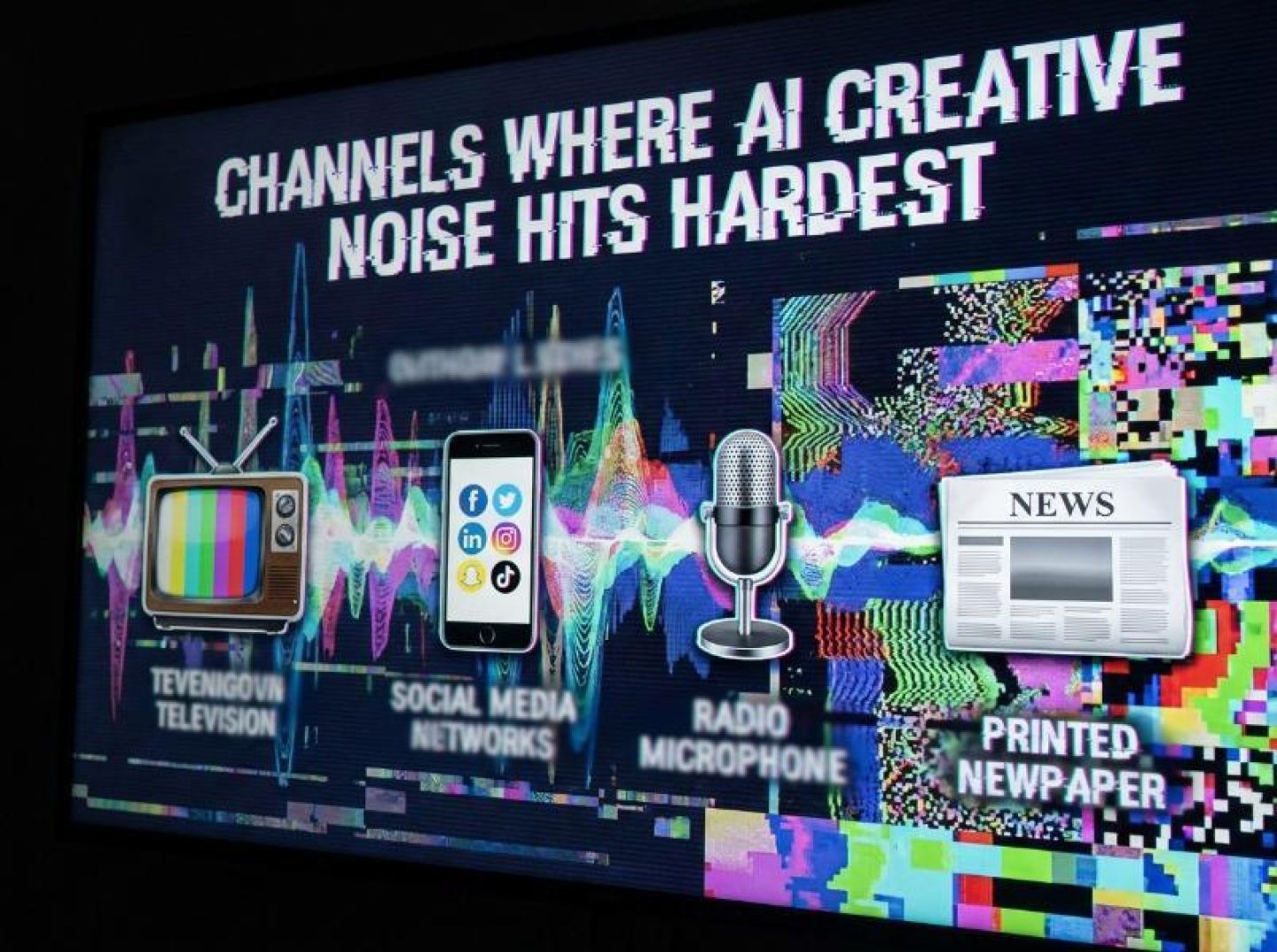
The creative flood doesn't hit every channel equally. On Meta and Google, advertisers at least operate with some degree of built-in transparency — public ad libraries, standardized reporting dashboards, and auction-level quality signals that give competitors a rough map of what's running and where. Native advertising, push notification ads, and pop/popunder channels offer no such luxury. These are environments where creative rotation is faster, platform-level transparency is nearly nonexistent, and the signals that separate a winning ad from a disposable test are visible only to the advertiser running it. As AI accelerates creative production across these channels, the fog of war doesn't just thicken — it becomes almost impenetrable without deliberate, systematic intelligence gathering.
The structural problem starts with fragmentation. As AdExchanger has documented, omnichannel campaigns now routinely span disconnected systems where planning, activation, reporting, optimization, and reconciliation happen across entirely separate platforms. Native, push, and pop traffic don't flow through a single walled garden with unified measurement. They move through a patchwork of demand-side platforms, traffic networks, and affiliate ecosystems — each with its own bidding logic, its own creative specs, and its own opaque performance data. There is no equivalent of Meta's Ad Library for Taboola widgets or push notification networks. When your competitor launches a native campaign, you don't get to browse a public repository of their creatives and see how long each one has been running.
That opacity compounds dramatically once autonomous AI enters the picture. Modern AI systems in advertising don't just automate a single bid decision — they continuously learn from campaign performance and make thousands of small adjustments in real time, evaluating millions of available impressions and determining which ones are most likely to drive results. Applied to native and push channels, this means the creative you encounter on a content widget at 9 AM may be gone by noon, replaced by an AI-evolved variant with a different headline, a different thumbnail, or an entirely reworked angle. The system isn't just rotating creatives on a schedule; it's actively killing underperformers and spawning new iterations faster than any manual competitive scan could capture.
This velocity creates a specific blind spot. On channels with built-in transparency tools, you can at least identify which creatives have been running for weeks or months — a reliable proxy for performance, since no rational advertiser keeps spending on ads that don't convert. On native, push, and pop, that longevity signal is invisible unless you're actively tracking it yourself. You can't distinguish a creative that ran for six hours and died from one that's been steadily scaling for three weeks, because the channel infrastructure doesn't surface that data to anyone but the buyer.
The strategic implication is straightforward: in these environments, competitive intelligence isn't supplementary to your workflow — it's the primary mechanism for separating signal from noise. The marketers who can systematically monitor which creatives persist over time, which angles keep getting budget behind them, and which landing pages survive weeks rather than hours hold an asymmetric advantage. They're not reacting to the creative flood; they're reading it, identifying the patterns that autonomous AI systems are converging on, and using those patterns to inform their own strategy before burning budget on guesswork. In channels where the platform won't tell you what's working, the only alternative is building the observational infrastructure yourself — or accepting that you're flying blind while your competitors' AI systems iterate at machine speed.
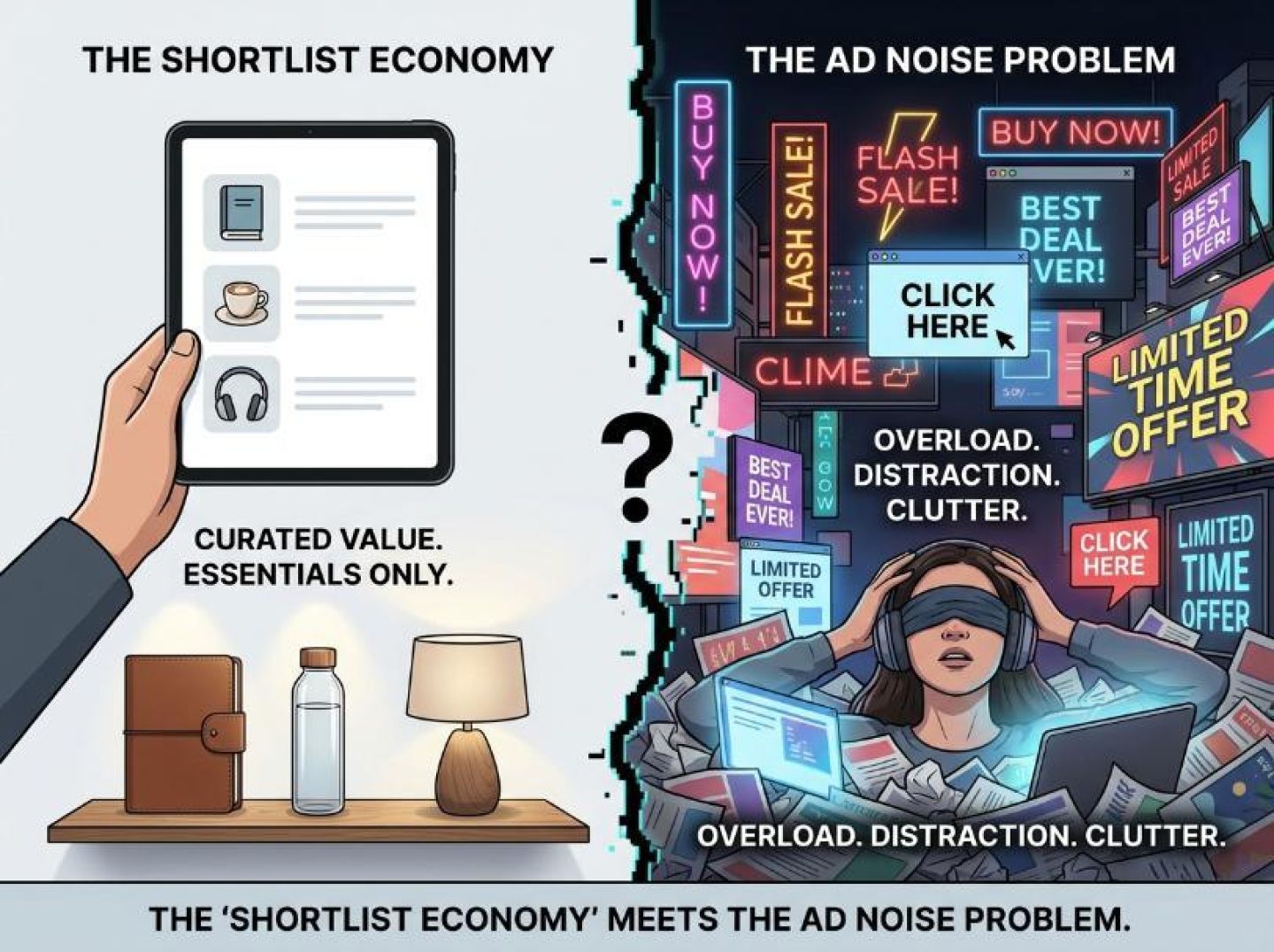
The idea of a "shortlist economy" has been gaining traction in search and AI-driven discovery, and it carries profound implications for anyone competing in paid media. As MarTech explains, when a consumer asks a conversational AI to recommend a product, "the system doesn't return a page of links. It evaluates trade-offs, highlights differentiators, and narrows choices within the conversation itself." The result is a brutally compressed field — three to five options surface, and if your brand isn't among them, "you effectively don't exist at the point of intent." This is the new gatekeeping logic of discovery: algorithms curate a tiny shortlist, and everything outside it is invisible.
Now apply that same logic to paid advertising channels — particularly native, push, and pop, where thousands of AI-generated variations flood the ecosystem every week. Not all of those ads survive. Most don't survive even a few days. Platforms enforce performance thresholds. Media buyers enforce budget discipline. Automated optimization loops cull underperformers in real time. The ads that are still running after two weeks, four weeks, eight weeks across competitive verticals are the ones that cleared every bar — click-through rates, conversion economics, audience fatigue resistance, and compliance review. They are the shortlist. They are the paid media equivalent of ranking in an AI-curated answer.
This is why the concept of "surviving ads" deserves to be treated as a discrete, high-value signal for competitive intelligence. In a landscape where AI creative tools allow brands to spin up hundreds of variations in a single afternoon, the sheer act of producing ads is no longer impressive or informative. What's informative is persistence. When a competitor's landing page lander and headline combination keeps appearing in native ad feeds month after month, that tells you something no spy tool screenshot can — it tells you the unit economics work. It tells you someone reviewed the data and decided to keep spending.
The speed of AI-powered testing only amplifies the reliability of this signal. As MarTech notes, "speed becomes a competitive advantage" because brands that can test and iterate hundreds of creative variations rapidly will surface winners faster than those relying on traditional production timelines. But the corollary is equally important: once that rapid-fire testing phase concludes, whatever remains in active rotation has been pressure-tested at a velocity and scale that would have been unimaginable three years ago. The survivors aren't lucky. They're validated.
Meanwhile, the infrastructure enabling this acceleration is growing more autonomous by the day. As illumin describes, modern AI in AdTech "continuously learns from campaign performance and makes thousands of small adjustments in real time," including real-time bid optimization, smarter auction pricing, and behavioral audience targeting. These systems don't preserve weak creative out of inertia. They kill it automatically. Every ad that remains live has, in effect, been re-approved by the algorithm thousands of times over.
For performance marketers, this reframes competitive intelligence entirely. Instead of trying to catalog every creative a competitor launches — an increasingly futile exercise given AI production volumes — the smarter move is to systematically track which ads persist. Longevity across channels becomes your proxy metric for performance. The ads that keep running are your competitor's revealed strategy, stripped of posturing and press releases. Monitoring that shortlist of survivors is, for all practical purposes, the closest thing the paid media world has to a rank tracking report — and ignoring it means flying blind while your competitors refine what already works.
The old competitive intelligence playbook was straightforward: pull your competitors' ads from a library, study their messaging, and reverse-engineer their strategy. That playbook assumed a manageable volume of creative output and a relatively stable rotation of ads. Both assumptions are now obsolete. When AI enables teams to produce dozens or hundreds of ad variations in a day — and when platforms like Meta actively reward that volume — the sheer quantity of competitor creative you'll encounter in any monitoring sweep is staggering. The question is no longer what are they running but what are they keeping.
Building a useful competitive intelligence workflow in this environment starts with a shift in focus from launches to persistence. Most competitor ads you'll see in any ad library snapshot are tests — short-lived experiments that were killed within days because they failed to clear internal performance thresholds. The ads that survive two, three, or four weeks of continuous spend are the ones that earned their place. Your monitoring cadence should reflect this reality. Rather than cataloging every new creative a competitor publishes, flag what's still running at regular intervals — weekly at minimum. The ads that persist are the signal; everything else is noise.
The second layer of the workflow involves tracking creative evolution patterns. AI doesn't just accelerate initial production; it accelerates iteration. As Neil Patel's team has outlined, the competitive advantage now lies in building systems that can run creative tests across hundreds of markets simultaneously, score the results, and route the winners forward — all at speeds that would have been unthinkable with manual processes. When your competitors are operating this way, you'll notice their surviving ads don't stay static. They evolve: headlines shift, hooks get swapped, visual treatments mutate while core concepts remain intact. Documenting that evolution tells you more about what's working than any single snapshot ever could. A competitor who keeps the same product angle but tests four different opening lines across successive weeks is telegraphing exactly where their performance bottleneck sits — and which version finally broke through.
The third component is gap analysis between what competitors launch and what they keep running. This is where you extract genuine strategic insight. If a competitor floods a channel with thirty new creatives and only three survive past the first week, those three survivors reveal the messaging and format combinations that their audience actually responds to. The twenty-seven that disappeared reveal what doesn't work — intelligence that's nearly as valuable. As illumin notes in their analysis of AI-driven campaign management, modern AI systems continuously learn from performance data and make thousands of small adjustments in real time, which means the surviving creative in a competitor's account has already been pressure-tested by sophisticated optimization algorithms. You're not just seeing what a creative director liked; you're seeing what an AI system validated with live spend data.
Practically, this means your competitive intelligence stack needs to move beyond screenshots and spreadsheets. You need timestamped tracking — when a creative first appeared, when it was last observed running, and how the creative itself changed between observations. You need a classification system that separates testing-phase ads from scaled-phase ads based on duration. And you need a feedback mechanism that connects what you learn from competitor persistence patterns to your own creative development process. The goal isn't to copy what competitors keep running. It's to understand the underlying principles — the angles, formats, and emotional triggers — that survive the Darwinian pressure of AI-optimized campaign management, and to apply those principles to creative that is distinctly your own.
Receive top converting landing pages in your inbox every week from us.
Most Read
Discover how digital ad intelligence is reshaping OOH by connecting proven digital creative, audience signals, and performance data with physical media. This guide explores how ad-spy insights, mobile billboards, and intelligence layers can turn OOH into a measurable, iterative performance channel.
David Kim
7 minSep 22, 2026
Featured
AI-driven ad intelligence is changing how brands evaluate creative, shifting the focus from individual creative leaders to scalable, data-driven systems. This guide explores how competitive ad intelligence, automated testing, and large-scale advertiser data can help teams generate, evaluate, and optimize creative faster.
Samantha Reed
7 minSep 21, 2026
Quick Read
OOH is increasingly becoming a measurable performance channel, but many industry roles are still built around selling inventory rather than outcomes. This guide explores how OOH careers can evolve toward performance marketing through attribution, ad intelligence, funnel design, landing-page data, and measurable campaign optimization.
David Kim
7 minSep 20, 2026