7 minSeptember 29, 2026

Our spy tools monitor millions of native ads from over 60+ countries and thousands of publishers.
Get StartedThe most important media buyer in your vertical might not be the person you keep seeing in spy tools. It might be a managing director you’ve never heard of — someone like Rebecca Sharon — quietly rewriting how creative, channels, and AI-driven optimization lock together behind the scenes.
Look at any aggressively scaling offer in CTV, social, or search. On the surface, you’ll see what everyone else sees: a handful of winning hooks, a few breakout UGC angles, some retargeting logic you can more or less guess. That’s what most affiliates and performance marketers obsess over: the individual ad. They rip, reword, relaunch — and then wonder why their version burns out faster, bids climb higher, and results decay.
What they’re missing is the operator.
Modern agencies are no longer just buying houses; they are, as Guerillascope’s Max Kelvin puts it, an “operating system for marketing decisions,” where technology makes media “easier to transact and much harder to understand,” and judgment about what not to buy becomes the real value driver embedded in the agency model, as he told VideoWeek. Inside that system sits a creative operator — often with a title like Managing Director, Head of Growth, or VP of Performance — who decides how your entire funnel shows up in-market: which ideas get tested, which audiences deserve real budget, which signals matter, and when AI is a scalpel versus a sledgehammer.
That role is becoming more critical as content volume explodes. Generative tools can now spin up infinite variations in seconds, but that only makes governance and consistency more fragile. As Marketing Dive notes, brand personality has shifted from a fluffy tone-of-voice exercise to a governance layer — objective criteria for evaluating creative and messaging decisions across internal teams, agencies, and AI-assisted workflows. The creative operator is the person enforcing those guardrails at speed. They’re the ones who decide which “wild” TikTok concept is actually on-brand, which AI-generated headline crosses the line, and which promising idea dies before it ever hits an impression.
This is where spying on isolated ads leads you astray. When you screenshot a winning creative, you’re capturing the output of a system you don’t see: the personality filters, the risk thresholds, the testing cadence, the mid‑funnel orchestration. Creative optimization companies are already fusing AI and human judgment to bridge this gap; Swayable’s chief growth officer Jenny Wall argues that digital teams became “so obsessed with programmatic” they forgot the creative that actually creates demand, and now use AI to test and refine that creative rather than just to transact impressions, as she explained to AdExchanger. The operators deciding which hypotheses get into that testing loop, and how results feed back into media strategy, are the ones really moving the numbers.
On the brand side, the same pattern is playing out. When Carat and Papa John’s talk about winning attention in a fragmented landscape, they emphasize frameworks that let teams respond to cultural moments within 24 hours without sacrificing authenticity, and integration models that bring creative and media closer together, as discussed in Adweek’s conversation on breaking through fragmentation. That’s operational thinking, not just “good creative.” It’s a playbook for how decisions get made — and who makes them.
For affiliates and performance marketers, this means the old competitive intelligence toolkit is rapidly going stale. Watching the ad library is table stakes. Scraping landing pages is hygiene. To stay ahead of bidding wars and creative trends, you need to start reverse‑engineering the operators: the hidden managing directors and heads of performance who define how creative, channels, measurement and AI collaborate.
Instead of asking, “What’s the ad?” you need to ask, “Who is the operator behind this, and what system are they running that lets this ad win while my copycat stalls out?” The rise of the creative operator is the quiet shift that’s already reshaping your auctions — whether you can see them or not.
Media buyers didn’t use to care who was sitting in the MD or CEO chair. Leadership changes were “HR news” — the kind of press release you scroll past on LinkedIn while you go hunting for the new winning hook in your spy tool of choice.
That’s quietly changing, for one simple reason: the way an agency is led now shows up directly in the numbers on your media dashboard.
Across the industry, there’s a growing recognition that the constraint isn’t tools or inventory; it’s people who can make hard, coherent decisions about how those tools fit together. A global survey from the World Federation of Advertisers and Mediasense, covered by More About Advertising, found that “strategic thinking” is now the number-one talent shortage in advertising. Seventy‑two percent of respondents said it’s what they’re missing most. The problem isn’t lack of data or AI; it’s leadership willing and able to choose “more of this, less of that” and live with the consequences.
For media buyers, that strategic deficit shows up as chaos:
This is what Omar Oakes describes as the “concierge model”: agencies saying yes to everything, while saying nothing definitive about where growth will really come from. It feels safe, but on the buy side it translates into mushy test plans, diluted budgets, and creative that never gets the repetitions it needs in any one channel to crack.
At the same time, AI is making the gap between good and bad leadership brutally visible. When media buying starts to tilt toward autonomous, agentic systems that can spin up hundreds of creative variants and shift budgets on their own, the value moves upstream. As MarTech notes, once execution is automated, performance is mostly a function of “stronger inputs”: sharper positioning, tighter messaging frameworks, and clearer rules of engagement for algorithms.
That is exactly where a managing director like Rebecca Sharon either makes you money or quietly taxes your ROAS:
Without that kind of leadership, “AI‑native” media buying quickly degenerates into what MarTech describes as endless execution without differentiation: more variants, same thinking. CPMs rise, learning is noisy, and everyone blames “the algo” instead of the strategy vacuum.
Contract structures are quietly pulling leadership into the center of the conversation too. Legal teams have begun to recognize that creative, media, and now generative AI are inseparable, and they’re baking that reality into scopes, approval flows, and IP clauses. In a recent review of agency agreements, All About Advertising Law highlighted how crucial it is to define scope tightly, manage “scope creep,” and clarify ownership around ideas versus executions — especially as AI gets involved. A managing director who understands those levers can negotiate room for iterative creative testing, clear change‑order processes, and data rights that actually let you train models on your own performance history.
Without that, the contract itself becomes anti‑performance: experiments get stuck in legal review, nobody’s sure who owns what data, and every cross‑channel idea risks becoming unpaid “spec work.” You feel it as slower learning cycles and mysteriously rising soft costs.
Finally, the fragmentation of attention is making leadership style a predictive metric for media outcomes. When Carat and Papa John’s talk about meeting people “in culture” and moving within 24 hours on real‑time trends, they’re really talking about operating systems imposed by leaders. In a recent Brandweek conversation, Adweek describes how Michael Law at Carat pushes for nimble, bowl‑of‑spaghetti media plans anchored by a single measurement principle and tight integration between creative and media. That doesn’t happen because an individual trader is clever; it happens because leadership has rewritten how teams, incentives, and approvals work.
Put bluntly: the MD’s philosophy now determines whether your CTV tests get live in a weekend or die in a steering committee, whether your TikTok creators get clear briefs or generic platitudes, and whether your AI agents are pointed at one coherent objective or many competing ones.
You can keep pretending that’s “HR news.” Or you can start treating agency leadership — especially the quiet creative operators like Rebecca Sharon — as part of the media buying playbook itself, a variable as material to your P&L as bid strategy, attribution windows, or LTV models.
If the last section was about why leadership suddenly matters to media buyers, this is where the “creative operator” shows you how that leadership actually shows up in the account.
At this level, strategy isn’t a keynote deck. It’s baked into how briefs are written, how bids move, and how fast a new hook can go from Slack message to spend. Managing directors like Rebecca Sharon don’t hover over every ad set; they architect a system where the right decisions become the default.
In an AI‑accelerated buying environment, execution is increasingly automated. The edge comes from the quality of what you feed the machine.
Agentic AI can now run “self‑optimizing” campaigns, reallocating budget and cycling creative at a pace no team can match, as MarTech notes in its analysis of AI‑native advertising. A creative operator uses that reality to force discipline upstream:
In practice, media buyers experience this as fewer random one‑off tests and more structured experiments: every new ad has a hypothesis, a mapped intent state, and a clear kill or scale rule.
Once you’re spinning up dozens or hundreds of variations, “does this feel on brand?” is no longer a vibe check in a creative review; it’s a governance problem.
As Marketing Dive argues, brand personality’s most important role is creating objective criteria for decisions. Creative operators operationalize that by:
This is how you run AI‑assisted content at scale without waking up to an off‑brand TikTok that technically “won on ROAS” but quietly undermined long‑term equity. Media buyers get faster approvals because leadership already translated fuzzy values into practical filters.
Modern growth offers live or die on how fast they can respond to culture. But “move fast” is useless advice unless it’s structurally possible.
In a discussion about winning attention in a fragmented landscape, Carat’s Michael Law and Papa John’s Shivram Vaideeswaran describe how their teams move on cultural moments within 24 hours by giving clear strategic principles and a single north‑star metric, not case‑by‑case micromanagement, as Adweek’s coverage explains.
Creative operators build similar systems inside agencies:
The result is that a TikTok sound or news moment can be turned into 10–20 tightly framed creative tests across channels in a day, instead of languishing in someone’s Slack DMs until it’s stale.
You can’t hard‑wire strategy into buying if your commercial terms still reward chaos.
Creative operators quietly renegotiate scopes and contracts so the behavior they want is actually billable. Guidance from ad‑agency contract experts stresses the importance of crystal‑clear scopes, approval procedures, and change‑order requirements to prevent “scope creep” and misaligned expectations, as.
Leaders like Sharon translate that into the media context:
This contract hygiene sounds dry, but it’s what protects media teams from being dragged into endless last‑minute ideas that blow up the playbook. It gives buyers the air cover to say, “That’s out of scope unless we de‑prioritize this other initiative,” which is how strategy actually survives contact with a frantic client calendar.
Industry surveys repeatedly show that strategic thinking is the number‑one talent shortage in advertising, with the pace of change outstripping agencies’ ability to develop people, as More About Advertising reports. The creative operator’s answer isn’t another “vision session.” It’s wiring strategy into the rituals of buying:
Over time, those habits create what Sharon would call “quiet courage” in a team: buyers who make sharper, braver calls because the system around them makes good strategy the path of least resistance.
In the next section, we’ll zoom back out and look at how these creative operators are reorganizing teams and roles so that media buyers, creatives, and data specialists stop operating as silos and start functioning as a single, compounding growth engine.
AI-native media buying is where the managing director stops being a figurehead and starts acting like a systems designer.
As media platforms move from “set-and-forget” rules to self-optimizing, agentic AI, the people in charge are no longer just approving budgets; they’re deciding how autonomous those systems are allowed to be, what they’re optimizing toward, and how human judgment plugs back in. In an AI-native environment, the MD becomes the person writing the constitution the machines have to live under.
You can see the outlines of this shift in how AI-driven platforms already behave. Modern buying systems don’t just raise bids when CPA drops; they continuously experiment, reallocating budget, swapping audiences, and rotating creative based on live performance data, edging toward the kind of “agentic AI” described in analysis of AI‑native advertising. That raises a fundamental leadership question: who sets the incentives for those agents, and who enforces the guardrails when they start doing things that technically work, but strategically or legally don’t?
In the old playbook, a managing director could sit comfortably at the top of a waterfall: client brief, strategy, planning, then handoff to the platform specialists. In the AI-native playbook, that distance is a liability. Leaders like Rebecca Sharon are pulled straight into the design of feedback loops: what success metrics agents are allowed to chase, which signals get priority (intent vs. pure response), when human review is mandatory, and how quickly learnings must cycle back into creative.
Those choices are no longer “ops details”; they are the strategy. When intent-based models infer what a user is trying to do in the moment, as described in coverage of AI-driven targeting, the MD is responsible for translating a brand’s positioning into decision trees and message hierarchies that can actually be executed. You can’t rewind the clock and rebuild brand equity at the bottom of the funnel when an autonomous system has been hammering discounts at anyone who twitches near your site for six months.
The creative stakes rise at the same time. As TV and CTV veterans like Jenny Wall keep pointing out, the industry’s obsession with programmatic has too often pushed creative to the sidelines, even though performance still depends on the ideas in the middle and top of the funnel, not just the mechanics at the bottom. In her view, AI tools are useful to “get to the answer faster,” but they don’t replace the need to deliberately bridge creative and performance in the way she’s now trying to do at Swayable, a role shift that mirrors what a creatively minded MD does inside a media agency, according to an interview on the evolving role of AI in CTV.
This is where the “creative operator” version of the MD emerges. Instead of treating AI as an invisible black box, they design teams, contracts, and workflows around its realities:
Underneath all of this, the MD’s real power is no longer in signing off on the annual media plan. It’s in architecting the interaction between humans and machines: deciding which parts of the system should move at machine speed, which demand human taste and ethics, and how learnings travel between them.
In other words, AI-native media buying doesn’t diminish the role of the managing director; it concentrates it. The more autonomous the buying becomes, the more every small leadership choice — about metrics, teams, contracts, and creative ownership — quietly writes the playbook your agents will follow.
Format decisions used to be a creative whim and a CPM math problem. In an AI-native account, they’re a form of governance. The managing director isn’t just asking, “What’s working?” but, “What do we want the algorithm to believe about this brand — and in which pipes are we willing to prove it?”
You can see this in how leaders quietly bias budgets across four battlegrounds: native placements, in‑stream video, creator-driven media, and the increasingly aggressive world of push and notifications.
Native is where MDs like Rebecca Sharon tend to encode the brand’s “default self.” Because native units sit inside editorial or aggregator environments, they’re the place where personality has to do more work than polish. When content volume explodes, you can’t manually bless every headline; instead, MDs lean on personality as a governance layer, turning it into a checklist for what’s allowed into the feed. As one analysis of brand personality argued, personality works best when it becomes the standard teams use to judge whether a message is truly “on character,” especially at content scale, rather than a loose guide to tone of voice that everyone interprets differently, as Marketing Dive explained. In practice, that means native spend doesn’t just chase cheap clicks; it’s constrained to formats and partners where the editorial frame won’t quietly erode that character.
In‑stream video is where the flattening forces of programmatic are most dangerous. Completion rates in a dashboard make YouTube pre‑roll, CTV, and low‑rent mobile video look strangely interchangeable. Strong MDs refuse that illusion. They push planners to differentiate not just on CPM but on context signal, asking questions like: What’s the content? How heavy is the ad load? Are we on an actual TV set or a random in‑app player? Max Kelvin warned that when you ignore those signals, “cheap inventory can become expensive waste” because you’ve treated all video as if it were premium, even when it isn’t, as VideoWeek reported. An MD who understands that quietly reweights spend toward higher-quality, harder-to-scale in‑stream, and lets algorithms hunt for efficiency elsewhere.
Then there’s creator inventory — the messy middle where culture, brand safety, and performance blur. In a fragmented attention landscape, MDs know they can’t win by paid alone. They have to meet audiences in culture, stitching together paid, organic, and creator participation into one operating plan. Leaders who’ve internalized this don’t ask, “What’s our influencer budget?” They ask, “Where in this plan are we letting humans carry the story?” That thinking echoes the way marketers are combining paid, creators, aggregator platforms, and organic to stay culturally relevant wherever people are actually engaging, as a conversation between Papa John’s and Carat leaders on Adweek made clear. Inside a performance account, that translates to deliberate creator-heavy formats on platforms like TikTok and Reels, then smart retargeting that lets AI remarket off that cultural footprint instead of treating creators as a one‑off awareness stunt.
Finally, push — from app notifications to SMS to Chrome and wallet passes — is the format where MDs most aggressively defend long-term equity. The temptation, especially in subscription and quick-commerce categories, is to let performance teams hammer push channels because the marginal cost is near-zero and the short-term numbers look beautiful. A creative operator steps in to throttle frequency, define “no‑go” tactics, and ensure that push is reserved for moments that feel like service, not spam. That governance instinct aligns with the broader legal guidance on structuring media and influencer work: the relationship breaks when one party focuses only on short-term leverage and ignores the long-term health of the collaboration, a tension framed clearly in agency agreement best practices covered by All About Advertising Law. In the same way, MDs treat push not as free GRPs but as a contract with the audience that can be breached.
Underneath all of this, the MD’s real move is subtle: she tells the algorithm where it’s allowed to explore. Native is the brand’s everyday voice. In‑stream is the premium stage, reserved for ideas that can live in high‑quality contexts. Creator is where the brand borrows cultural oxygen. Push is for the most valuable, permission-based interactions. Tilt spend incorrectly, and AI optimizes you into a brand no one meant to build. Tilt it well, and the account starts behaving like a coherent personality — no keynote required.
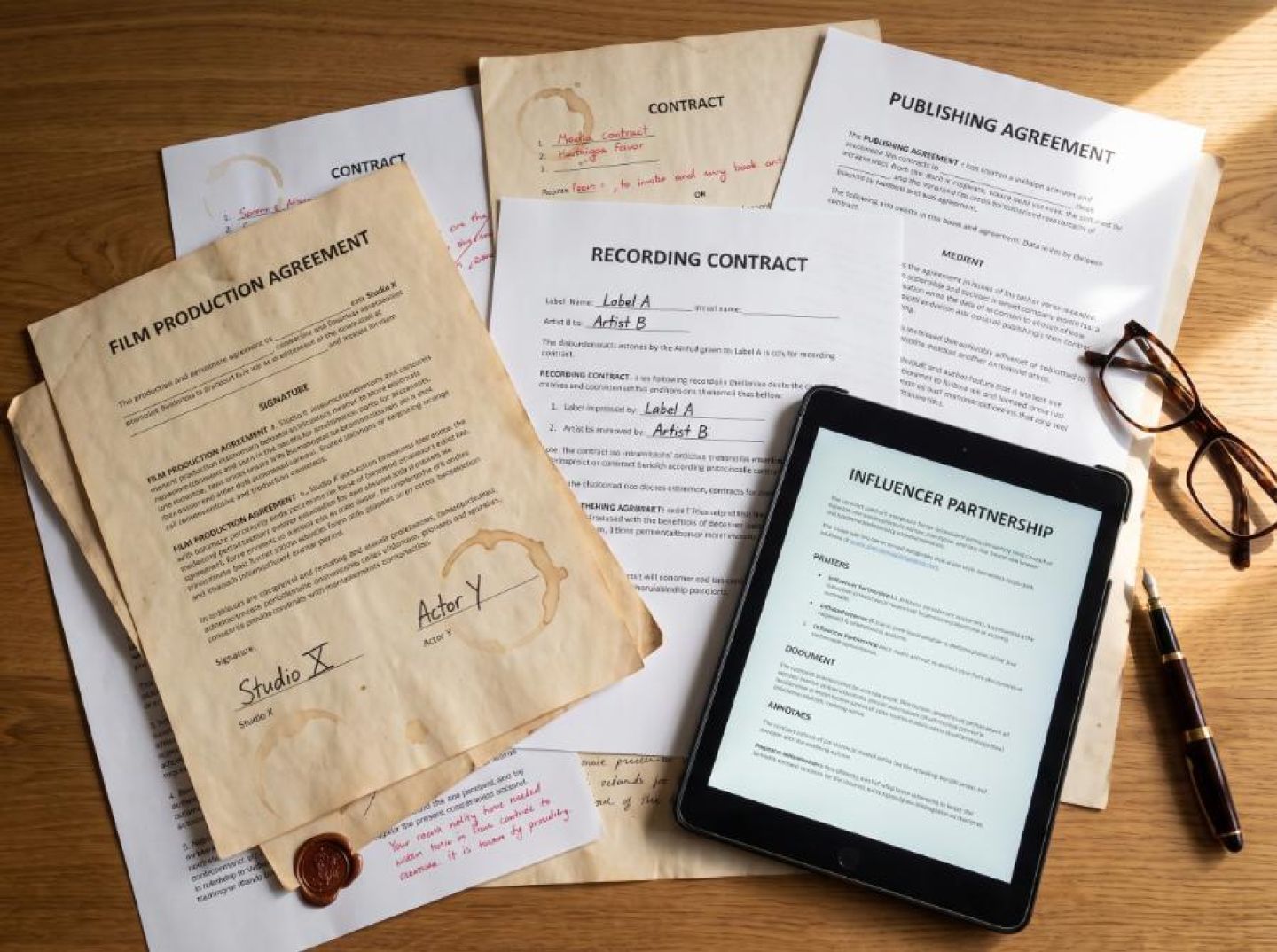
If you want to understand how a managing director really thinks about media, don’t look at the dashboard. Look at the contract.
Agency agreements are where autonomy, risk, and incentive structures get frozen into place. On the surface they’re about indemnities, payment terms, and scopes of work. In practice, they quietly encode answers to questions like: “How much freedom do we give the algorithm?”, “Who gets to touch the data?”, and “What happens when we chase performance a little too hard?”
Legal teams frame this as risk allocation, but modern creative operators treat contracts as operating systems for media behavior.
Start with scope. As Venable’s team explains, the scope of work in an agency agreement is supposed to prevent “scope creep” and surprise costs. In an AI‑native media account, that same scope line also decides whether your agency is just trafficking tags or actively designing the optimization logic: Are they allowed to build custom bidding scripts? Spin up experimentation frameworks? Plug third‑party intelligence into platform APIs? When a managing director like Rebecca Sharon fights to keep “testing design, algorithm configuration, and learning agenda” explicitly inside the SOW, she isn’t nitpicking. She’s making sure strategic levers don’t get quietly reclassified as “value‑add” and deprioritized the next time budgets tighten.
Control over data and platforms tells you even more. A contract that defines the client as “seat owner” on ad platforms, with the agency logged in as an operator, creates a very different power dynamic from one where the agency owns the accounts and pipes in “reports” to the brand. The former lets the brand’s internal measurement team apply a single north‑star metric across channels, much like the way Papa John’s and Carat describe using unified attention metrics to steer planning in their conversation on winning attention in a fragmented world, as recounted by Adweek’s coverage of their Brandweek session. The latter effectively turns the agency into a black box where platform‑level signals, brand safety settings, and placement rules are hidden behind “proprietary optimization.”
You see this most starkly in how agreements handle “hidden” terms. The rise of embedded platform conditions and evolving AI tools pushed lawyers to warn against incorporating changeable online terms by reference, recommending that relevant conditions be attached or time‑stamped instead, as All About Advertising Law’s recap of a recent agency‑contracts webinar makes clear. A cautious legal team reads that as protection from surprise liability. A sophisticated managing director reads it as protection from surprise behavior: if Meta or Google silently updates how their AI interprets audience signals or creative variations, the agency can’t shrug and say, “The terms changed, so the machine did what it did.” Contract language that pins down which version of which platform rules govern a campaign sets a baseline for diagnosing when results are genuinely strategy‑driven versus when they’re the by‑product of a newly unleashed optimization mode.
Then there is the quiet governance of brand personality. Most agreements treat “brand guidelines” as an attachment; the creative operator treats them as a control system. As Marketing Dive points out, a clearly articulated brand personality is less about tone and more about governance, giving teams objective criteria for evaluating creative and messaging at scale as their analysis of personality as a decision framework notes. When those personality guardrails are written into approval workflows, escalation paths, and even influencer briefing clauses, they become constraints on what the algorithm is allowed to explore: which topics are out of bounds, what kinds of creators are non‑negotiable no‑go’s, and how far performance‑driven copy can drift before it is deemed “off‑character” and automatically paused.
Incentives and payment terms finish the picture. Omar Oakes has argued that a lack of strategic courage leads agencies to over‑deliver on service, give away ideas, and accept brutal payment terms in a “concierge” model that avoids hard choices, as he describes in his critique of weak positioning and risk‑averse behavior in the industry on More About Advertising. The contract is where a managing director either reinforces that dynamic or breaks it. Compensation tied purely to hours and outputs nudges teams toward being polite order‑takers, quietly letting platforms’ default automations decide where the money flows. Compensation that recognizes outcome quality, experimentation velocity, and the development of reusable decision frameworks pays for something else entirely: operators who will say no to “do everything, everywhere” briefs and instead codify trade‑offs into both dashboards and deal terms.
Put all of this together, and an agency agreement stops looking like dense boilerplate and starts looking like a blueprint for how your media behaves in the wild. It defines how much discretion sits with the AI, how much with the humans, and how much with companies whose terms of service you’ve never read. Managing directors who see contracts this way aren’t just protecting their margins; they’re quietly rewriting the rules the algorithms have to play by.
Receive top converting landing pages in your inbox every week from us.
Featured
Explore how creative operators and managing directors are shaping modern media buying by connecting creative strategy, AI, channel allocation, experimentation, and governance. This guide examines how leadership decisions influence Native, In-Stream, Creator, and Push campaigns, as well as the contracts and systems that determine how media teams operate.
Dan Smith
7 minSep 29, 2026
Most Read
Learn how OOH employers can move beyond selling billboard inventory and start monetizing the full funnel impact of every outdoor impression. This guide shows how to connect OOH with Native and TikTok-style funnels using competitive intelligence, creative research, tracking, retargeting, and performance-focused roles.
Rachel Thompson
7 minSep 28, 2026
Must Read
Discover how Pure Leaf’s “Break Conference” can be deconstructed as a full-funnel strategy spanning Native, Push, and Pop advertising. This guide shows how marketers can use creator content, TikTok Instream, Anstrex, search data, and PR signals to turn a feel-good brand stunt into a measurable performance engine.
Priya Kapoor
7 minSep 27, 2026