6 minJune 11, 2026

Our spy tools monitor millions of native ads from over 60+ countries and thousands of publishers.
Get StartedEvery marketer has a Google Analytics tab open somewhere. It's the default dashboard, the quarterly reporting backbone, the tool that gets cited in every strategy meeting when someone asks, "How do we know this is working?" And for understanding what happens on your own website — which pages visitors land on, where they drop off, how long they linger before converting — it's genuinely excellent. But somewhere along the way, the industry conflated "owned-site behavioral measurement" with "competitive intelligence," and that confusion created a blind spot large enough for your competitors to drive entire campaigns through without you ever noticing.
The core issue is deceptively simple: Google Analytics tells you what happened on your site. It captures none of the creative decisions, placement strategies, or channel-level tactics that explain why a competitor's campaign is outperforming yours. It can't show you which headlines they're testing on Taboola widgets, which push notification sequences they're running, or how they're rotating landing pages to find winning combinations. As Voluum's analysis of native ads tracking makes clear, Google Analytics doesn't allow marketers to rotate campaign destinations — which means no A/B testing, a crucial aspect of native ads optimization. If you can't even split-test your own landing pages natively within GA, imagine how little visibility it gives you into a competitor who's running those tests across entirely separate ad networks.
This limitation compounds when you consider the channels where some of the most aggressive performance marketing actually happens. Native advertising — those content recommendation widgets on news sites, the sponsored posts that blend seamlessly into editorial feeds — operates in an ecosystem that lives almost entirely outside Google's tracking infrastructure. The big platforms like Facebook and Google have their own tracking ecosystems, but as Voluum notes, these are only sufficient if you don't want to dig into the numbers too deeply or conduct meaningful split testing. For marketers who treat A/B testing as the core of their optimization workflow, relying on GA alone is like trying to navigate a city with a map that only shows your own street.
Meanwhile, the competitive intelligence tools that do exist tend to cluster around search and display. Semrush's approach to Google Ads competitor analysis, for example, provides robust frameworks for monitoring keywords, ad copy, and landing pages within Google's own ecosystem. But even the most sophisticated search-focused competitive analysis misses what's happening in native and push channels — the very channels where cost-per-click tends to be lower, creative testing cycles are faster, and performance marketers are quietly scaling campaigns that never appear in a Google Auction Insights report.
This is the tracking gap. It's the space between what your analytics can measure on your own properties and what's actually driving results across the broader competitive landscape. Marketers operating solely within Google Analytics are optimizing in a closed loop: they know that a landing page converted at 3.2 percent, but they have zero visibility into the strategic moves accumulating around them. They can't see the competitor who tested forty headline variations on a native network last month, found a winner that cut their cost per acquisition in half, and is now scaling aggressively into audiences that overlap with theirs.
The danger isn't that Google Analytics is a bad tool. It's that treating it as a single source of truth creates a false sense of completeness. You end up optimizing what you can see while competitive advantage silently accumulates in the channels you can't.
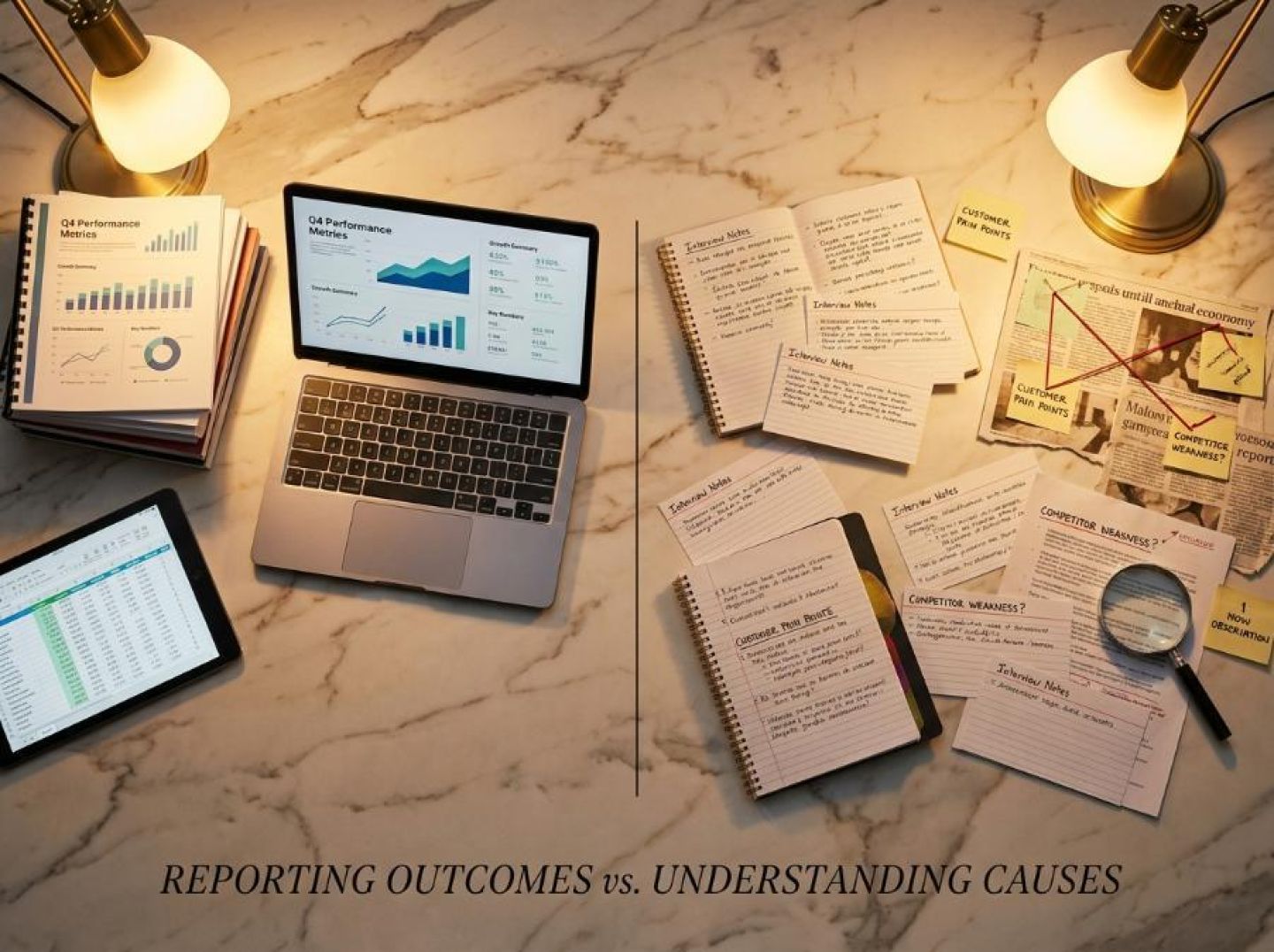
There's a distinction most marketers intuitively understand but rarely articulate clearly, and it explains why so many competitive strategies stall before they start. Think of it as the difference between "that" data and "why" data — two fundamentally different categories of insight that require fundamentally different tools to capture.
"That" data is what your analytics stack already excels at. It tells you that your last campaign earned a 3.2% click-through rate. That your landing page converted at 6.8%. That visitors from a particular source bounced after eleven seconds. This is performance measurement in its purest form — backward-looking, self-referential, and confined to the boundaries of your own campaigns. It's enormously valuable for optimization, and as Katia Hausman of LocaliQ put it, "If you're only tracking how many leads your campaign drove, you're missing the point. You need to know which of those leads actually turned into customers." Even within the "that" category, most teams aren't going deep enough. But the larger blind spot isn't depth — it's direction.
"Why" data faces outward. It answers a completely different set of questions: Why is a competitor's ad creative running unchanged for six months? Why did they shift spend from one publisher placement to another? Why are three of the top five advertisers in your vertical suddenly testing curiosity-gap headlines instead of benefit-driven ones? These signals — creative choices, headline angles, landing page structures, placement strategies, and spend patterns — explain why certain campaigns win. And no amount of pixel-firing or UTM-tagging on your own site will surface them.
The gap between these two categories is structural, not just methodological. Performance tracking tools like Google Analytics, and even more sophisticated setups involving ad tracking for monitoring return on advertising spend, are designed to collect data from your campaigns. They watch your visitors, measure your conversions, and report on your results. They are mirrors, not windows. Competitive intelligence, by contrast, requires you to observe what's happening on someone else's stage entirely — their creatives, their targeting signals, their distribution footprint across networks you may not even be buying on yet.
Industry benchmarks represent a middle ground, but they're blunter than most marketers realize. As Brax notes, comparing yourself against industry-wide averages is "essentially competitor analysis, except you are comparing yourself with the industry as a whole" — useful for calibration, but far too aggregated to reveal the specific creative and strategic moves that separate the top performers from the median. Knowing that the average CVR in your vertical is 4.1% doesn't tell you which landing page structure is producing outlier results for the brand that's been scaling aggressively on Taboola for the past quarter.
This is where the tracking gap widens into a chasm. Frameworks for monitoring competitor keywords, ad copy, landing pages, and estimated spend exist — and they're genuinely powerful for search advertisers operating within Google's ecosystem. But for advertisers running native, push, or display campaigns across fragmented ad networks, even those frameworks fall short. The "why" layer for these channels demands dedicated ad intelligence tools capable of surfacing creative variations across publishers, identifying which specific ad-network placements a competitor is scaling, and flagging campaign longevity signals that distinguish real winners from short-lived tests. Google's auction insights won't show you any of this. Neither will your analytics dashboard, no matter how many custom segments you build.
The uncomfortable truth is that most marketing teams have invested heavily in answering backward-looking "that" questions while barely scratching the surface of forward-looking "why" questions — the very questions that determine whether you're leading your market or reacting to it.
If you want to understand why your competitors' best-performing ads are invisible to your analytics setup, you need to understand where those ads actually live — and it's not in the channels your existing tools were built to monitor.
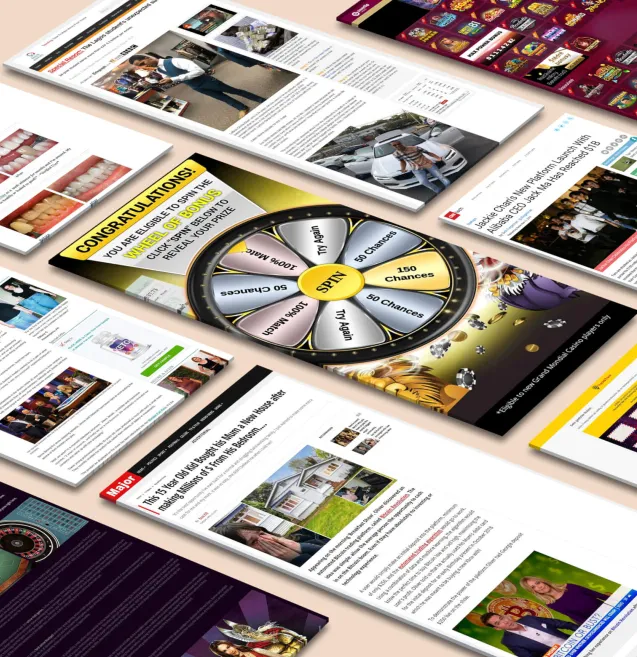
Native advertising spans a surprisingly broad set of formats. As Voluum's tracking guide explains, when marketers talk about native ads, they're often referring to entirely different channels: social ads designed to resemble user posts, content recommendation widgets embedded on news publishers' websites, and influencer-driven content that's "almost impossible to tell apart from regular content" — sometimes not even marked as advertising at all. Each of these formats shares a critical characteristic: they blend into the surrounding editorial environment so seamlessly that traditional competitive research tools, designed to crawl search results and display networks, simply can't see them.
This isn't a minor oversight. It's a structural gap in how the industry gathers competitive intelligence. Tools like Semrush are built to analyze Google Search ads, Shopping ads, and Display Network placements — the ecosystems where ad creative, keyword targeting, and spend data can be surfaced through standardized APIs and auction transparency. Native ads don't participate in those ecosystems. They flow through entirely separate demand-side platforms like Taboola, Outbrain, MGID, and RevContent, each with its own closed auction system and proprietary reporting. When a competitor runs a high-converting native campaign on a major news site, it leaves no trace in Google's ad transparency tools, no footprint in your search-focused competitive dashboards, and no signal in your analytics account.
The tracking infrastructure itself compounds the problem. Most major platforms rely on pixel-based tracking — small code snippets embedded on web pages that record user activity after arrival. But as Voluum notes, pixel tracking alone can't enable one of native advertising's most essential optimization techniques: dynamic rotation of landing page destinations. Redirect-based tracking, where a user clicking an ad passes through a tracking domain before being routed to a destination that can be switched on the fly, is what powers sophisticated A/B testing of landing pages at scale. This means the competitors who are winning in native aren't just running one static campaign — they're running dozens of variations simultaneously, testing headlines, page layouts, and offers in combinations that pixel-only systems can't replicate. And because those redirects happen in milliseconds through third-party tracking domains, none of that testing activity is visible to anyone watching from the outside with conventional tools.
Push notification campaigns introduce yet another layer of invisibility. These ads are delivered directly to subscribers' devices through browser-level permissions, bypassing websites entirely. There's no search query to intercept, no display placement to screenshot, no public ad library to browse. The entire interaction happens in a closed loop between the ad network, the subscriber's browser, and the advertiser's tracking system.
The result is a significant asymmetry in competitive intelligence. As AdPushup highlights in its breakdown of ad tracking, modern advertisers have access to enormous volumes of performance data from their own campaigns — but that data is fundamentally self-referential. You can measure your own return on ad spend with precision, yet you have almost no window into what your competitors are doing in channels where the tracking infrastructure itself is designed for privacy and performance rather than transparency. Most marketers default to broad industry benchmarks, averaging their way toward mediocrity instead of studying specific winning campaigns.
This is precisely where the information advantage emerges. The marketers who invest in dedicated ad intelligence tools for native and push aren't just getting slightly better data — they're operating in a fundamentally different information environment than competitors who remain anchored to search and display analytics. While the majority benchmarks against averages, a small minority studies what's actually working, campaign by campaign, creative by creative. That gap doesn't close on its own.
Most advertisers treat competitive intelligence as a one-time project: pull a report, scan a few competitor ads, maybe steal a headline angle, and move on. But the marketers who consistently outperform don't just analyze competitors — they build systems that turn competitive data into a compounding advantage. The difference between the two approaches is structural, and getting the structure right matters more than any individual insight you might uncover.
The most useful structural model starts with three clearly defined pillars. As Semrush's guide to competitor analysis outlines, a competitive intelligence framework needs to define what to monitor, how often to check it, and how findings feed back into campaign decisions. This is the right skeleton — but it was designed primarily for Google Ads. To close the tracking gap we've been discussing, you need to extend each of those pillars into the native and push channels where your competitors' most profitable campaigns actually run.
What to monitor should go well beyond keywords and ad copy in search results. Your monitoring inputs need to include competitor creative libraries across native platforms — the specific headlines, images, and thumbnail styles they're using on Taboola, Outbrain, MGID, and push networks. Track placement patterns: which publisher sites are their ads appearing on repeatedly? And pay close attention to campaign duration, because longevity is one of the strongest proxy signals for profitability. If a competitor has been running the same native ad creative for 90 days without pulling it, that's not laziness — it's almost certainly generating positive ROI. Duration tells you what dashboards can't.
How often to check depends on what you're tracking. Creative rotation in native advertising tends to move slower than search, so a biweekly creative scan is usually sufficient for tracking new angles and messaging shifts. Placement patterns deserve monthly reviews, since publisher relationships and inventory deals don't change overnight. But campaign duration should be monitored continuously — a simple spreadsheet logging first-seen and last-seen dates for competitor creatives will reveal which ads have legs and which were killed quickly.
How findings feed into decisions is where most frameworks fall apart, because the insight never reaches the person building the next campaign. This is where Neil Patel's three-layer model — Data, Activation, Optimization — provides a complementary architecture. Your data layer shouldn't consist solely of your own CRM and analytics; it should incorporate competitor creative libraries and placement intelligence as first-class inputs. Your activation layer — the actual campaigns you launch across ads, SEO, and social — should be informed by what's demonstrably working across the competitive landscape, not just your own historical performance. And your optimization layer, where AI testing and budget allocation happen, should use competitor campaign longevity and creative iteration patterns as directional signals that inform your own testing roadmap.
The critical shift here is from centralized strategy built on internal data alone to centralized strategy enriched by external competitive signals. As Brax notes, stepping beyond your own data and understanding your standing within the wider industry context can prove invaluable in achieving advertising success. That principle applies doubly when you extend it from aggregate industry benchmarks to granular competitor-level intelligence.
When you combine these two models — Semrush's repeatable cadence framework with Neil Patel's layered architecture — you stop treating competitive intelligence as an occasional exercise and start building something that compounds. Every cycle of monitoring generates new inputs. Every activation informed by competitive signals produces performance data that sharpens your next round of analysis. The system doesn't just keep pace with competitors; it learns from their spending in channels your analytics stack was never designed to see.
The tools you use to measure performance don't just report on your strategy — they define it. When your measurement stack begins and ends with Google Analytics, your strategic imagination gets bounded by what GA can see: your own traffic, your own conversions, your own campaign clicks. Everything outside that aperture — what competitors are testing, where they're spending, which creative angles are gaining traction across the broader market — becomes invisible. And invisible problems don't get solved.
This isn't just a tooling problem. It's an organizational one. Semrush's study on AI and SEO operating models found that measurement is the part of the marketing operating model that has changed the least, even as every other function — content production, channel strategy, audience targeting — has been reshaped by new technology and new competitive dynamics. Teams have overhauled how they create and distribute content, but the way they evaluate what's working remains stuck in frameworks designed for a simpler landscape. That inertia has consequences. When measurement doesn't evolve, neither does the strategy it informs.
The same study identified a deeper structural issue: fragmented operating models where organic visibility work spans multiple teams but nobody owns the final outcome. This fragmentation produces exactly the kind of blind spots that make competitive intelligence fall through the cracks. Competitive analysis gets treated as a one-off project — someone pulls a report before a quarterly planning meeting, a few insights get mentioned in a slide deck, and then the data goes stale. There's no ongoing system, no consistent cadence, no clear owner. Without that ownership, teams default to optimizing what's directly in front of them: their own campaigns, their own metrics, their own dashboard.
Neil Patel describes the same pattern in multi-location businesses, where performance data stays siloed in individual markets so top-performing locations can't surface insights to underperformers. The competitive intelligence equivalent is the wall between your internal analytics and the broader market's activity. Your best-performing campaigns might be generating strong results — but if a competitor is quietly testing a creative angle or channel strategy that's outperforming yours, you won't know until the gap has already widened. The data that could alert you exists, but it lives outside the systems you check every day.
This is how the measurement gap becomes the strategy gap. Limited measurement tools produce limited strategic options. If you only track what happens after someone clicks your ad, you'll only ever optimize the post-click experience. You'll miss the pre-click battle: the positioning, the messaging frameworks, the channel diversification that determines whether prospects even see your brand in the first place.
The fix isn't simply buying another tool — it's rethinking who owns competitive intelligence and how it feeds into ongoing decision-making. The teams that consistently outperform their markets don't just have better data; they have systems that route competitive insights into campaign decisions on a regular cadence. They assign ownership. They build competitive monitoring into their weekly or monthly workflows rather than relegating it to annual planning cycles. They treat the gap between their own analytics and the market's broader activity not as an unavoidable limitation, but as a solvable problem — one that requires the same rigor and consistency they already apply to their own performance data.
When nobody owns this function, the default is comfortable stagnation: optimizing within the walls of your own data while competitors operate in the space you've decided not to measure.
Receive top converting landing pages in your inbox every week from us.
In-Depth
Discover how multi-location brands can unify local SEO, out-of-home (OOH) advertising, and native ad intelligence to make smarter marketing decisions across every market. Learn how to connect location data, search intent, creative testing, and performance measurement to identify winning messages, improve local visibility, and allocate budgets more effectively.
Priya Kapoor
7 minOct 24, 2026
Must Read
Discover how AI-driven search and agentic shopping are reshaping traffic, advertising visibility, and the performance marketing funnel. Learn how to use competitive ad intelligence and AI search insights to uncover emerging buyer priorities, strengthen campaign messaging, build more effective landing pages, and identify opportunities beyond traditional clicks.
Samantha Reed
7 minOct 24, 2026
Must Read
Discover how AI-generated ad fatigue is making native, push, and TikTok campaigns increasingly look alike, weakening engagement and reducing competitive advantage. Learn how to use competitive ad intelligence tools to identify repetitive creative patterns, develop more distinctive ads, and stand out in AI-driven advertising auctions.
Liam O’Connor
7 minOct 14, 2026