11 minSeptember 4, 2026

Our spy tools monitor millions of native ads from over 60+ countries and thousands of publishers.
Get StartedSupply-path optimization was sold as the cure for programmatic waste. Consolidate exchanges, negotiate cleaner deals, tighten up the hops in the auction, and the money you spend will finally reach “better” inventory instead of vanishing into mystery fees. And to be fair, SPO has largely delivered on that narrow brief: it fixes the pipes. What it doesn’t fix is the experience.
The uncomfortable truth is that you can have pristine supply paths and still serve irrelevant, unpersuasive, or flat‑out invisible ads.
Classic ad-serving infrastructure made this disconnect easy to ignore. An independent ad server gave brands a centralized command center that consolidated reporting across exchanges and DSPs, simplified trafficking, and reduced budget leakage, as the team at MobileAds explains. You could A/B test creatives via a single tag, push updates everywhere at once, and even run dynamic anstrex.com/blog/how-ai-powered-marketing-is-changing-the-game" target="_blank" rel="noreferrer noopener">creative optimization that stitched together different elements based on time of day, location, device, or weather. From a workflow perspective, it felt like control.
But this was still optimization inside a black box: you saw your own impressions and clicks, not the competing ads your audience was seeing in the same feeds, breaks, and scroll sessions. The “pipes” were efficient; the actual human experience remained largely inferred.
AI has only intensified this split. On the infrastructure side, agentic systems are already reallocating budget, tweaking bids, and rotating creatives autonomously. As one MarTech analysis of AI‑native advertising puts it, self‑optimizing agents now experiment continuously, slashing acquisition costs and compressing sales cycles. Media owners are racing to match that promise: Warner Bros. Discovery’s Always-On Measurement & Attribution Dashboard and NBCU’s Performance Insights Hub were both pitched as ways to give buyers real-time visibility and in‑flight optimization across outcomes, measurement partners, and inventory, according to coverage of the 2026 upfronts.
At the same time, media companies are deploying AI directly into the creative layer—but still from within their own walls. shopify-vs-Amazon-why-some-sellers-are-abandoning-amazon-for-shopify" target="_blank" rel="noreferrer noopener">Amazon’s Dynamic TV Creative, for example, automatically personalizes interactive video ads using Amazon’s shopping signals and AI‑driven creative optimization to adjust formats, headlines, and calls‑to‑action based on where a viewer is in their purchase journey, as Marketing Dive reports. That makes the ad more relevant, and it streamlines execution for brands. Yet it remains optimization from one seller’s vantage point.
What’s missing is perspective on the competitive context—what your prospects are seeing alongside you, before you, and after you.
Practitioners who live and die by performance intuitively know this. Growth marketers building “hit” creatives on social aren’t just trusting internal dashboards; they’re actively mining the Facebook Ads Library and third‑party tools to see which competitor concepts have been running longest with high impression volumes, using longevity as a proxy for performance. Then they adapt those winning ideas to their own positioning, avatar, and funnel stage, as one recent playbook for scaling eCommerce campaigns with Facebook ads makes clear. In other words, they’re already practicing a crude form of “creative path optimization”: not just asking “Which supply path is cheapest?” but “Which creative paths have demonstrably proven they can win attention and convert in this environment?”
The industry’s current stack—SPO, AI bidding agents, DCO, and media-owner AI like Dynamic TV Creative—optimizes what it can see: your bids, your placements, your first‑party signals. What it cannot see is the lived ad experience from the customer’s point of view, stitched across platforms and crowded with competitors who are also testing, iterating, and personalizing.
Until we redefine the problem in those terms, we’ll keep perfecting the plumbing while leaving the real performance lever—the creative experience in competitive context—largely to guesswork.
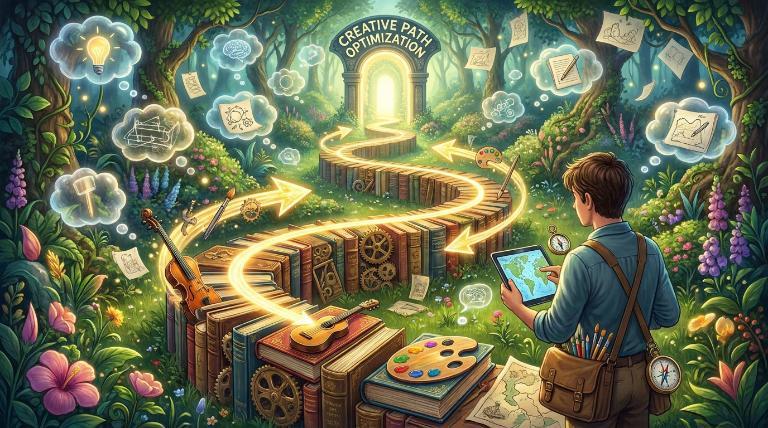
Creative Path Optimization (CPO) starts from a simple premise: if SPO is about choosing the most efficient route to where your ad shows up, CPO is about deliberately engineering what shows up along that route — and learning from your competitors’ creative to do it better than they do.
Think of CPO as a continuous loop that answers three questions:
Traditional optimization has treated creative as a black box: plug in some assets, let the algorithm allocate budget, and hope the “system” figures it out. But as autonomous buying gets more sophisticated, the creative surface area has exploded. Platforms like AdStellar AI now spin up and test large volumes of Meta ads in bulk, with orchestras of specialized agents choosing combinations of headlines, images, and audiences at machine speed, while a “Winners Hub” locks in top performers for reuse in future campaigns, as described on the HubSpot Marketing Blog. If the assets you feed into that machine are mediocre, the system just becomes very efficient at scaling mediocrity.
That’s why CPO matters now: algorithms are no longer the bottleneck — creative clarity is. Modern AI in AdTech can already optimize where and when your ads appear with impressive precision, analyzing behavior patterns to target high-value audiences and automate buying decisions across channels, as illumin explains in its overview of predictive optimization. Generative AI can also remix your building blocks — headlines, visuals, CTAs — into endless permutations. But neither of those systems can see a crucial piece of context: what your competitors are saying, showing, and offering to the very same users you’re chasing.
CPO fills that blind spot by treating competitor creatives as a live, high-signal dataset instead of background noise. The objective isn’t to copy; it’s to reverse-engineer the “creative paths” that are currently shaping expectations in your category, then design your own paths that are intentionally differentiated and systematically tested.
Concretely, CPO connects three layers that are usually siloed:
The timing is critical. Ad fatigue is accelerating, and platforms increasingly expect a high volume of distinct creatives to keep performance stable. Meta’s Andromeda update, for instance, stopped rewarding hundreds of near-duplicate ads and began treating them as a single creative, which means marketers now need truly different variations, not trivial tweaks, as Social Media Examiner notes in its guide to AI for ad creative. Generative AI makes that volume attainable, but only if you give it sharp, competitive context.
CPO is the operating system for that context. It acknowledges that you can’t see auction dynamics inside the black box, but you can see what’s on the screen. By systematically mining competitor ads, translating their patterns into structured experiments, and feeding the outcomes into your automated buying, you finally start optimizing the piece of the path that users actually experience — not just the pipes that deliver it.
Most marketers can sketch the “path” from impression to purchase in their sleep: user sees ad, user clicks, user lands, user converts. In practice, the creative path is a chain of fragile micro‑moments, each with its own failure modes — and most of them are either invisible to your bid optimizer or badly misdiagnosed in platform reports.
To use competitors’ ads intelligently, you first have to see where your own path leaks.
The first leak is brutal and simple: most people never really see your ad. Viewability issues alone mean a large share of impressions are effectively wasted before creative has a chance to work, which is why independent verification and ad‑server‑level diagnostics matter so much, as the team behind the MobileAds ad server overview points out.
Among impressions that are seen, three creative variables dominate:
Platforms are rolling out more tools to preview and stress‑test these first impressions. Microsoft’s latest product newsletter adds richer creative previews and AI‑assisted reporting, including Topic Insights that show which themes AI systems associate with your brand and competitors, and how those topics surface across ad experiences, as explained in Search Engine Journal’s coverage. That’s not just search hygiene; it’s an early warning system for “invisible” leaks where your creative is consistently misaligned with how users — and AI surfaces — actually frame the problem.
If you’re losing at this stage, your competitors’ ads tell you exactly how: they’re winning the scroll by being more native to the context and more specific in their promise.
When users do engage, the next leak appears in the hand‑off between ad and destination.
On social and display, pre‑land elements (lead forms, in‑app browsers, interstitials) introduce micro‑frictions that don’t show up in simple click‑through rate. On search, the main distortion is intent drift: a user clicks expecting one thing and gets something just different enough to create bounce.
Generative AI placements raise the stakes here. In AI Overviews and similar formats, your ad sits inside a synthesized explanation of the topic; copy that feels vague or brand‑centred tends to underperform contextually sharp, location‑ or use‑case‑specific offers. Franchise advertisers have already seen that location‑specific headlines and offers outperform generic branding when ads are embedded in AI‑generated summaries, as described in Neil Patel’s discussion of franchise PPC. That’s not just a franchise quirk — it’s a preview of how all performance creative will need to work when “the click” increasingly comes from users emerging out of an AI narrative, not a bare list of links.
Here, competitor analysis is gold: what language do they use when they show up alongside AI content for the same queries? How tightly do their hooks mirror the phrasing the AI uses? That’s the new baseline for “relevance.”
Most money leaks on the landing experience, and this is where traditional optimization finally gets some attention — but often in a siloed, CRO‑only way.
Winning paths do three things well:
Modern platforms are trying to collapse this gap between media and on‑site testing. Experimentation tools that let non‑technical marketers iterate copy, layout, and modules quickly — much like the approachable testing workflows praised in the HubSpot team’s review of experimentation platforms such as Optimizely One — are effectively creative‑path repair kits. But those kits only work if you’re borrowing the right hypotheses from the market: which competitor layouts, proof points, and flows keep showing up in top‑performing ads and high‑visibility placements?
By the time someone hits the cart, many teams mentally hand off responsibility to “product” or “ecommerce.” That’s a mistake. Cart abandonment is often a creative path problem disguised as a pricing or UX issue:
Generative and dynamic creative tools are increasingly capable of personalizing these last‑mile elements. AI‑driven Dynamic Creative Optimization can already assemble tailored combinations of headlines, images, and CTAs in milliseconds based on context and audience data, as outlined in illumin’s overview of AI‑powered creative in AdTech. Yet most brands limit that intelligence to the ad unit and stop personalizing the story once the user is “on site,” leaving a gap competitors can exploit with more consistent, end‑to‑end messaging.
When you map the creative path this way — ad unit, click context, landing, cart — your competitors’ ads stop being curiosities in the feed and become a live benchmark of how others are stitching these stages together. Creative Path Optimization is about tracing those stitches, finding where your thread frays, and then using what you see in competing flows to repair the parts your bidding algorithms and SPO graphs were never designed to understand.
The easiest way to make “creative path optimization” real is to steal like a scientist: systematically observe what’s working for competitors, map their creative paths, and then benchmark your own against that map.
Most teams already dabble in this. Someone scrolls the feed, drops a good ad in Slack, and says, “We should try this.” CPO demands something more disciplined: treating competitor ad intelligence as a structured dataset that tells you how rival brands are solving the same path you’re trying to fix.
Start with where competitors actually show up. Platforms are beginning to expose more about how AI systems associate brands with topics and surfaces. Microsoft’s new AI Visibility reporting in Clarity, for example, lets you see which themes AI systems link to a domain and how often it appears relative to others, framed as “citation share” and “share of authority” across topics the system identifies as important for a category. When you compare your own topical footprint with the domains that keep appearing as competing citations, you’re effectively looking at a machine‑generated list of your “creative path neighbors” — the brands whose ads and content are most likely to sit alongside yours in high‑intent journeys. Those are the competitors whose ads you should be dissecting first, because they’re operating in the same semantic lanes the AI and auction care about.
Next, inventory their creatives by stage of the path, not by “ad” in the abstract. Treat each visible touchpoint as a separate artifact: the ad unit, the first-click destination, the scroll path, the CTA microcopy, the offer framing, the proof devices. For social ads, that means pulling not just headline and image, but also hooks, visual motifs, and narrative structure. When Sam Brown recommends mining the Facebook Ads Library and tools like MagicBrief by sorting for ads with long run times and high impression counts, he’s really describing a quick‑and‑dirty proxy for “stable winners” that have survived the platform’s auction pressure. Those long‑running units are the ideal raw material for mapping.
From there, you can build a simple but powerful benchmarking schema. For each competitor and each creative path you care about (prospecting, retargeting, reactivation, upsell), score the components that matter most to your category:
The output is not a pretty slide; it’s a working “competitive creative path grid” that shows, at a glance, how rivals are solving each micro‑moment you mapped in the previous section. One competitor might over‑index on hyper‑specific avatars (e.g., “construction workers with back pain”) and semi‑scripted UGC to drive cheap attention; another may lean hard into high‑velocity testing of many variations — an approach that newer AI‑driven platforms encourage with features like bulk creative launch and Winners Hubs that automatically surface and recycle top‑performing elements for future campaigns. Those behavioral patterns tell you how seriously each brand is treating the path, and where they’re betting their optimization chips.
This is where CPO gets interesting: you’re not copying their ads; you’re benchmarking their paths. For any path segment where a competitor is clearly out‑executing you — say their ad‑to‑landing message match is tighter, their social proof surfaces earlier, or their mobile layouts eliminate more friction — you flag that as a structural gap, not “a cool idea.” Conversely, if you see universal blind spots (e.g., no one is tailoring creative for AI overview placements that synthesize content around queries like “best [product] near me”), those become arbitrage opportunities: places where you can design a more coherent, context‑aware path before the rest of the market catches up.
Over time, the benchmark becomes your control chart. As you introduce new creative paths or overhaul existing ones, you’re no longer optimizing in isolation or on platform‑reported metrics alone. You’re asking, “Relative to the best paths our competitors are fielding — and the topics and surfaces the AI associates us with — are we closing the gap, or widening it?” That’s the mindset shift from generic “competitive research” to genuine creative path optimization.
Operationalizing “creative path optimization” sounds abstract until you turn it into a weekly, almost boring routine. The goal is simple: use competitor ads to surface failure points in your own path, then use your existing tools — pixels, ad servers, and AI optimizers — to close those gaps.
Here’s a pragmatic workflow you can run whether you’re a solo affiliate or an in‑house brand team.
First, define a small set of “anchor journeys.” Pick 3–5 high‑value audience slices (e.g., cold interest, warm remarketing, branded search) and 1–2 flagship offers for each. This is what you’ll obsess over. In a world of AI‑native, always‑on campaigns where autonomous agents continuously reallocate spend and tweak creative, teams that win are the ones that feed those systems highly structured, premium journeys instead of random experiments, as MarTech’s analysis of AI‑native operating models argues.
Next, build a lightweight “competitive paths” board for each anchor journey. Use Meta Ad Library, TikTok Creative Center, Google Ads Transparency Center, and native platforms to:
You’re not copying ads; you’re building a catalog of proven path archetypes. Over time this becomes your benchmark for what “good” looks like in your specific category and funnel type.
Then translate those observations into a CPO hypothesis doc for the coming week. For each anchor journey, you want one dominant hypothesis such as:
This is where you decide what to change at the path level, not just “spin up more creatives.” It mirrors how advanced ad servers centralize creative testing across placements so you can update the experience once and propagate it everywhere, as the MobileAds explanation of ad server workflows describes.
With hypotheses in hand, you design a small number of high‑impact experiments across the path, not just in the ad. Examples:
An ad server with creative split‑testing and basic dynamic creative capabilities lets you execute this in a centralized way: a single tag across traffic sources and a control/variant setup for each key step, just as MobileAds outlines with creative split‑testing and DCO. Even if you rely heavily on platform automation, you’re supplying those systems with more conversion‑efficient paths to optimize within.
Now you wire all of this into an “always‑on” measurement cadence. Rather than drowning in platform reports, you want a simple weekly CPO scorecard:
The big TV players are moving in this direction with outcome‑focused dashboards that expose performance in real time and enable in‑flight path refinement. Warner Bros. Discovery’s launch of an always‑on attribution dashboard and NBCU’s forthcoming Performance Insights Hub are both attempts to normalize this “optimize the journey, not just the spot” mindset, as Marketing Dive reported in its upfronts coverage. You’re doing the same thing on a smaller canvas.
Finally, close the loop with your AI bidding and budgeting. Once you’ve validated a path improvement — say, a 20% lift in lander‑to‑checkout completion — bake it into your default stack and only then give your automated systems more leash. This echoes the guidance that AI agents perform best when they’re nested inside robust, experiment‑driven operating models instead of being asked to “fix” broken journeys, a point stressed in.
Run this loop every week:
Over a quarter or two, this rhythm quietly compounds. You’re no longer hoping your bid optimizer guesses why performance swings. You’re systematically fixing the part of the funnel it can’t see — guided by what’s already winning in the wild.
Start by treating Anstrex like an x‑ray machine for your niche, not a shiny spy gadget. You’re not looking for random “cool ads”; you’re looking for durable, validated flows that can serve as the reference map for your own creative path optimization.
The first filter: time and volume. Sort by longest‑running, highest‑traffic campaigns in your vertical. Longevity is a strong proxy for performance — the same principle drives competitive research advice in Facebook ads, where practitioners recommend sorting for ads with high impressions and long run times because platforms tend not to keep losing creatives in rotation for months on end unless they’re profitable, as explained in this discussion of eCommerce ad longevity. In Anstrex, that logic scales: you can see which offers and angles have survived weeks or months of spend across multiple geos and placements.
Next, drill into one winning campaign at a time and reconstruct the full path:
3. Core landing page.
Click through to the money page and audit its role in the path:
4. Offer mechanics and risk reversal.
Finally, look past the design and into the economics: discount structure, bundles, payment plans, guarantees, and urgency devices. Annotate how early in the flow those elements appear and how strongly they’re framed. AI‑driven optimization tools can automate bid and budget decisions with impressive sophistication, and platforms are increasingly surfacing “winner” combinations of assets and audiences via features like AI‑powered “Winners Hub”‑style libraries and experimentation workflows, much like the autonomous orchestration and rapid testing capabilities described for AI campaign builders. But those systems still depend on inputs — the raw offer and the way it’s positioned.
Once you’ve dissected 10–20 top flows, build a visual catalog. Group them by dominant hook (problem, desire, status, curiosity), by pre‑lander type (story/ advertorial/ quiz), and by offer structure (discount vs. bonus vs. payment plan). This becomes your “creative path atlas” for the niche.
With that atlas in hand, Anstrex stops being a voyeuristic tool and becomes a benchmarking engine. When you overlay your own paths on top of these proven flows, you can see exactly where you’re off‑pattern — missing pre‑landers where everyone else pre‑sells, skipping risk reversal where every winner stacks guarantees — and feed those insights back into your testing roadmap, letting your pixels and AI optimizers refine what you now know is structurally sound.
Receive top converting landing pages in your inbox every week from us.
Must Read
Discover how AI-generated ad fatigue is making native, push, and TikTok campaigns increasingly look alike, weakening engagement and reducing competitive advantage. Learn how to use competitive ad intelligence tools to identify repetitive creative patterns, develop more distinctive ads, and stand out in AI-driven advertising auctions.
Liam O’Connor
7 minOct 14, 2026
How-To
Learn how to connect out-of-home (OOH) advertising with digital performance campaigns to create measurable cross-channel funnels. Discover how to plan LED truck routes, coordinate search and social ads, optimize mobile landing pages, and track conversions so physical advertising drives measurable business results.
Samantha Reed
7 minOct 13, 2026
How-To
Discover how big-brand sports sponsorships use fan behavior, geographic targeting, and cross-channel advertising to reach high-intent audiences beyond celebrity endorsements. Learn how to reverse-engineer sponsorship strategies, validate audience segments with competitive intelligence, and build cost-effective campaigns around local fandom, CTV, mobile, and creator content.
Dan Smith
7 minOct 12, 2026