12 minAugust 14, 2026

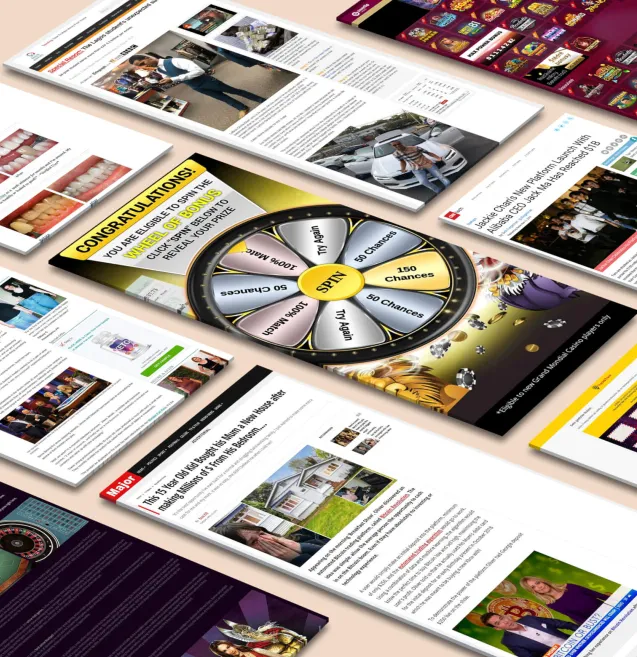
Our spy tools monitor millions of native ads from over 60+ countries and thousands of publishers.
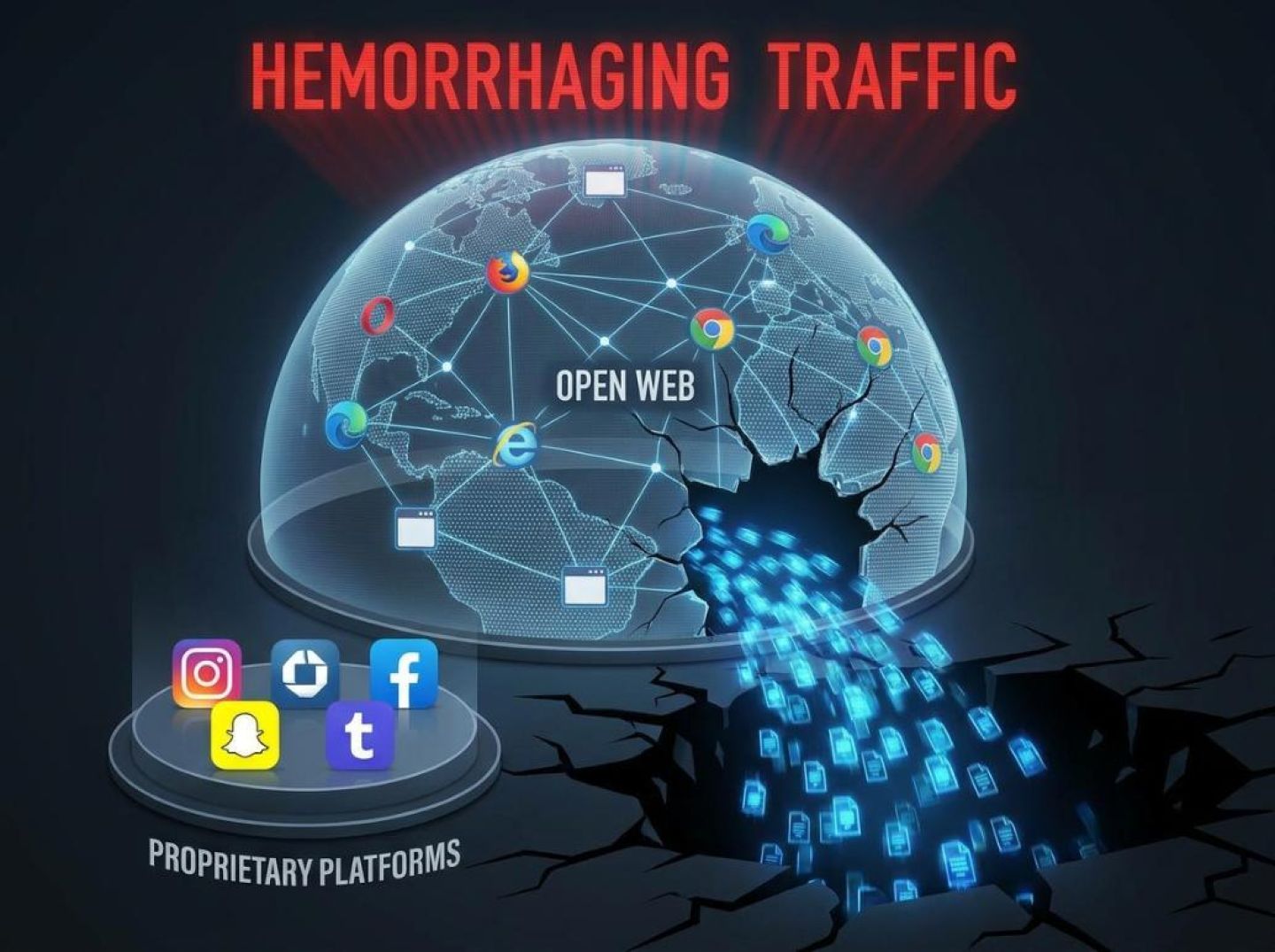
Get StartedFor two decades, the open web ran on a simple bargain: publishers created content, Google indexed it, and in return, Google sent traffic. That bargain is now breaking down — not gradually, but structurally. Generative search experiences and AI summaries are answering user questions directly on the results page, keeping users inside Google's ecosystem instead of sending them to external websites. The result is a traffic collapse that no algorithm update or content refresh can reverse.
The numbers tell a stark story. Neil Patel's analysis of referral patterns found a 60 percent decline in search referral traffic for smaller publishers, a figure he describes not as a fluctuation but as "a signal of where information discovery is going." Larger publishers aren't immune either. As Adweek reported, USA Today Inc. CEO Mike Reed has confirmed that his company — which encompasses a nationwide network of news sites — is actively weighing whether to delist from Google entirely. The logic is straightforward: if Google is using publisher content to train AI products that regurgitate their data without compensation and without sending meaningful traffic back, the century-old value exchange no longer pencils out.
That a publisher the size of USA Today would even consider abandoning Google Search would have been, as SEO consultant Lily Ray told Adweek, "commercial suicide" just a few years ago. But the gradual erosion of search traffic has paradoxically given publishers more agency to walk away. USA Today Inc. has responded by bolstering audience from newsletters, social media, and events, maintaining its goal of one billion pageviews monthly for the last three years. Its monetization strategy now leans on licensing agreements with Meta, Microsoft, and Amazon — deals that Google, unlike its hyperscaler peers, has refused to strike with any publisher.
What makes this contraction especially insidious is how Google is working to obscure it. As Search Engine Journal detailed, Google's recent update to Search Console — allowing brands to track how their social media and video posts perform in search results — looks helpful on the surface but functions as something far more calculated. By folding TikTok impressions and YouTube views into the same dashboard where marketers once tracked clicks to their websites, Google is quietly redefining what "success" means. If your website traffic drops by a third, Google can point to thousands of social impressions your content received on the search page and suggest you're still winning — even though no one actually visited your site. It forces marketers to view Google as the central control room for all visibility, even when Google stops sending visitors to their websites.
This is not a temporary dip caused by a single algorithm change. It is a permanent contraction of the search-driven open web — and it carries a consequence that extends well beyond publishers. Every page that loses organic traffic is a page that loses ad impressions. The display and programmatic inventory that brands have purchased through Google's ad network for years depends on those pages attracting visitors in the first place. As the audience pipeline dries up, so does the supply of quality ad placements. CPMs rise, reach shrinks, and advertisers find themselves paying more to reach fewer people on a diminishing landscape of viable publisher pages. The infrastructure that powered two decades of digital advertising is contracting in real time, and Google is holding the tourniquet.
The publisher traffic crisis isn't just a problem for publishers — it's a cascading failure that is quietly dismantling the economics of Google's own advertising network. When publishers lose organic traffic, the ad inventory on their sites degrades in tandem. Fewer visitors mean fewer impressions, lower engagement, and diminished returns for advertisers buying placements through Google's Display Network. What was once a vast, liquid marketplace of third-party ad space is thinning out, and Google's response tells you everything about how serious the problem has become.
In late May 2026, Search Engine Roundtable reported that Google is folding Display Ads into its Demand Gen campaigns — a move the company frames as a modernization of its ad products. But read between the lines and the consolidation looks less like an upgrade and more like triage. Standalone display placements depend on a healthy ecosystem of publisher pages generating consistent pageviews. When AI Overviews answer queries directly on Google's results page — eliminating the need for a user to ever click through to a publisher's site — those pageviews evaporate. Fewer pageviews mean fewer ad slots worth buying, and fewer ad slots worth buying mean Google needs to bundle what remains into broader, AI-driven campaign types just to maintain advertiser spend.
The mechanism is straightforward. A user searches for "best running shoes for flat feet," and instead of clicking on a running blog's review article — where Google Display ads would have loaded alongside the content — they receive a synthesized AI answer right on the search page. The blog never gets the visit. The display ad never loads. The advertiser never gets the impression. As MarTech explained, this AI discovery layer acts as an intelligent filter between audiences and websites, and because it is so efficient at satisfying informational queries, it serves as a structural barrier to traditional website visits. The downstream consequence is that the entire impression-based advertising model built on top of those visits is contracting from within.
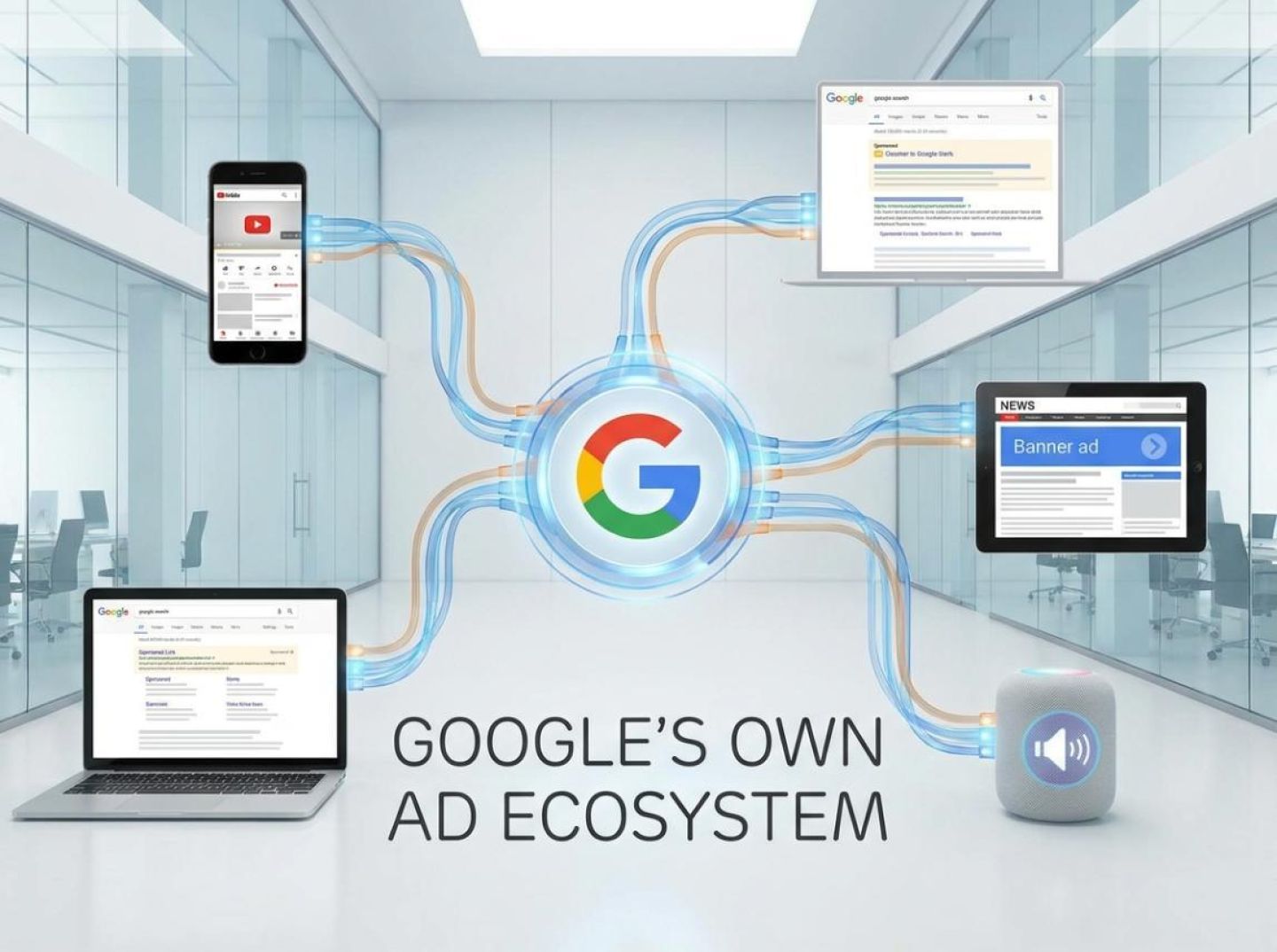
Google's pivot to Demand Gen is an attempt to keep ad dollars flowing into its ecosystem by redirecting them toward its owned-and-operated surfaces — YouTube, Discover, Gmail — where it controls the inventory directly. But for performance marketers who need actual clicks and measurable conversions, this restructuring presents a problem. Demand Gen campaigns optimize for engagement within Google's walled garden, not for driving users to external landing pages where conversion tracking is most precise. eMarketer's much-cited $26 billion AI advertising forecast sounds impressive until you consider the critical caveat embedded in it: if AI answers continue suppressing clicks the way they have in traditional search, that ad spend may not deliver the traffic the dollar figure implies. Advertisers could end up paying premium rates for impressions that never translate into site visits.
Meanwhile, the publishers who still generate meaningful traffic are increasingly questioning whether Google deserves access to their content at all. As Adweek documented, major publishers like USA Today Inc. are actively weighing whether to delist from Google Search entirely, having already diversified their audience acquisition through newsletters, social media, and events. Every publisher that pulls out further erodes the available inventory in Google's network, accelerating the very cycle that prompted the Display-to-Demand-Gen consolidation in the first place.
For marketers accustomed to treating Google's ad network as a reliable, scalable channel, the math is deteriorating fast. The inventory is shrinking, the clicks are disappearing, and the platform itself is reorganizing around a model designed to keep users — and ad revenue — inside its own walls. That leaves a growing number of performance-driven advertisers looking for channels where a click still means a click and a visitor still lands on a page they control.
The audience Google is deflecting away from traditional search isn't vanishing into thin air — it's scattering across channels that most performance marketers have historically undervalued. Understanding where those users are landing is the key to unlocking the next wave of native and push advertising growth.
Publishers themselves are drawing the map. USA Today Inc. offers one of the clearest case studies: as search traffic eroded, the company bolstered audience from other sources, like newsletters, social media, and events, managing to sustain its goal of one billion monthly pageviews for three consecutive years despite Google's AI features siphoning away organic clicks. CEO Mike Reed's willingness to even consider delisting from Google entirely signals just how viable these alternative channels have become. USA Today isn't an outlier — it's a leading indicator. Across the publishing industry, the playbook is the same: build direct relationships with readers through email inboxes, app notifications, and social feeds rather than renting attention from a search engine that increasingly keeps users for itself.
What makes this migration especially significant for native and push advertisers is the trust crisis baked into AI search itself. Only 28 percent of Americans trust AI-generated search results, according to Search Engine Journal's reporting, and a substantial share say nothing could persuade them to rely on AI answers. That skepticism doesn't suppress demand for information — it redirects it. Users who distrust an AI summary don't stop wanting the answer; they seek it from a source they can evaluate on its own terms. They click through to a newsletter they subscribed to deliberately. They tap a push notification from a publisher they opted into. They scroll a content feed on a platform where editorial context is visible. Each of these touchpoints represents a user who has actively chosen engagement over passive consumption of a machine-generated synopsis.
This is precisely the behavioral profile that native advertising was built to serve. Native content thrives in environments where users are already in a discovery mindset — scrolling a feed, reading an article, browsing curated recommendations. Push notifications, meanwhile, capture attention at the most intentional moment possible: the user literally granted permission to be interrupted. Both formats benefit enormously when the audience arriving through these channels is doing so because they want deeper, more trustworthy content than what an AI snippet provides.
The structural shift is also visible in how Google itself is responding. As Ahrefs observed, searches related to traffic-loss audits and zero-click search strategies are climbing as marketers scramble to diagnose and adapt to disappearing clicks. Meanwhile, Google's own move to surface social media and video performance inside Search Console is less a concession to creators and more an attempt to redefine what "visibility" means now that actual website visits are in decline. But redefining metrics doesn't change the underlying economics: advertisers need audiences that click, read, and convert — not audiences that glance at an AI-generated answer and move on.
The displaced audience is migrating toward exactly the environments where native and push have always performed best: opted-in, high-intent, editorially rich channels. Publishers diversifying away from Google dependency are building subscriber lists, notification audiences, and social communities that represent something Google's AI Overviews cannot replicate — genuine, permission-based attention. For advertisers willing to follow the audience rather than cling to a deteriorating search paradigm, the opportunity isn't theoretical. It's already taking shape.
The performance marketing case for native and push advertising has never been more straightforward: the primary measurement infrastructure that search marketers have relied on for two decades is being systematically dismantled, and the budgets tethered to it need somewhere to go.
Google's AI-mediated search experience is not just reducing clicks — it's clouding the attribution signals that performance buyers depend on to justify spend. As MarTech has detailed, the AI discovery layer now acts as an "intelligent filter" between audiences and websites, meaning the traditional marketing funnel "requires a complete rebuild." When a user's journey begins and ends inside an AI-generated answer, there is no click to attribute, no landing page session to measure, and no conversion path to optimize. For CMOs accountable to quarterly ROI targets, this opacity is untenable. Budgets don't disappear when a channel loses measurability — they migrate to channels where the math still works.
Native advertising platforms like Taboola, Outbrain, and MGID offer exactly the transparent click-through economics that search is losing. Every impression, click, and downstream conversion is tracked, attributed, and optimizable in real time. Push notification networks provide an even more direct signal chain: a user opts in, receives a notification, clicks, and either converts or doesn't. There is no AI intermediary summarizing the offer before the user arrives. There is no ambiguity about whether the click happened or who deserves credit for it.
The arbitrage opportunity sitting in front of early movers is a function of timing. Inventory on native platforms is expanding rapidly as publishers who have seen search referral traffic decline by as much as 60 percent scramble to diversify their monetization. More widget placements, more content recommendation slots, and more push notification opt-in prompts are appearing across the open web every week. But advertiser competition on these placements has not yet caught up. Most performance marketing budgets are still locked into Google Search campaigns out of institutional inertia, even as the returns from those campaigns erode. The result is a favorable supply-demand imbalance: growing inventory, static competition, and CPCs and CPAs that remain well below what the same audiences would cost in a fully competitive marketplace.
The data confirms that marketers sense the shift but haven't yet acted on it at scale. Ahrefs reports that searches for "zero-click search strategy," traffic-loss audits, and variations of "why is my website traffic dropping" are all climbing as marketers look for a plan. They know the old playbook is broken. They are diagnosing the problem. But diagnosis is not the same as reallocation. The gap between recognizing that search is underperforming and actually moving budget into native and push channels is where the arbitrage lives.
That window shrinks every week a competitor figures this out first. The pattern is familiar to anyone who watched the early days of Facebook advertising or programmatic display: a brief period of underpriced inventory, followed by a rush of budget that normalizes pricing and compresses margins. The advertisers who used those windows to test creatives, build audience segments, and lock in winning angles were the ones who scaled profitably when everyone else arrived and bid up costs.
For native and push advertisers, this is that window. The displaced budgets from underperforming search campaigns are already in motion, and channels with transparent attribution, growing publisher inventory, and favorable unit economics are the natural landing zone. The question isn't whether the migration will happen — it's whether you'll have your creatives, funnels, and data infrastructure in place before the flood arrives and the CPAs rise with it.
The competitive intelligence playbook that search marketers have refined over the past decade is losing its foundation. Keyword gap analysis assumes you can observe what competitors rank for; SERP tracking assumes organic positions translate into predictable click-through rates; backlink monitoring assumes that link equity flows in ways Google's algorithm will continue to reward. Each of these assumptions is eroding as Google's AI layer absorbs more of the search experience and returns fewer actionable signals to the open web.
The problem runs deeper than vanishing clicks. As MarTech has documented, the AI discovery layer now acts as an intelligent filter between audiences and websites, synthesizing hundreds of pages into a single response so users never need to visit individual sources. When that intermediary controls what information reaches the user — and when Google withholds granular data about how those AI-mediated interactions perform — traditional competitive intelligence tools are essentially reading yesterday's map. You can still track which keywords a competitor nominally ranks for, but you can no longer trust that those rankings produce the traffic or conversions they once did. The signal-to-noise ratio in search-based CI has inverted.
Google's own behavior confirms the opacity is intentional. As Ahrefs noted in its analysis of 2026 AI search trends, the platform introduced a Generative AI report in Search Console under regulatory pressure, yet still withholds the data marketers actually need to quantify AI-driven traffic. Opting out of AI search features means opting out of potential visibility, but no one can measure what that visibility is worth because Google controls both the audience and the measurement layer. This is the competitive intelligence equivalent of flying blind — you know the landscape has changed, but the instruments you relied on to navigate it are no longer calibrated to the new terrain.
Meanwhile, the consolidation of Display Ads into Demand Gen campaigns, as Search Engine Roundtable recently recapped, further reduces the granularity available to outside observers. Fewer distinct campaign types mean fewer discrete signals to reverse-engineer. The walled garden is getting higher walls.
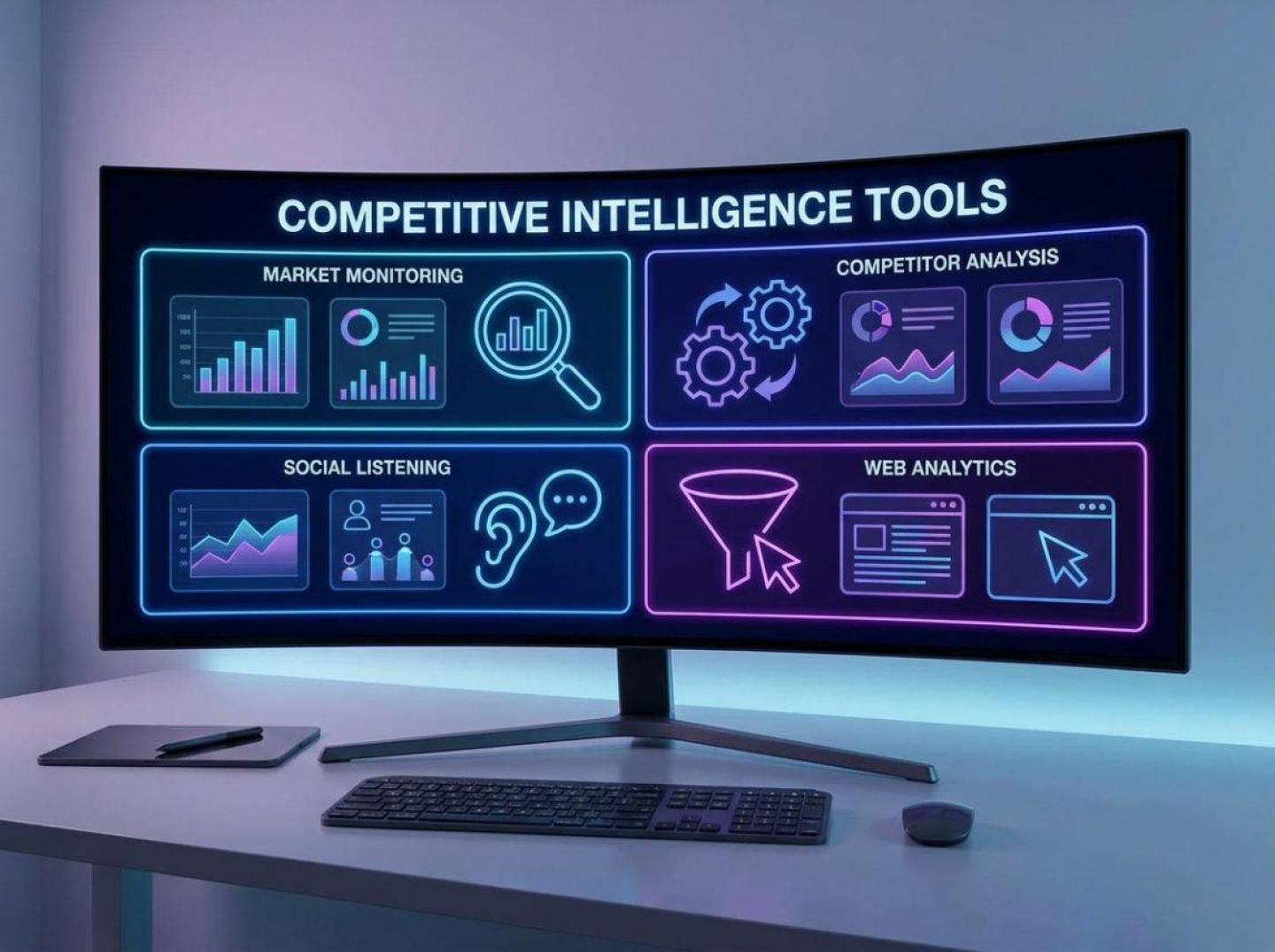
This is precisely why competitive intelligence in native and push advertising operates on an entirely different — and currently more reliable — axis. Spy tools built for performance channels don't infer intent from keyword positions or estimate traffic from algorithmic proxies. They surface the actual artifacts of competition: running creatives, live landing pages, targeting angles, ad copy variations, and the specific networks where campaigns are active. When a competitor launches a new push notification funnel or scales a native advertorial, that activity leaves a concrete, observable footprint that no AI intermediary can obscure.
The actionability gap between search CI and native/push CI is widening by the quarter. Search-based tools tell you what a competitor might be doing; performance ad spy tools tell you what they are doing right now, down to the headline and the call-to-action button color. In an environment where Google is actively making its own ecosystem less transparent to outside measurement, the channels where competitive signals remain visible and concrete become disproportionately valuable — not just for campaign optimization, but for strategic planning. The advertisers who recognize this shift earliest will build the deepest moats, because they'll be making decisions based on observed market behavior rather than algorithmic guesswork filtered through an increasingly opaque AI layer.
Receive top converting landing pages in your inbox every week from us.
Most Read
Learn how OOH employers can move beyond selling billboard inventory and start monetizing the full funnel impact of every outdoor impression. This guide shows how to connect OOH with Native and TikTok-style funnels using competitive intelligence, creative research, tracking, retargeting, and performance-focused roles.
Rachel Thompson
7 minSep 28, 2026
Must Read
Discover how Pure Leaf’s “Break Conference” can be deconstructed as a full-funnel strategy spanning Native, Push, and Pop advertising. This guide shows how marketers can use creator content, TikTok Instream, Anstrex, search data, and PR signals to turn a feel-good brand stunt into a measurable performance engine.
Priya Kapoor
7 minSep 27, 2026
Must Read
Learn how to transform one powerful brand moment into scalable Native, Push, and Pop funnels instead of relying on a single hero ad. This guide covers modular creative, TikTok funnel thinking, competitive intelligence with Anstrex, cross-channel testing, and a repeatable creative supply chain.
Dan Smith
7 minSep 26, 2026