9 minAugust 26, 2026

Our spy tools monitor millions of push notification ads from over 90+ countries and thousands of publishers.
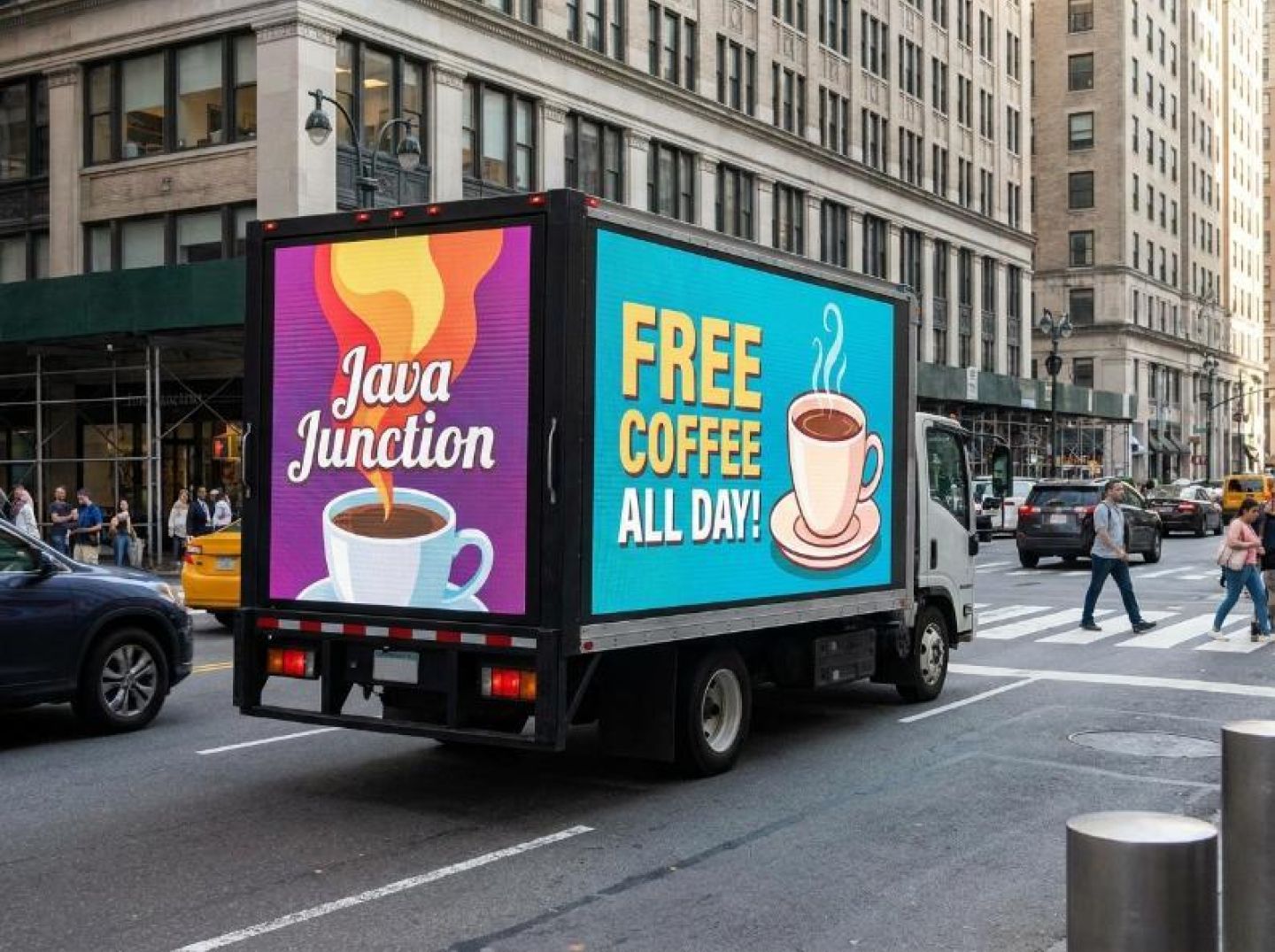
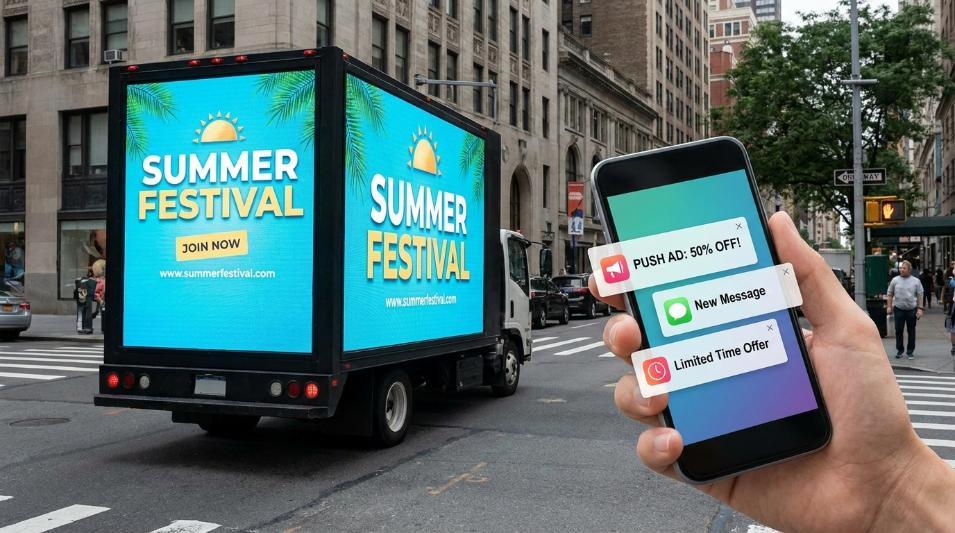
Get StartedPerformance marketers love their taxonomies. Digital goes here, out-of-home goes there, and never the twain shall meet. But strip away the medium — the glass screen, the steel truck panel — and what remains is a nearly identical advertising mechanism: an interruptive message, engineered to reach a specific person in a specific context at a specific moment, with no prior signal of intent from the audience. The sooner marketers recognize that structural symmetry, the sooner they can build a feedback loop between the two channels that compounds the performance of both.
Start with the most fundamental parallel: targeting logic. A push notification doesn't wait for a user to type a query into a search bar. It arrives based on contextual signals — time of day, browsing behavior, location, device type — and it succeeds or fails on whether those signals accurately predict receptivity. Mobile billboard advertising operates on the same principle, just with atoms instead of bits. As lessons drawn from more than 2,500 campaigns make clear, the format succeeds not by owning a fixed location but by "bringing the message directly to the audience" — routing trucks through business districts, event venues, and transportation hubs based on where people are most likely to be at a given hour. That is, functionally, geo-targeted push delivery on wheels.
Then there is the question of creative constraints. A push notification gets, at most, a title, a line or two of body copy, and a small image. A mobile billboard gets roughly three seconds of a pedestrian's or driver's attention. Both formats demand instant legibility — no nuance, no long-form persuasion, just a single proposition sharp enough to register before the moment passes. Creatives that work in one channel share almost all their DNA with creatives that work in the other: high-contrast visuals, an unmistakable call to action, and zero wasted words.
The interruptive nature of both channels also means they face similar trust headwinds. MarTech's analysis of the web push landscape in 2026 details how Google's late-2024 policy updates cracked down on deceptive notification practices, making unsubscribe options more accessible and banning certain promotional tactics outright — all in the name of reducing the perception that push notifications are intrusive or misleading. Mobile billboards face an analog version of the same pressure: municipal regulation, public fatigue with advertising clutter, and the constant need to earn attention rather than annoy. In both cases, the formats that survive are the ones that respect the audience's context rather than abusing their access to it.
Finally, and perhaps most importantly, both channels are converging on the same measurement expectations. Advertisers once accepted billboards as "awareness" media with fuzzy attribution. No longer. Modern mobile billboard campaigns now routinely include GPS route tracking, impression estimates, time-and-location breakdowns, and proof-of-performance documentation — a reporting stack that increasingly mirrors the click-through rates, conversion windows, and audience segmentation dashboards that push notification platforms have offered for years. When two channels share the same targeting philosophy, the same creative grammar, and the same accountability framework, they aren't different channels at all. They are the same channel in different clothes — and the marketer who treats them as a single system gains a compounding advantage that siloed teams will never see.
Push notification marketers will split-test seventeen variations of a headline and never once ask the question that mobile billboard creative teams answer before a single truck leaves the lot: Where does the eye land first, and what does it find there?
This is the discipline of spatial hierarchy — the deliberate arrangement of visual and textual elements so the value proposition registers before the conscious mind decides to dismiss. It's a discipline forged not in A/B testing dashboards but on asphalt, at sixty miles per hour, where you get roughly three seconds of a driver's peripheral attention. And it translates to push notifications with almost eerie precision.
Consider the creative framework behind the Discover Milpitas campaign, which generated 560,000 impressions in just three days. The truck-side creative wasn't a single sprawling message. It was built around four self-contained quadrants — "Big Flavors," "World-Class Shopping," "Local Adventures," "Signature Sips" — each one pairing a category-level phrase with a bright, immediately legible image. A passerby didn't need to read fine print or decode a tagline. They caught one quadrant, understood the proposition, and moved on with a clear mental imprint. The creative team understood that when attention is involuntary and fleeting, you don't compete for comprehension — you compete for recognition.
Now map those quadrants onto the anatomy of a rich push notification. You have four discrete creative zones: the title, the description body, the icon, and the hero image. Most marketers treat these as a single block of copy with decorative imagery attached. That's the equivalent of plastering a paragraph on the side of a truck. The Milpitas approach suggests something fundamentally different — treat each zone as a self-contained messaging unit that independently communicates value. The title carries the category ("Big Flavors"). The hero image delivers instant emotional context (a vivid food shot). The description adds a single concrete detail. The icon anchors brand recognition. If the user sees only the title and image before swiping, the message still lands.
Three specific OOH principles deserve direct importation into push creative workflows. First, high contrast is non-negotiable. The Milpitas campaign used bold red backgrounds with white typography specifically because low-contrast or muted color palettes die on a moving screen. Push hero images face an identical challenge — they render on screens at varying brightness levels, often against system UI chrome that competes for visual dominance. High-saturation backgrounds with contrasting text overlays will outperform subtle gradients every time.
Second, category-level messaging beats granular detail. A billboard doesn't say "15% off select artisanal cold-brew beverages this Thursday." It says "Signature Sips." Push marketers who cram specifics into a title are solving the wrong problem at the wrong stage of the funnel.
Third, mobility itself changes the creative rules. As insights from over 2,500 campaigns have demonstrated, the medium's strength lies in bringing the message to the audience rather than waiting for the audience to find it — which is precisely the operating logic of push notifications. Both formats are interruptions delivered in motion. Both demand creative that resolves in a glance.
The actionable takeaway is straightforward: stop designing push notifications as miniature emails and start designing them as miniature billboards. Build each creative zone to function independently. Prioritize contrast over cleverness. And test quadrant-style hero images — a single image divided into distinct visual sections, each carrying one facet of the value proposition — against your current flat-image controls. The billboard industry has spent millions learning what three seconds of attention can actually hold. There's no reason to relearn it from scratch.
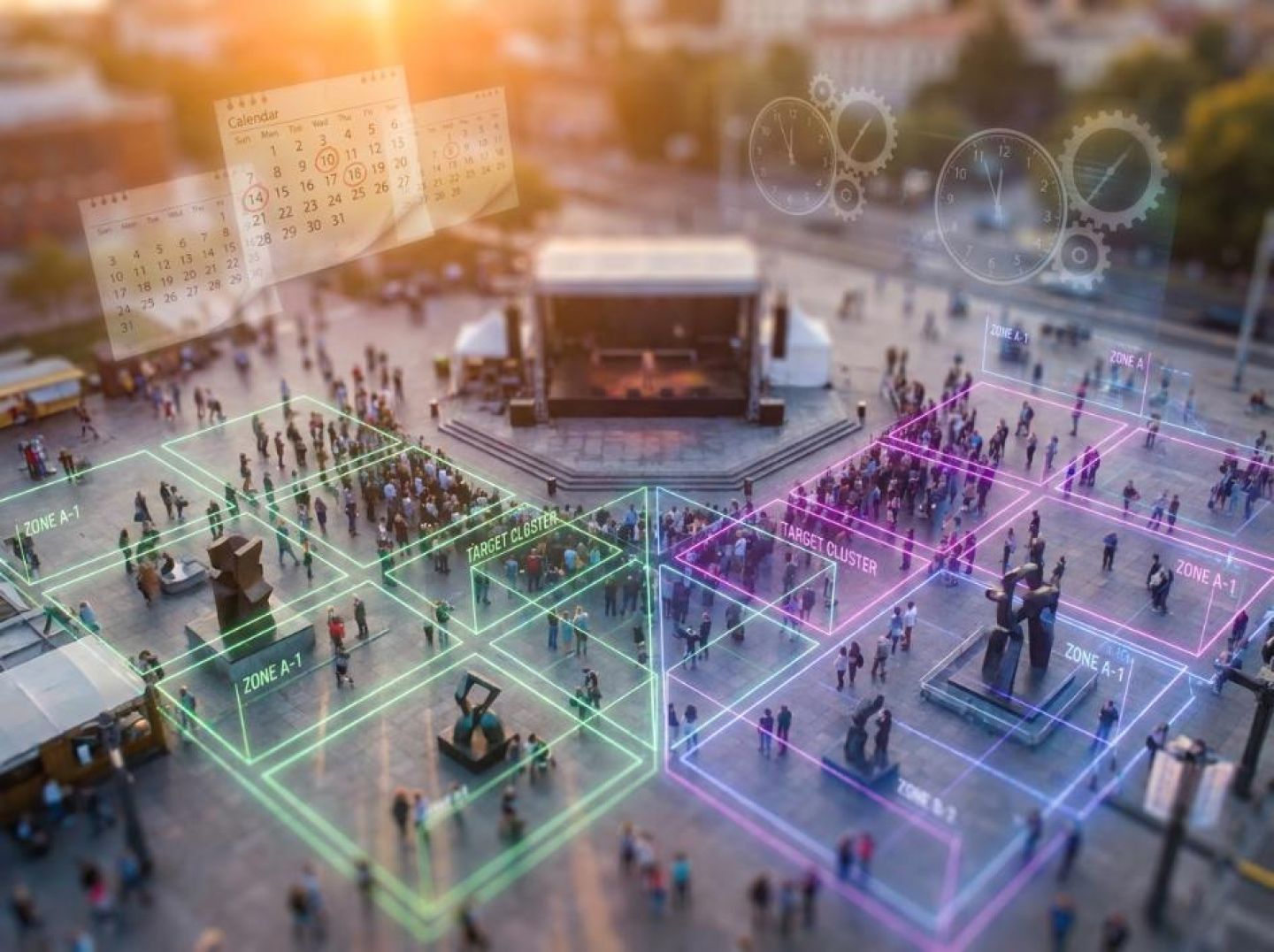
Mobile billboard operators don't guess where their audiences will be — they know. Conventions publish attendee projections months in advance. Stadiums announce game schedules a year out. Festival organizers broadcast lineup dates and expected foot traffic with promotional fervor. The OOH industry has built an entire deployment logic around this publicly available intelligence, and the results from thousands of campaigns confirm the approach works. As Can't Miss US reported after executing more than 2,500 campaigns, event-based campaigns consistently generate strong visibility because routes can be customized around venue traffic patterns, attendee movement, nearby entertainment districts, hotels, and transportation hubs. The trucks don't park and hope. They chase density — the predictable, scheduled, publicly announced kind.
Push notification marketers, by contrast, still overwhelmingly rely on platform-level "best time to send" averages — Tuesday at 10 a.m., Thursday at 2 p.m. — as though every user in every city on every day of the week occupies the same behavioral state. They don't. And the OOH data proves it with uncomfortable precision.
Consider the Milpitas campaign that generated 560,000 impressions in three days. The same creative ran on the same route on consecutive days, yet the Visit Index — a measure of how effectively the campaign drove real-world visits — dropped from 101 on Friday to 95 on Saturday. Nothing about the message changed. Nothing about the truck changed. The audience shifted. Friday's commuters, errand-runners, and pre-weekend planners responded differently than Saturday's leisure crowd on the same streets. That six-point swing isn't noise; it's a structural signal about how timing and audience composition interact even when geography stays constant.
Push marketers should treat this as a smoking gun. If identical creative on an identical route produces measurably different engagement depending on the day, then identical push copy sent to users in the same geo-fenced zone will perform differently depending on what else is happening in that zone at that moment. A push notification promoting a food delivery app will land differently in downtown Austin on a regular Wednesday than it will during South by Southwest, when the streets are flooded with out-of-towners who don't know local restaurants. A fitness app's re-engagement push will hit harder in a college town the Monday after spring break than the Friday before it.
The operational model already exists in OOH. Mobile billboard operators systematically deploy trucks around conventions, festivals, concerts, sporting events, and trade shows because those gatherings concentrate high-engagement audiences in predictable locations at predictable times. They even design creative to encourage social media amplification — a secondary distribution channel that push notifications, ironically, almost never attempt to trigger.
Push campaigns should be syncing to the same event calendars. Conference schedules, game-day timelines, cultural moments, even local traffic pattern shifts tied to weather or road closures — all of this is targetable context that most push platforms already have the geo-fencing and scheduling infrastructure to exploit. The problem isn't capability; it's mindset. Push marketers have internalized a broadcast paradigm where timing optimization means finding the single best hour across an entire user base, when the evolving push ecosystem increasingly demands better engagement quality and reduced intrusiveness. Sending the right message at a generically optimal hour is less effective than sending it at a contextually perfect one — when the user's physical environment, emotional state, and social surroundings align with the offer.
The OOH playbook is simple: go where the crowd is, when the crowd is there. Push marketers have the tools to do exactly this. They just haven't stolen the playbook yet.
For years, the mobile billboard industry got away with a measurement standard that amounted to little more than odometer readings and optimism. An operator would report that a truck drove 200 miles, claim it reached thousands of people, and everyone would nod along. As one industry analysis bluntly put it, that's not measurement — that's a guess wrapped in confidence. The push notification industry operated under a remarkably similar delusion: success was measured by the size of a subscriber list, regardless of how those subscribers were acquired or whether they ever engaged with a single message. Both channels mistook volume for value, and both are now being dragged — some willingly, some not — toward the same accountability reckoning.
On the OOH side, the transformation is already measurable. Modern mobile billboard campaigns now log granular GPS data at every point along a route. The Milpitas campaign documented by OOH Today, for instance, recorded 1,552 GPS pings across 204.1 miles, capturing every position, every dwell stop, and every hour of operation. From that data, the campaign calculated OAAA-compliant impressions using Opportunity-to-See methodology — accounting for vehicle occupancy, screen visibility geometry, pedestrian exposure, and speed-based legibility discounts — arriving at 560,400 likelihood-adjusted impressions. But the real sophistication lies in what comes after: Gross Rating Points of 280.2, unique reach of 187,900 people, and an average frequency of three exposures per person. Those metrics let a media buyer compare a mobile billboard campaign to a digital display buy or a radio flight on genuinely equivalent terms. The growing demand for this kind of proof-of-performance reporting has made accountability not just a differentiator but an operational requirement across the industry.
Push notifications are undergoing the same forced maturation, though the catalyst is punitive rather than competitive. When Google introduced updates in Q4 2024 that made unsubscribing easier on Android and strengthened its Safe Browsing policies, the subscriber-count vanity metric collapsed overnight. Publishers who had built enormous lists through deceptive opt-in flows — misleading prompts, clickbait permission dialogs, buried decline buttons — watched those inflated numbers deflate as users exercised their newly frictionless exit. Domains were banned, flagged, or restricted due to compliance failures. The message from Google was unambiguous: raw subscriber counts are meaningless if the subscribers never wanted to be there. What matters now is opt-in legitimacy, engagement quality, and delivery to audiences who actually chose to receive the message.
The parallel is almost uncanny. OOH moved from "miles driven" to likelihood-adjusted impressions. Push moved from "subscribers collected" to post-crackdown engagement quality. Both industries were forced to answer the same uncomfortable question: Of the people you claim to have reached, how many actually had a meaningful opportunity to see your message — and how many of those were real?
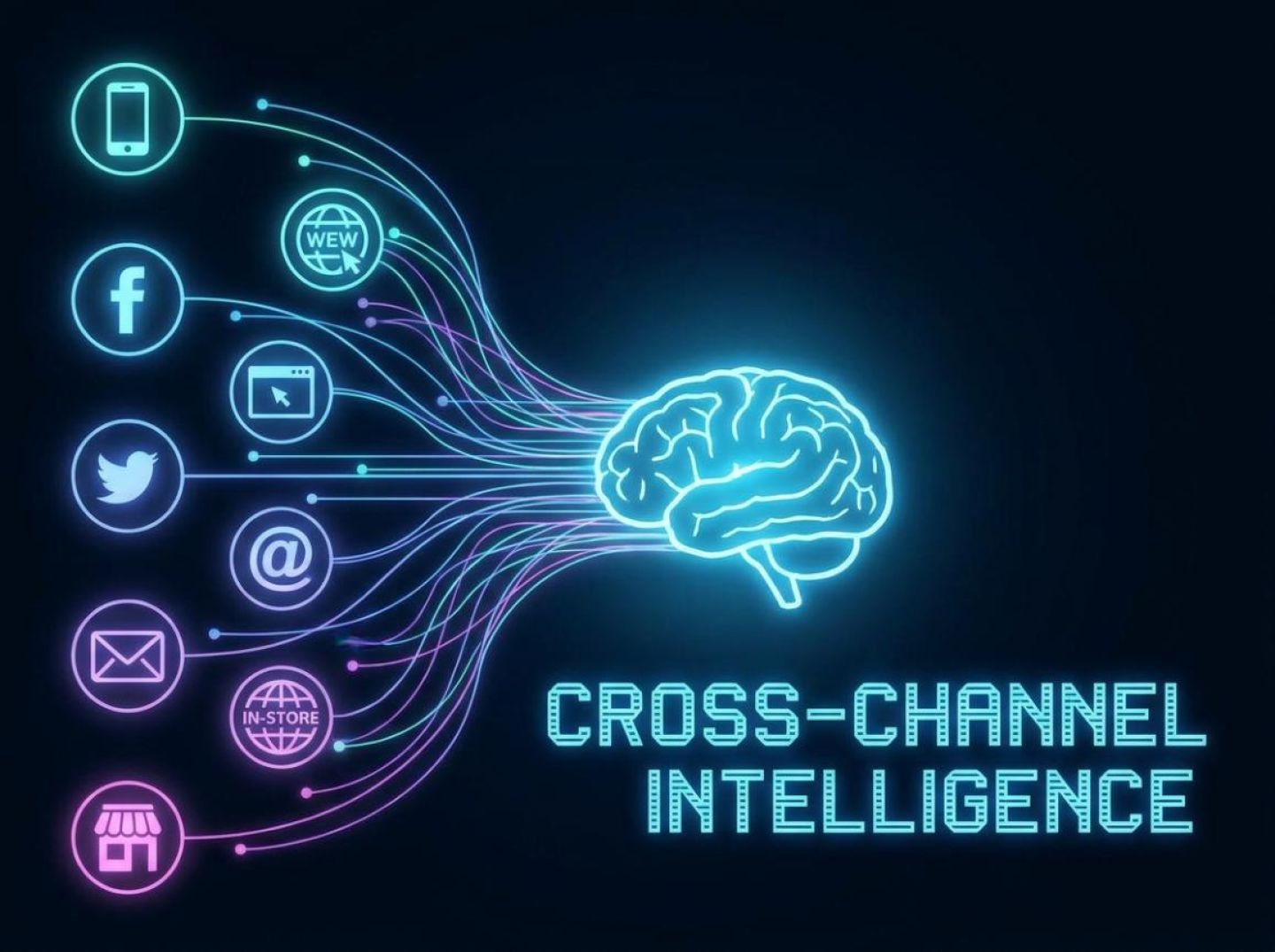
For marketers running both channels, this convergence creates a practical opportunity. When your mobile billboard campaign reports unique reach, frequency, and GRPs, and your push campaign reports verified opt-in rates, actual delivery confirmations, and engagement depth, you finally have a common language for cross-channel evaluation. Budget allocation stops being a philosophical argument about "awareness versus direct response" and starts being a data conversation about comparable delivery quality, contextual relevance, and cost per genuinely reached human. The maturation arc is the same. The reporting frameworks should be too.
The moment you realize that someone else has already spent tens of thousands of dollars testing messaging in the wild — and that you can study the results for free — competitive intelligence stops being a nice-to-have and becomes the backbone of your creative strategy. The overlap between mobile billboard advertising and push notification campaigns creates a particularly lucrative arbitrage opportunity: OOH creative is tested at enormous scale in physical environments, while push creative is tested at enormous scale in digital ones. By cross-referencing insights from both channels, you can shortcut the expensive trial-and-error cycle that eats most advertising budgets alive.
Start with push notification spy tools. The competitive intelligence landscape in push advertising has matured significantly, with platforms that let you spy on any website to see exactly what notifications competitors are sending, how frequently they deploy them, and what creative angles they're leaning on. These tools catalog thousands of active push campaigns across verticals, giving you a searchable database of headlines, images, CTAs, and send frequencies. Your first step is to identify the top advertisers in your vertical — or adjacent verticals — and pull their most persistent push creatives. Longevity is the signal. If a notification has been running for weeks or months without modification, it's performing. Nobody pays to keep a loser in rotation.
Now layer in OOH observation. Operators like Can't Miss US have executed more than 2,500 mobile billboard campaigns across the mainland United States, deploying creative on over 80 trucks in every conceivable market. That volume of testing produces a visible record — the billboards themselves — that anyone can photograph, catalog, and analyze. When a national brand runs the same headline on mobile billboards in twelve cities simultaneously, that creative has survived internal review, agency vetting, and likely A/B testing against alternatives. It represents a substantial investment in validated messaging.
The practical workflow looks like this. First, build a swipe file of OOH creative from your category by photographing mobile billboards, monitoring competitor social media for campaign shares, and checking industry showcases. Second, log into your push spy tool and search for the same brands or product categories. Third, compare the messaging frameworks side by side. You're looking for patterns that persist across both channels: emotional triggers, value propositions, urgency mechanics, and specific language structures that appear in both the 8-word billboard headline and the 40-character push title. When a theme shows up in both places, you've found a message that works regardless of medium — a rare and valuable signal.
Fourth, adapt those patterns into your own push creative. The key insight is cost asymmetry. National OOH campaigns tested across multiple markets with centralized coordination can cost hundreds of thousands of dollars. A push notification test costs nearly nothing beyond the traffic. You're essentially importing battle-tested messaging frameworks from a high-cost channel into a low-cost one, skipping the discovery phase that your competitors paid dearly to complete.
Fifth — and this is where most people stop too early — reverse the flow. Take your highest-performing push creatives, strip them down to their core emotional hook, and test those hooks on localized OOH placements. The spy tool data gives you predictability in an environment where platform changes can shift performance overnight, while OOH observation gives you creative durability data that no digital dashboard can replicate. Used together, they form a closed-loop intelligence system that continuously feeds both channels with proven messaging at a fraction of what either channel's testing would cost in isolation.
Receive top converting landing pages in your inbox every week from us.
How-To
Learn how to turn big brand-building stunts into measurable performance funnels across Native, Push, Pop, and TikTok. This guide breaks down how to repurpose stunt assets, build channel-specific sequences, design story-led landers, and measure their impact on conversions and revenue.
Priya Kapoor
7 minOct 5, 2026
Most Read
Discover how OOH teams can use Native, Push, and TikTok ad intelligence to move beyond location-first planning and build smarter, audience-driven campaigns. This guide shows how to translate digital creative, targeting, and performance signals into OOH ideas, test them in the physical world, and feed the results back into digital campaigns.
David Kim
7 minOct 4, 2026
Recently Updated
Learn how to turn award-winning brand campaigns into scalable Push, Pop, Native, TikTok, and dropship performance campaigns. This guide shows how to spy on proven funnels, extract the psychology behind successful creative, adapt big-brand concepts into direct-response angles, and use AI to produce high-velocity variations that can be judged by ROAS and CPA.
Liam O’Connor
7 minOct 3, 2026