12 minJuly 20, 2026

Our spy tools monitor millions of native ads from over 60+ countries and thousands of publishers.
Get StartedFor years, the programmatic supply chain has been a black box with a price tag. Advertisers could see who got paid, but they had little visibility into the full roster of companies that processed, routed, enriched, or transmitted a bid request before it landed in their laps. IAB Tech Lab's proposed SupplyChain v1.1 update aims to change that by exposing both the commercial and technical journey of a bid request, giving buyers a map of every entity that touches an impression opportunity — not just the ones that collect a fee along the way.
The mechanics are elegant. Under the current schain standard, only companies participating in the payment flow appear in the chain. The v1.1 proposal introduces an hp=0 designation for companies that take technical custody of a request without participating in the financial transaction. Think Prebid wrappers, server-side ad insertion platforms, SDKs, and ad servers — the invisible plumbing that routes billions of bid requests daily. By surfacing these participants, the update transforms what was once a financial ledger into something closer to a full chain-of-custody record.
The industry is right to be excited. As IAB Tech Lab CEO Anthony Katsur described it, this represents "one of the most significant transparency enhancements to the digital advertising supply chain in years." And the implications go beyond mere visibility. The update fundamentally reframes how buyers should think about supply-path optimization: instead of reflexively favoring the shortest path, they can now evaluate what each participant actually contributes. A longer supply chain with transparent, value-adding intermediaries may outperform a shorter one riddled with opaque reselling — a meaningful philosophical shift for an industry that has long equated fewer hops with better outcomes.
The practical stakes are real. Consider that roughly 32% of open-auction bid requests involve the resale of non-exclusive inventory by an SSP or other intermediary, according to Jounce Media's research. Agencies like Goodway Group have used aggressive SPO practices to slash their spend on such inventory to approximately 2%. SupplyChain v1.1 would give every buyer — not just the most sophisticated ones — the raw data to make similar evaluations, democratizing the kind of supply-chain hygiene that currently requires custom reporting relationships and dedicated analyst time.
But here is where the industry conversation stalls out. Everything about this update — the technical custody signals, the chain-of-custody transparency, the ability to evaluate intermediary value — solves a plumbing problem. It answers questions about infrastructure: Who touched this bid request? Did they add value or just add latency? Am I paying for redundant hops?
These are important questions. They are also entirely insufficient.
You can have crystalline visibility into every intermediary that touches a bid request and still lose the auction. Or worse, you can win the auction at the most efficient price, through the cleanest possible supply path, and utterly waste the impression — because the ad you served and the landing page it led to were flatly inferior to what your competitor ran on the same placement five minutes later. Perfect plumbing does not fix a leaky message. And right now, the industry's transparency infrastructure has nothing to say about the strategic half of the equation: what your competitors are actually showing users, how they are framing their value propositions, and why their creative is outperforming yours in the moments that matter most.
When Goodway Group decided to get serious about supply-path optimization, it didn't tinker around the edges. The independent agency cut its SSP partners down to single digits and built a review process that holds each remaining partner accountable for the inventory flowing through its pipes. The results speak for themselves: while the average buyer still spends roughly 22% of open-auction budgets on non-exclusive inventory — impressions that have been resold or re-auctioned by intermediaries — Goodway Group drove that figure down to approximately 2%, according to analysis by Jounce Media founder Chris Kane. In an ecosystem where the typical publisher still sells ads through more than 25 SSPs on average, that level of discipline is genuinely rare.
The mechanics are worth understanding. Goodway requests SupplyChain object reports from its SSP partners, detailing exactly what inventory was purchased and through which paths. When an SSP pitches a solution claiming to avoid MFA inventory or minimize intermediary hops, Goodway checks the receipts — and prioritizes working with partners that can resolve discrepancies within a day. That kind of operational rigor is what separates performative transparency from actual transparency.
But here's the thing: SPO is an efficiency strategy, not a competitive strategy. It eliminates waste. It does not generate advantage. Once your supply path is clean — once you've purged the resellers, collapsed the hops, and verified the inventory — every remaining dollar of spend lives or dies on what you actually push through that pristine pipe. And on that question, the industry's infrastructure goes almost completely silent.
Consider how DSPs frame their own role. As Yahoo DSP's Joshua John told AdExchanger, a DSP collapses "thousands of signals — audience, context, frequency, budget" into a single bid decision in milliseconds. Agencies configure bid multipliers, pacing controls, and rules that dictate which creative to serve and when. The entire infrastructure is built to answer one question: Am I buying real inventory through a clean path at the right price? That question now has sophisticated, standardized answers. But the adjacent question — Is my ad compelling enough to outperform the other ads a user sees on this same supply source? — has almost no standardized infrastructure at all.
This is where Goodway's case study becomes instructive for what it doesn't address. After you've cut non-exclusive spend to 2%, the remaining 98% competes in auctions against other advertisers who are also cleaning up their supply paths, also filtering MFA, also collapsing hops. The differentiation that remains is creative: the message, the offer, the format, the hook. And yet the industry has no transparency standard — no equivalent of the SupplyChain object — for understanding what creative strategies your competitors are running through those same clean pipes.
Performance CTV makes this gap especially visible. As VideoWeek has reported, sophisticated advertisers are migrating spend toward direct paths with OEMs and streamers once a supply source proves it can drive outcomes, but the next constraint they hit is measurement and attribution — not supply quality. When you demand incrementality rather than just attribution, a lot of ostensibly scalable supply stops clearing the bar. At that point, the variable that determines whether your CTV exposure kicks off a successful retargeting sequence isn't path cleanliness. It's whether your creative was strong enough to make an impression in the first place.
SPO gave us the clean pipe. Now the industry needs to build equally rigorous infrastructure for what flows through it.
The industry's transparency crusade has been laser-focused on the plumbing — who touches the bid request, how many intermediaries skim margin, whether the impression is even real. That matters. But it leaves an enormous blind spot in the channels where performance marketers actually spend the most money and burn through creative at the fastest rate: native advertising, push notifications, and pop traffic. These are the workhorses of affiliate and performance marketing, and they operate in a transparency vacuum that makes Meta's Ad Library and Google's Ads Transparency Center look like miracles of open government.
Consider the pattern VideoWeek identified in performance CTV: as budgets flow into a channel, more "creative" supply packaging and opportunism follow, and the gap between "all available inventory" and "inventory that actually drives outcomes" keeps widening. In CTV, the next binding constraint after supply quality turns out to be measurement and incrementality — the ability to prove causal impact rather than just correlation. But in native, push, and pop channels, that bottleneck hits somewhere different and arguably more painful: creative intelligence. There is no public archive of what's running. There's no transparency center to browse. There's no API to query. The ads appear, burn out, and vanish, often within days or even hours.
Creative fatigue curves in these channels are brutally compressed. A native headline that converts at a two-percent click-through rate on Monday can crater to half that by Thursday as audiences develop banner blindness to the angle. Performance affiliates routinely cycle through hundreds of ad variations per campaign — swapping hooks, reframing pain points, testing thumbnail images, and rebuilding landing page structures from scratch. The operational burden this creates is staggering, and as MarTech has noted, even well-resourced teams struggle to sustain creative testing velocity without either bloating headcount or relying on increasingly automated assembly of headline, image, and description components. In native and push, the problem is worse because there's no equivalent of Google's Performance Max to experimentally recombine assets and surface winners. The testing is manual, the feedback loops are slower, and the cost of a wrong hypothesis is measured in real dollars spent on traffic that doesn't convert.
This is where the competitive asymmetry becomes dangerous. Advertisers who have access to creative intelligence tools — platforms that scrape, categorize, and surface competitor ad variations across native networks, push traffic sources, and pop exchanges — can observe which angles are gaining traction in real time. They can see when a competitor pivots from a fear-based hook to a curiosity-driven one, when a particular landing page structure starts appearing across multiple offers, or when a once-dominant creative concept disappears because it's been exhausted. Everyone else is guessing.
The industry's transparency agenda, for all its ambition, stops at the bid request. IAB Tech Lab's SupplyChain updates promise to reveal every company that processes, routes, or transmits an impression opportunity before it reaches a buyer. That's a meaningful advance for supply-chain hygiene. But it tells a performance marketer absolutely nothing about what their competitor's ad actually said, what visual it used, what emotional trigger it pulled, or what landing page it pointed to. You get full visibility into the pipe and zero visibility into the message flowing through it. For a media buyer running native campaigns at scale, that's like getting a detailed invoice for every toll on the highway while having no idea where your competitors are actually driving.
"Just test more" is the programmatic creative industry's favorite non-answer. When media buyers ask how competitors are winning with certain ad formats, angles, or hooks, the reflexive response is always the same: run more A/B tests, iterate faster, let the algorithm find the winner. It sounds disciplined. It sounds data-driven. In reality, it is the creative strategy equivalent of wandering a city without a map and calling it exploration.
The structural problem hiding behind that advice becomes obvious when you compare it to what's happening in AI search visibility. A recent Semrush study found that only 22% of marketers have fully integrated their AI search and SEO operations — and the consequences for the other 78% are severe and predictable. When no single team owns the full picture, the study found, organizations end up with competitors mentioned more frequently than their own brand in AI-generated answers, inaccurate brand descriptions surfaced to potential customers, and positioning that reads as generic rather than differentiated. These aren't random failures. They are, as the study puts it, "the predictable outputs of a fragmented operating model."
Now map that finding onto programmatic creative strategy. In most organizations, no single team owns the competitive creative picture either. Paid media buyers optimize bids and placements. Creative teams produce assets based on internal briefs. Analytics reviews performance after the fact. Nobody systematically monitors what angles, formats, or emotional hooks competitors are deploying across native, push, pop, and display — the channels where, as we covered in the previous section, performance marketers spend the heaviest and iterate the fastest. The result is the same fragmentation the Semrush research documents: teams without clear ownership struggling to execute consistently, not because they lack talent, but because the operating model never assigned anyone responsibility for watching the competitive landscape and translating it into creative direction.
"Just test more" doesn't fix that gap. It compounds it. Every test run without competitive context is a coin flip dressed up as methodology. You might discover that a fear-based headline outperforms a benefit-driven one — but a competitor who already monitors the landscape knew that three months ago and has moved on to the next angle while you're still celebrating a statistically significant lift on a message the audience is already fatigued by.
The measurement parallel is just as damning. As VideoWeek has reported, sophisticated performance advertisers are moving beyond platform-reported outcomes toward incrementality requirements — and when they do, a lot of supply that looked scalable suddenly stops clearing a higher bar of causal impact. The same reckoning awaits creative testing programs that operate without competitive intelligence. You can optimize click-through rates on a thousand variants and still lose the war if every variant is positioned against the wrong competitor frame. Incrementality in creative isn't just about whether a given ad lifts conversions over a holdout group; it's about whether your messaging occupies a differentiated position in the market or simply echoes what everyone else is already running.
The Semrush data puts a number on the cost of this blindness: 37% of marketers say competitors are mentioned more often than their own brand in AI-generated answers. That visibility failure didn't happen because those brands forgot to publish content. It happened because no one was assigned to monitor the competitive landscape and coordinate a response. The programmatic creative world has the same disease — it just hasn't built the diagnostic tools to see the symptoms yet. Testing without intelligence isn't strategy. It's an expensive confession that nobody is watching.
Performance marketers who want to close the transparency gap need more than a single fix. They need a layered framework — one that addresses the full journey from supply chain plumbing through measurement rigor to competitive creative intelligence. Think of it as a three-layer transparency stack, where each layer compounds the value of the ones beneath it.
Layer 1: Supply Chain Transparency — Know Who Touches Your Bid.
This is the layer the industry has spent a decade building, and it is finally approaching something close to maturity. The proposed SupplyChain v1.1 update from IAB Tech Lab would expose not just who gets paid in a programmatic transaction, but every company that processes, routes, or enriches a bid request along the way. That distinction is critical. Under the current standard, buyers see the financial trail but remain blind to the technical intermediaries who handle their impressions behind the scenes. The v1.1 proposal shifts the conversation from "how short is this supply path?" to "who participates in this path and why?" — a far more useful question for performance buyers evaluating whether each node in the chain adds genuine value or simply extracts margin.
Your practical move here is straightforward: audit your supply paths using schain data, enforce SPO discipline, and ruthlessly cut intermediaries who cannot justify their presence. If a vendor can't explain what it contributes to the transaction, it probably doesn't contribute anything.
Layer 2: Measurement and Attribution Transparency — Know What Actually Works.
Supply chain cleanliness is necessary but insufficient. You can run ads through pristine, fully verified paths and still waste budget if you cannot distinguish correlation from causation in your results. This is why the most sophisticated performance teams are moving beyond last-click attribution toward incrementality testing — and the results are often uncomfortable. As VideoWeek has reported, the moment you demand incrementality in parallel with attribution, a lot of "scalable" supply stops looking scalable because it cannot consistently clear a higher bar of causal impact. That insight applies far beyond CTV. In native, push, and pop channels, much of what looks like high-volume performance under platform-reported metrics collapses when subjected to holdout testing and lift analysis.
Your practical move: implement geo-based or audience-based holdout tests across your highest-spend placements. Start with the traffic sources that report the most impressive ROAS numbers — those are usually the first to fall apart under incrementality scrutiny.
Layer 3: Competitive Creative Intelligence — Know What Your Rivals Are Running.
Here is where the entire industry drops the ball. Layers 1 and 2 tell you whether your supply is clean and whether your measurement is honest. Neither tells you whether your creative strategy is competitive. You can have perfect supply paths and rigorous incrementality frameworks and still lose to a competitor who discovered a better headline angle, a more compelling landing page hook, or a creative format you haven't tested yet — simply because you had no mechanism to observe what they were doing.
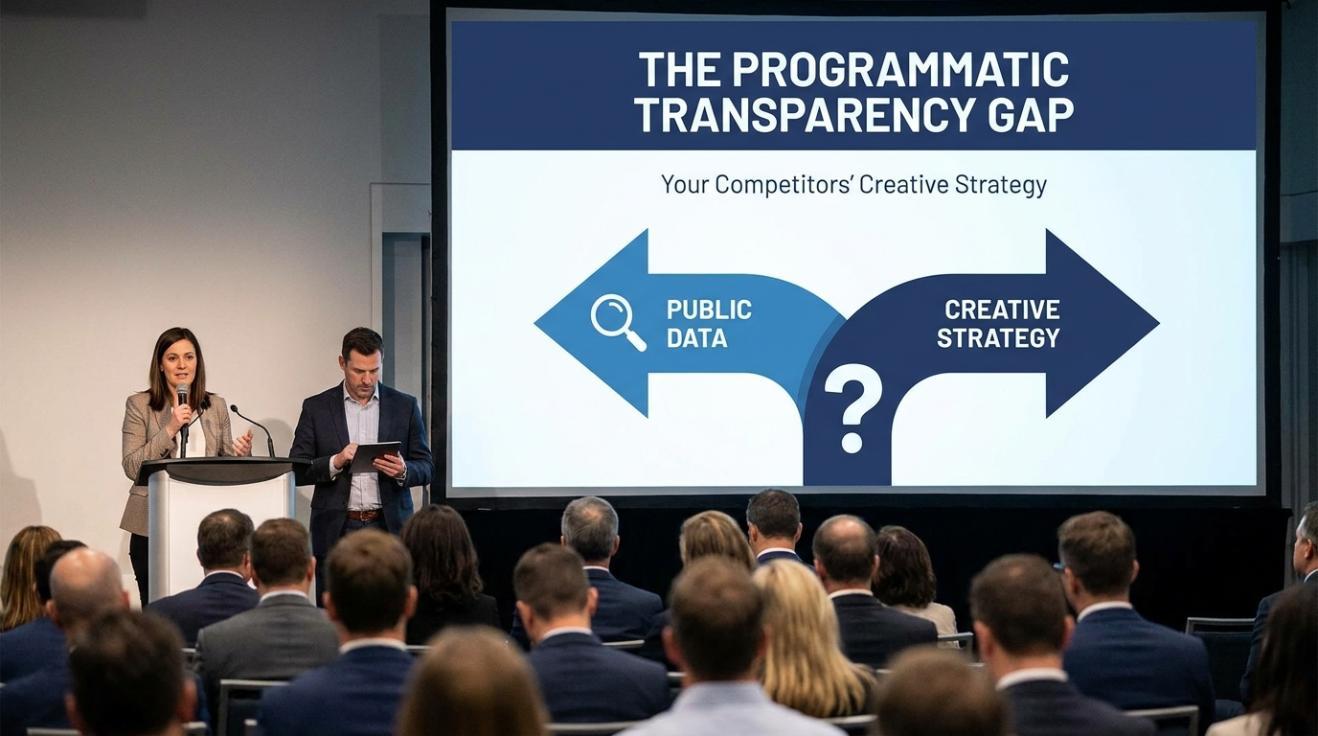
This layer barely exists as a category. There is no schain equivalent for creative intelligence, no industry body proposing a standard, no universal protocol for exposing what ads run where and how they perform. That vacuum is the transparency gap this article is about. Performance marketers operate in channels where creative fatigue is measured in days, not weeks, yet they have no systematic way to monitor the competitive creative landscape at the scale and speed their media buying demands.
Your practical move: stop treating competitive research as an occasional manual exercise and start building — or buying — infrastructure that delivers continuous, structured visibility into rival campaigns across the channels where you actually spend. The marketers who assemble all three layers will not just buy media more efficiently; they will create better ads, faster, with the full context their competitors wish they didn't have.
Tags
Receive top converting landing pages in your inbox every week from us.
Recently Updated
Discover how TikTok, YouTube, and LinkedIn are turning creator content into performance marketing opportunities, and why brands should look beyond influencer fit and engagement metrics. Learn how to evaluate creator campaigns using earnings per click (EPC), marketing efficiency ratio (MER), and arbitrage margins to identify profitable creative, improve campaign decisions, and scale what works.
Dan Smith
7 minOct 16, 2026
Featured
Discover how performance marketers can turn the post-holiday advertising period, known as Q5, into an opportunity for lower-cost testing and smarter campaign optimization. Learn how to use Anstrex ad spy data to identify winning creatives, analyze competitor funnels, launch original landing pages, and turn Q5 insights into scalable Q1 campaigns.
Elena Morales
7 minOct 14, 2026
In-Depth
Explore what Pure Leaf’s “Break Conference” reveals about the gap between polished brand marketing and measurable performance. This guide breaks down how Native, Push, TikTok, and affiliate-style funnels use creative testing, clear offers, first-party data, and hard performance metrics to turn cultural moments into revenue.
Rachel Thompson
7 minOct 1, 2026